The Road to Now

RTN Productions

Details

Bob Crawford (The Avett Brothers) & Dr. Ben Sawyer (MTSU History) share conversations with great thinkers from a variety of backgrounds – historians, artists, legal scholars, political figures and more –who help us uncover the many roads that run between past and present. For more information, visit TheRoadToNow.com If you'd like to support our work, join us on Patreon: Patreon.com/TheRoadToNow

Recent Episodes

OCT 19, 2026
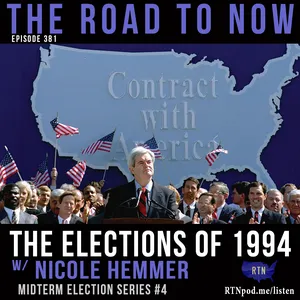
#381 The Elections of 1994 (Midterm Elections Series #4)
In 1994, the Republican Party took both houses of Congress for the first time in more than four decades, defeating a Democratic Party that, just two years earlier, had pulled off a "trifecta" (winning both houses of Congress and the Presidency in a single election), and ushering in an era of GOP congressional control that would persist into the 21stcentury. How did the party that had spent most of the post-WWII era on the sidelines reemerge as a political force in the 1990s? Why did the majority of southern voters support Republicans for the first time since Reconstruction? And why did the man of the moment – Newt Gingrich – fall from grace even as his party's star continued to rise? In this episode, Nicole Hemmer join us to dig into the political revolution that remade the Republican Party and forever changed politics. Nicole Hemmer is the director of the Carolyn T. and Robert M. Rogers Center for the American Presidency and associate professor of history at Vanderbilt University. She is also the author of multiple books, including Partisans: The Conservative Revolutionaries Who Remade American Politics in the 1990s. If you enjoy this episode, make sure to check out her podcast, This Day. If you'd like to help Ben's fundraising effort to help The Store fight food insecurity in Tennessee, just go to RTNpod.me/thestore. This is part 3 of our midterm election series, in which we look at some of the most consequential congressional elections in American history. With the midterms of 2026 just around the corner, we hope these episodes will put things in context and convince you that midterm elections are just as, and sometimes more important, than the Presidential elections that only roll around every 4 years. If you enjoy this conversation, make sure to listen to our other episodes in the series on 1858 (Episode 378), 1874 w/ Jefferson Cowie (episode 379) and 1946 (episode 380). This episode was edited by Gary Fletcher.

58 MIN
OCT 12, 2026
#380 The Elections of 1946 (Midterm Elections Series #3)
In 1946, the Democrats had held the majority in both houses of Congress and the Presidency for fourteen years, in which time they had led the country through both the Great Depression and World War II. So why, in the first election after the end of the war, did American voters go to the polls in a midterm election and hand both the House and the Senate to the Republicans? In this episode, Bob takes the lead as we break down the reasons that American voters soured so quickly on the Democrats in 1946, the impact that the election had on American politics, and why voters returned to the polls just two years later and handed Congress back to the Democrats. (For those looking for parallels with 2026, it turns out that a wildly unpopular President can be detrimental to his entire party, even when he isn't up for reelection.) If you'd like to help Ben's fundraising effort to help The Store fight food insecurity in Tennessee, just go to RTNpod.me/thestore. This is part 3 of our midterm election series, in which we look at some of the most consequential congressional elections in American history. With the midterms of 2026 just around the corner, we hope these episodes will put things in context and convince you that midterm elections are just as, and sometimes more important, than the Presidential elections that only roll around every 4 years. If you enjoy this conversation, make sure to listen to our other episodes in the series on 1858 (Episode 378) and 1874 w/ Jefferson Cowie (episode 379). This episode was edited by Gary Fletcher.

49 MIN
OCT 5, 2026
#379 The Elections of 1874 w/ Jefferson Cowie (Midterm Elections Series #2)
Most histories mark the 1876 Presidential election as the end of post-Civil War reconstruction, but the end of that era might have already been signaled when Democrats took control of the House of Representatives in the 1874 midterms. Why was the party of secession able to regain so much power in the federal government less than a decade after the end of the Civil War? And how did the outcome of these elections lay the groundwork for the Compromise of 1877 and the restoration of white supremacy in the south? Jefferson Cowie returns to the show to help Ben and Bob answer these questions and more in a deep dive into the 1874 elections and the crucial role they played in shaping post-Civil War America. (Click here for the side-by-side comparison of the 1872 and 1874 election results discussed in the episode). To learn more about the violence that took place in Barbour County in these years, pick up a copy of Jefferson Cowie's Pulitzer Prize winning book, Freedom's Dominion: A Saga of White Resistance to Federal Power. If you'd like to help Ben's fundraising effort to help The Store fight food insecurity in Tennessee, or get tickets to Nashville's Got Talent on October 22, just go to RTNpod.me/thestore. This is part 2 of our midterm election series, in which we look at some of the most consequential congressional elections in American history. With the midterms of 2026 just around the corner, we hope these episodes will put things in context and convince you that midterm elections are just as, and sometimes more important, than the Presidential elections that only roll around every 4 years. If you enjoy this conversation, make sure to listen to our first episode in the series on 1858 in episode 378. This episode was edited by Gary Fletcher.
53 MIN