People of the Pod
People of the Pod

People of the Pod

American Jewish Committee (AJC)

Overview
Episodes

Details

People of the Pod is an award-winning weekly podcast analyzing global affairs through a Jewish lens, brought to you by American Jewish Committee. Host Manya Brachear Pashman examines current events, the people driving them, and what it all means for America, Israel, and the Jewish people.

Recent Episodes

Inside the Advocacy Effort to Bring the Hostages Home
OCT 10, 2025
Inside the Advocacy Effort to Bring the Hostages Home

"Since before he was President, he [Trump] has made it clear that this is a priority, and he has instructed his team to work on this issue day in and day out . . . "

More than two years after the October 7 massacre, Hamas has agreed to return the 48 hostages still in Gaza under the U.S.-brokered peace deal. Jessica Bernton, AJC's Director of Congressional Affairs, shares details of AJC's joint advocacy with the hostage families of returned hostages—how personal stories, bipartisan meetings with Congress and the White House, and coordinated delegations kept the issue at the forefront. She reflects on the emotional weight of this work, its impact on the U.S. administration, and the ongoing need to press policymakers to ensure that all hostages are safely returned.

*The views and opinions expressed by guests do not necessarily reflect the views or position of AJC.

Take Action:

Elected Leaders: Demand Hamas Release the Hostages

Key Resources:

AJC's Efforts to Support the Hostages

Listen – AJC Podcasts:

Architects of Peace

The Forgotten Exodus

People of the Pod

Follow People of the Pod on your favorite podcast app, and learn more at AJC.org/PeopleofthePod

You can reach us at: [email protected]

If you've appreciated this episode, please be sure to tell your friends, and rate and review us on Apple Podcasts or Spotify.

Transcript of the Interview:

Manya Brachear Pashman:

More than two years after the October 7 massacre, the Hamas terror group has reportedly agreed at long last, to return the 48 hostages that remain in Gaza. With us now is Jessica Bernton, AJC's director of Congressional Affairs, who has been working with the families of hostages since day one to bring them all home. Jessica, welcome to People of the Pod.

Jessica Bernton:

Thanks so much, Manya, it's a pleasure to be here.

Manya Brachear Pashman:

So you must be so relieved. I know you've been so immersed in all of this. When can we celebrate though? Is now too soon?

Jessica Bernton:

Oh, what a great question. I would say, I have this cautious optimism at the moment. There have been many ups and downs. There have been starts and stops throughout these long months and now two years, but this one does feel different. I would say, you know, this is the most progress we've seen since the spring, and we have to continue to have hope.

We also cannot afford to let up the pressure until every single hostage is returned home. And so I would say we cannot exhale until everyone is returned. And once everybody is walking across the border, or the deceased are returned home for burial, that is when we can truly celebrate. Once every single person is returned.

Manya Brachear Pashman:

You said it feels different? How? How does it feel different?

Jessica Bernton:

You know, there's been a lot of pressure exerted in recent weeks. I'd say the US administration has stepped up their efforts as well, working with other countries, including partners across the world here. And a deal was signed.

And so I think a lot can happen, though, between this announcement and actually, again, when hostages are returned, or when the first phase begins, and both sides need to continue to adhere to each side of the agreement. But this really is the most progress that there has been in some time.

Manya Brachear Pashman:

As I said in the introduction, you've been working since day one, bringing delegations to Washington to meet with members of Congress, meet with White House staff, including both President Biden and President Trump. What has happened most recently that might have made a difference here?

Jessica Bernton:

I think the most important thing here is that the families as well as the returned hostages, because we've been so far down in this process that we were advocating for the release of certain hostages, and now those individuals have come to DC and have been traveling across the world to make sure that their voice is heard. And they're speaking up for those that they were held in captivity with, who don't have a voice at the moment.

And so it's been really incredible and emotional to have advocated, let's say, for somebody like the return of Keith Siegel or Doron Steinbrecher. And now we have joined them in going to the Hill, into these meetings, advocating for the return of every single hostage, and that's been really incredible.

But I think the most important thing here is that these conversations have continued. And keeping this issue at the forefront of everybody's minds. The American public, government officials, foreign officials, community leaders, ensuring that the hostages have not been forgotten has been our top priority here, and ensuring that this remains a foreign policy priority for the US government in particular.

And clearly it has paid off, because these hostages have been able to continue to tell their story, and we are where we are today, and hopefully this progress will continue. But it's been really incredible to see this, especially in the past couple months, as those who have been returned or released have now come to Washington, DC as well and are able to do this type of advocacy.

Manya Brachear Pashman:

You mentioned Keith Siegel, one of the American-Israeli hostages, who was released earlier this year. They've been able to talk about their experiences, former hostages have been able to talk about their experiences in captivity and share that with President Trump in a way that their loved ones who were advocating for their release could not. What have they revealed about their experience that their loved ones could not possibly have known?

Jessica Bernton:

You know, I think it's one thing to read articles or, you know, hear about what happened to them, and then it's another thing to hear it firsthand. And I think hearing about the brutality and the heartbreak and everything that they suffered, as well as what they've shared publicly about who they were held with and the information that they've been able to also offer to families and hope that they've been able to give to the families who don't know the status of their loved one.

Again, it's one thing to read an article and it's another to be sitting in a room listening to these incredibly powerful, emotional, and moving stories. And I think, you know, having them be able to share this has been incredibly important, and I think very impactful.

Manya Brachear Pashman:

Is there a particular story or experience that stands out in your mind, that perhaps someone shared with you first intimately, before they shared it publicly? One that really stands out.

Jessica Bernton:

I think I'll share a little bit about Ilana Gritzewsky, because we've hosted her for delegations, and our CEO, Ted Deutch joined with her at a press conference on Capitol Hill on Tuesday, on the second anniversary of the October 7 attacks. And she was also on Capitol Hill earlier this year, testifying at the House Foreign Affairs Committee at a bipartisan round table there. And she was brutally kidnapped alongside her partner, Matan Zangauker, who's still being held captive.

And the words that have stuck with me about Ilana, and also sort of you know the story with her partner, Matan, is that she said she cannot heal until everyone has returned home, and the rest of the hostages who have come home also cannot heal until every single person has been returned. And I think that is something that we've heard time and time again, this process, you know, in order for them to grieve, to heal, to process. I don't think there will ever be getting back to a normal life, but as much as they can, it will begin once everybody is returned home.

Manya Brachear Pashman:

Former hostages, families of hostages have met with President Trump. He's welcomed them into the Oval Office. It seems like President Trump has made this a personal mission of his to get the hostages home. Perhaps that's why we've finally seen success and a deal made. Why do you think that might be the case? What moved the needle finally?

Jessica Bernton:

Yeah, I mean, I think since before he was President, he has made it clear that this is a priority, and he has instructed his team to work on this issue day in and day out, and to have this access to a president like this is very notable. And we've seen these incredibly powerful images of released hostages, returned hostages, and also family members of those who are still captive meeting in the Oval Office.

And one can only assume that this has to be a priority for the President here, he's shown his seriousness. And again, we've now ended up with this current deal, which hopefully can be seen to fruition and can be implemented all the way. But it does seem like this has taken on greater importance as the months have gone on this past year, and it's truly incredible.

Manya Brachear Pashman:

Any final thoughts, Jessica, as we wait to see the hostages actually return and the various components of this deal come to fruition?

Jessica Bernton:

Yeah, I think you know, again, going back to this cautious optimism, I saw a video posted online where there's several returned hostages and released hostages, as well as family members who are in town this week, they've been in town for the second anniversary, and have been doing different meetings and events this week in Washington, DC. And they were on the phone with the President last night, you know, expressing their gratitude. And I think again, that's a powerful symbol here.

But going back to your initial question, and, is it too early to celebrate? We need to be cautiously optimistic and keep the pressure on, and hopefully we really can be celebrating on Monday, if that's when everyone is returned. But AJC will not stop until everybody, every single hostage, has been returned, and that's when we will truly celebrate here.

Manya Brachear Pashman:

Thank you so much, Jessica. Really appreciate you joining us, and may we see all of this materialize in the days to come.

Jessica Bernton:

Absolutely thank you, Manya.

Manya Brachear Pashman:

Prior to the High Holidays, we brought you five episodes of our limited podcast series, architects of peace, the story of the Abraham accords. Our final episode deals with the challenges presented by the Israel-Hamas war.

As we approach a potential end to that war, we are pressing pause on that episode to make sure we include any significant developments. Until then, People of the Pod will resume its regular weekly interviews. Stay tuned for the final episode of Architects of Peace.

play-circle icon
11 MIN
Why Israel Had No Choice: Inside the Defensive Strike That Shook Iran's Nuclear Program
JUN 13, 2025
Why Israel Had No Choice: Inside the Defensive Strike That Shook Iran's Nuclear Program

Why did Israel launch defensive strikes against Iran's nuclear sites — and what does this mean for regional security? AJC Jerusalem Director Lt. Col. (res.) Avital Leibovich joins from IDF reserve duty to explain Operation Rising Lion — Israel's precision military strikes aimed at dismantling Iran's nuclear and missile capabilities. Find out why Israel saw this defensive action as vital to protect millions of lives and prevent Iran's nuclear breakout.

Resources:

Listen – AJC Podcasts:

Follow People of the Pod on your favorite podcast app, and learn more at AJC.org/PeopleofthePod

You can reach us at: [email protected]

If you've appreciated this episode, please be sure to tell your friends, and rate and review us on Apple Podcasts or Spotify.

Transcript of the Interview:

Manya Brachear Pashman

Late Thursday night, Israel launched a series of preemptive strikes against Iran in a military offensive dubbed Operation Rising Lion. The wave of strikes comes after the International Atomic Energy Agency censured Iran for obstructing its inspections after the revelation of a secretive nuclear site. What is happening on the ground, what's next, and what are the implications for Israel, Iran, and the broader Middle East? AJC Jerusalem director, Avital Leibovich, who also serves as Lieutenant Colonel in the IDF reserves, joins us now from reserve duty as counterattacks from Iran have begun. Avital, thank you for joining us with pleasure. Avital, negotiations for a new nuclear deal with Iran have been underway since April. There have been five rounds, maybe six, and another was going to begin on Sunday. President Trump also asked Israel to hold off on this preemptive operation. So why did Israel choose to launch these strikes? At this particular time,

Avital Leibovich

Israel took a decision already to prepare for a preemptive attack on Iran. Since November, what happened in November? In November, Hezbollah lost the majority of its capabilities, of its military capabilities, and also of its leadership. Actually, a lot of his leaders, military leaders, have been eliminated, starting with Nasrallah, Hassan, Nasrallah, and going on to all the major generals of the organization. And basically the Shiite axis, as we call it here in Israel, was broken. Add to this, what happened a month later in December, when Assad's regime crashed, collapsed and was replaced by an anti Iranian man, jihadist, which jihadist background, by the name of Ahmed al Shara. So Iran was actually by on its own, really, because instead of circling Israel from the north, both from Syria and from Lebanon. Now it was circling in a very one dimension way, only from the east. So in order to do that, Iran figured out it needed to really upscale its nuclear capabilities, and for that, they sped up a few processes, for example, uranium enrichment, but not only that, also the weaponization of a potential nuclear bomb. And all of these steps actually brought us to a point that we are today, the point of no return. Iran will not be able to return to 20 years ago, 30 years ago, when it did not have those capabilities as it has today. For us in Israel, this is an issue of existence, either we exist or we don't, and that is the sole reason why the preemptive strike actually began today. This is according to Israeli intelligence, we have all the indications and data showing us this really major leap. And look the IAEA, you know, they issue reports every couple of months. It's their kind of responsibility for us. It's a matter of life and death. We cannot, you know, comply only with reports. And the reports sit on some shelf somewhere and and there's a lot of dust which is piling up on these reports for us, we needed action. So based on this very accurate intelligence, and some of this intelligence that has been accumulated for many, many years, you can see in the attack in Iran, you can see the very accurate attacks, the pinpointed strikes, which actually are directed at specific terrorists and not causing damage to uninvolved civilians, just To the locals. Yeah,

Manya Brachear Pashman

And how do you evaluate the Trump administration's response so far, given the diplomatic efforts underway? Well,

Avital Leibovich

I think that he is using the attacks to leverage and put pressure on Iran to resume the negotiation table in a few days. And as you know, there were six rounds of talks, and the best of my knowledge, there were huge gaps between the two sides, the American side and the Iranian side. I'm not sure these gaps can be bridged. We heard over and over again, President Trump say that Iran will never be able to enrich uranium. And then we heard Iranian leaders like Hamina say, this is the basic right of the Iranian people to enrich uranium. So I'm not sure how you can get you can bridge such a deep gap overall, I think that the President. Uh, has been congratulating Israel on its excellent attacks until now. But again, we are in the beginning. We're in the beginning phase of the attacks, although they're spread all over Iran. This is still the first day. We need to keep this in mind.

Manya Brachear Pashman

The targets included more than nuclear sites. It included ballistic missile sites as well, and we're receiving word that Iran has fired ballistic missiles toward Israel as we speak, they fired ballistic missiles on Israel in April. If this counterattack continues, do you expect the United States to step in to defend Israel, and do you expect some of your neighbors to step in and help as well as they did in April the United Arab Emirates or Bahrain

Avital Leibovich

So as for the neighbors, I think that if their aerial space will be violated and breached by Iran, then of course, they have the right, like any other country, they're sovereign, to protect their own airspace. First of all, they will be protecting themselves and their people, not Israel, as for the US. This really depends on what Iran chooses to do next. The retaliation that Iran had practiced until now was launching 100 plus drones, explosive drones, to Israel. Almost all of these drones have been intercepted. This happened in the morning today. Now if Iran will decide that the ballistic missiles or the cruise missiles that it will launch here, will attack not only Israel, but also US bases across the region. Then here, there's a question, how will the US respond? Will the US retaliate as well? If that would happen, we could have even a more significant strike together the US and Israel.

Manya Brachear Pashman

These attacks killed two lead scientists, IRGC commanders, Islamic Revolutionary Guard Corps leaders. Is there a long-term goal of prompting a regime change?

Avital Leibovich

So first of all, there are few types of targets in Iran, and you mentioned some of them. Physics and nuclear scientists are, of course, a critical human resource to the Iranian regime, as they rely on their long term knowledge and expertise on producing the bomb as soon as possible, as quick as possible, and by eliminating them in a way, you are removing the immediate threat. Other options are economic options. For example, really Iran relies on oil and buys it from China and maybe other countries as well. So obviously, Israel could decide to target its oil reserves, and this will be, of course, a significant economic blow. The third option is to target the government, leadership, politicians. Now, Israel, up to this moment, did not choose an economic target or a political target, but this may change in the future. The military targets, of course, are the most immediate targets that Israel is attacking, and the idea is to eliminate the immediate threat on Israel for the long range? Well, in the Middle East, in this part of the world, unfortunately, long range is something we can only put as a vision which is not bad. I'm happy to dream. I'm dreaming often Iran, which is similar to the Iran we knew before 1979 before the revolution, a moderate country, a human, loving country with values that I can share and adopt just the same. I'm looking at a different Middle East, maybe in a few years, with an expansion of the Abraham Accords, and creating an axis of moderate countries and other Shiite countries. So all of these changes that we're witnessing right now in the region and may still witness in the future, may all have an impact also on the long range outcome of the current war, which is unprecedented.

Manya Brachear Pashman

I know Israel calls this a preemptive attack, but what do you say to countries who have already expressed concern about what they call an unprovoked attack?

Avital Leibovich

Well, I think it's enough for them just to look at the many kind of materials, which Israel and the Israeli. Army released today, showing what they have done, what Iran has done on its own soil. Now, when you follow the targets we just spoke about, you can see that these are not civilian targets. In other words, Israel is not attacking a school or a building just in the middle of Tehran for nothing. It's attacking deliberate military related sites. Actually, I think that, if I'm daring to dream again, I think that the people of Israel and the people of Iran have a lot in common. They're both people with deep heritage, with beautiful cultures. So I do envision one day a different regime in Iran, such a regime that could really bring the two countries together, opening a new page. And I think it will do a better Middle East here for all of us.

Manya Brachear Pashman

We have talked about how Hamas embeds itself among the Palestinian civilians in Gaza. So no matter how precise Israel's attacks are, civilians are killed. Does Iran do the same thing? Or, I should say, does the Iranian regime do the same thing in Iran?

Avital Leibovich

Obviously, Iran is not a democracy, and there is a similarity here with Hamas. We are talking about almost a fanaticist religious kind of aspect, which is also very similar to Hamas. Actually, Hamas and Iran have been connected for decades, for many, many decades, so they do share a lot of similarities. But unfortunately, the freedom of movement, freedom of speech, freedom of of culture, is not something which is of an ordinary situation in Iran. It's very unfortunate. You know, I'm sometimes following the social media in Iran, and I see how people speak about the regime. I see how they curse the regime. I see how they aspire for better lives. I see them organize parties in basements and so so the regime will not find out. I see them the women wearing jeans underneath hijabs long dresses, trying to conceal them for God forbid, so they would not be considered as not modest. So it's very unfortunate that the public is suffering in Iran, and we see that, not only in the general atmosphere, but also we see it with the standards of life, they have only electricity a couple of days of couple of hours a day. Water is scarce. The the prices of food, they are huge. Take, for example, today, one American dollar, it equals almost 1 million rials. For comparison, $1 equals three point 60 Israeli shekels. So yeah, they're suffering from many, many perspectives.

Manya Brachear Pashman

Thank you so much for joining us stay safe.

Avital Leibovich

Thank you, Manya, and I'll just thank everybody for their support. I'm Israel. If

Manya Brachear Pashman

you missed last week's episode, be sure to tune in for a special crossover episode between people of the pod and Books and Beyond, the podcast of the Rabbi Sacks legacy, Dr Tanya white, host of Books and Beyond, and Joanna benaroche, global, Chief Executive of the legacy, sit down with my colleague, Maggie wishegrad Fredman to discuss how the wisdom and perspective of the late Rabbi Lord Jonathan Sacks still endures today.

play-circle icon
14 MIN
AJC's CEO Ted Deutch: Messages That Moved Me After the D.C. Tragedy
MAY 29, 2025
AJC's CEO Ted Deutch: Messages That Moved Me After the D.C. Tragedy

In this episode about the week following the antisemitic murders of Israeli embassy employees Yaron Lischinsky and Sarah Milgrim, AJC CEO Ted Deutch shares how leaders and allies around the globe, as well as hostage families, despite their own state of grief, have reached out to offer comfort and condolences, and what we all must do to shape a new future for the Jewish people.

Resources:

What To Know About The Murder of Sarah Milgrim z"l and Yaron Lischinsky z"l in Washington, D.C.

Listen – AJC Podcasts:

Follow People of the Pod on your favorite podcast app, and learn more at AJC.org/PeopleofthePod

You can reach us at: [email protected]

If you've appreciated this episode, please be sure to tell your friends, and rate and review us on Apple Podcasts or Spotify.

Transcript of the Interview:

Manya Brachear Pashman:

On May 21, Sarah Milgrim and Yaron Lischinsky were murdered outside the Capital Jewish Museum in Washington, D.C., following the Young Diplomats Reception hosted annually by American Jewish Committee.

Yaron returned to his home in Israel to be buried on Sunday. Sarah's funeral in Kansas City took place on Tuesday. AJC CEO Ted Deutch was there and is with us now to talk about this incredibly sad and significant loss for the Jewish community – really for the world. Ted, thank you so much for joining us.

Ted Deutch:

Thanks, Manya.

Manya Brachear Pashman:

So Ted, I have to ask, Where were you when you heard the news of what happened?

Ted Deutch:

Well, I had been in Washington with the team there. I had done meetings in the capital. I've had some meetings in Atlanta. I flew to Atlanta, and there were some questions as I was flying. But it wasn't until I landed that it was clear what had happened. And the rest of the night on into the morning, obviously, we're all completely tied up trying to address the crisis and make sure that everything was being addressed for our people. For those who were there with law enforcement, with the administration, was a really, really horrible, horrible night.

Manya Brachear Pashman:

This was an annual reception for Young Diplomats. What was the theme of the event this year, though, was it different from years past?

Ted Deutch:

The theme was humanitarian diplomacy, which is the cruel irony here. This brutal, violent terror attack came immediately after a big group of young leaders from across Washington came together. AJC leaders, Jewish leaders, young diplomats, literally Young Diplomats from across the diplomatic corps all came together to focus on how to bring people together to provide humanitarian assistance, ultimately, to make life better for everyone. For Jews and Muslims and Christians, for Israelis and Arabs, Palestinians. Everyone coming together with this sense of hope, and then that was, of course, followed with the despair that we felt immediately after, as a result of this tragedy.

Manya Brachear Pashman:

Given the climate since October 7, given the rise in antiSemitism and the virulence of a lot of the protests, was this predictable, sadly, or was it really unimaginable?

Ted Deutch:

Strangely, I think both of those things can be true. It was, on the one hand, absolutely predictable. We've been saying since before October 7, but certainly since we've seen these horrific protests and people chanting to globalize the Intifada and Palestine from the river to the sea and calling for the destruction of Israel, and the attacks against Jews on the streets. We've been saying that words can lead to violence. We've seen this happen. We've seen it happen throughout our history. We've seen it happen across Europe, and we've seen the kind of deadly violence here in the United States. At Tree of Life and Poway and elsewhere.

And so, on the one hand, completely predictable, at the same time, unimaginable. How is it that a group of dedicated young Jewish leaders and their allies from around the world could come together in a Jewish museum, to focus on the hope for a better future for everyone and be a target for a brutal, vicious antisemitic killer?

And that's the point we've been trying to make since. Is that sure, that incitement, that words aren't just words because they can lead to violence, but also that we shouldn't live in a place where we just expect that the Jewish community is always going to be under threat. That's not normal. It's not normal in the United States. It shouldn't be normal anywhere.

Manya Brachear Pashman:

What have you learned about Yaron and Sarah, since last Wednesday?

Ted Deutch

I have…Yaron was a partner of AJC on a lot of work, but among the many messages that I received since last Wednesday, there was a really touching message from a diplomat, from an ambassador in Washington, who had just recently met with a group of hostages, hostage families, I should say, that Yaron brought to them, and he wanted to share how meaningful was, and in particular, the care that Yaron showed for these families who have been struggling now as we're recording this, 600 days. I thought that was really meaningful to hear from someone who had only recently spent considerable time with him.

In Sarah's case, I just got back from her funeral and Shiva in Kansas City, and I learned a lot. And I had met her before, but I didn't know a fraction of the ways that she's made so many meaningful contributions to her community in Kansas City, to the work that she's done in all of the jobs that she's had, to the incredible work that she's done at the Embassy in Washington, working to go out into the community, to groups. In particular groups that included people who had ostracized her because of her strong positions, and when she took this job at the Israeli embassy and worked to bring people together and to build bridges in all of these different communities across Washington and around the country, really, really meaningful.

We knew that both of them, I've said this a lot, and you can tell, even just from the photo, they're a beautiful couple, and they really represented the best of us. But when you hear her rabbis, her friends, her family talk about all that Sarah really was. It's a really, really tremendous loss.

And there's this feeling in Kansas City. There was this feeling in the synagogue yesterday, which was, of course, filled to overflowing, that–everyone there felt invested in Sarah's life, her development, her success, the impact that she's had on the Jewish community and the world.

And everyone felt the loss personally, and it really speaks to the way that we've all reacted to this. The more that we get to know about Sarah and Yaron the more we understand just how dramatic a tragedy this really was.

Manya Brachear Pashman:

You know, your story about Yaron, bringing the hostage families together just is heartbreaking, because I just can't imagine the pain that's amplified now for those families having met and worked with Yaron, and now this.

Ted Deutch:

Manya, among the most powerful messages that we've received since last week were the many messages from the hostage families that we at AJC have gotten to know so well now for 600 days, because of all of the times that we've spent with them and getting to know them and trying to lift up their voices with leaders in Washington around the world, to think about what they have experienced, the loss that some of them have felt, the tragedy of knowing that their loved ones are gone, but being unable to bury them and have closure, and yet the decency and the humanity to reach out to express their sadness over these losses, it's just really, really powerful.

Also, not in the Jewish community, but along these same lines. I mean, as you know, when I was in Congress, I got to know many of the families who lost loved ones in the school shooting in Parkland, and after spending a lot of time with them and trying to be there for them, it's just unbelievable to me, the number of those families who almost immediately reached out to see if there's anything they could do.

Manya Brachear Pashman:

Oh, wow, wow. That's amazing. That encounter you had with gun violence that took other young lives–how was that experience similar to this one, and how is it very different?

Ted Deutch:

Well, I've actually been thinking about this a lot. And the greatest similarity, is really beyond the sadness, obviously, which is profound. It's the outrage in in the case of Parkland, it's the fact that students went to school that day to a place that should be safe and never returned to their families, that their school became the most dangerous place they could have been. And last Wednesday, for Sarah and Yaron, they were with peers, friends, leaders in the Jewish community and beyond in a hopeful setting, talking about the way to address suffering, really the best of what we would want anyone, anyone, especially our young people, to be spending their time on. And this was the most dangerous place for them. And ultimately, when, when the event ended and they walked outside, they lost their lives as well. And the world that we live in, in which both of those things happen, that's what I've really struggled with.

Manya Brachear Pashman:

We're all struggling with this. What is the takeaway? How do we find any glimmer of hope in any of this?

Ted Deutch:

Well, Rachel Goldberg-Polon has, we've all heard her say over and over that hope is mandatory. And for the hostages and look, I think, for where we go as a Jewish people, hope is also mandatory. But hope alone isn't enough. We have work to do.

We if, if we're going to if, if we're going to come through this as a community that is, that is different and, and, frankly, safer and living in a world which is different than the one that we live in now, then, then we have to, we have to honor Sarah and Yaron's lives by making this conversation different than it normally is. Yes, we have to focus on increasing security and making sure that the community is safe and but if all we're doing is, if the only thing that we're doing is talking about how to get more money for security and and police officers with bigger guns and metal detectors and and and creating turning our synagogues and day schools and JCC's into fortresses. Some of that is necessary at this moment, but we have to change the conversation so that no one thinks that it's normal in America for Jews to be the only group that has to think about how they represent a target, just by being together, that that has to change

It's not just about making people care about antisemitism and fighting antisemitism and acknowledging this, the loss of the tragic loss of life that has happened. I mean, there the messages from around for the highest levels of government, from around the United States, from around the world, so much sympathy and and it's important. But as I told one governor yesterday, I am grateful for the additional security that you'll be providing. But there is so much more than that in terms of changing this conversation, the conversation about why it's not normal for Jews to be afraid, why we have to recognize once and for all, that calls for globalizing the Intifada are not the calls of a social justice movement. They're the cause of a terrorist movement.

We have to understand that when people that when people decide that because of something that's happening in Gaza, that they're going to they're going to protest outside of synagogues and and they're going to vandalize Jewish owned restaurants, and they're going to get on the subway in New York, and they're going to march in other places, and they're going to accost Jews, that can't be tolerated, and that's a different conversation than we then we've been willing to have, and we need to force that conversation and force it upon our leaders.

Manya Brachear Pashman:

Well, I do hope that this is a turning point in that direction so Ted, thank you so much for joining us.

Ted Deutch:

Manya, I appreciate it. Since you had asked about hope, I want to make sure that we try to end on a hopeful note, which is, what's been especially striking for me is not the responses from all of the leaders for which we are really grateful. It's the responses from people, especially young people, especially like the ones that I saw yesterday at Sarah's funeral, who understand that the world has to change, and that they have to play a role, helping to change it and to really honor Sarah and Yaron's memory, providing more and more opportunities for young people to play exactly the roles that the two of them were playing on the night that they were killed, where they were trying to change the conversation, to build bridges, to bring people together. That's what has to happen. Those are the opportunities that we have to provide going forward.

Manya Brachear Pashman:

Thank you so much, Ted.

Ted Deutch:

Thanks, Manya. I appreciate it.

play-circle icon
15 MIN
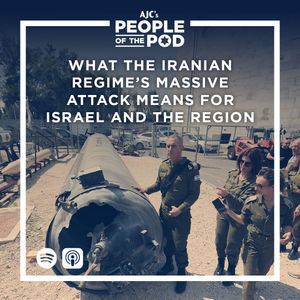
What the Iranian Regime's Massive Attack Means for Israel and the Region
APR 17, 2024
What the Iranian Regime's Massive Attack Means for Israel and the Region

AJC Jerusalem director Lt. Col. (res.) Avital Leibovich shares how the IDF — and its neighbors and allies — defended Israel with remarkable success. In the early hours of April 14, sirens and explosions were heard across the Jewish state. In an unprecedented, first-ever direct attack on the Israeli people, the Iranian regime launched a wave of more than 300 drones and missiles.

Episode Lineup:

  • (0:40) Avital Leibovich

Show Notes: Take Action: Join AJC in urging Congress to call on the EU to designate all of Hezbollah and the IRGC as terror organizations. Read AJC's Explainers on Iran:

Listen to AJC's People of the Pod on the Israel-Hamas War:

Follow People of the Pod on your favorite podcast app, and learn more at AJC.org/PeopleofthePod

You can reach us at: [email protected]

If you've appreciated this episode, please be sure to tell your friends, and rate and review us on Apple Podcasts.

Episode Transcript:

Manya Brachear Pashman:

Few of us slept well on Saturday night into Sunday knowing that Iran had launched a wave of more than 300 drones and missiles in its first ever direct attack on Israel. In the early hours of Sunday, sirens and explosions were heard across the Jewish state. Here to talk about how Israel definit itself from what many feared was inevitable, Director of AJC Jerusalem Avital Leibovich, who also serves in the Israel Defence Force Reserves.

Avital Leibovich:

Thank you.

Manya Brachear Pashman:

So can you share with our listeners what it was like to hear that Iran had launched this wave of missiles and drones? Did Israelis immediately pack up and head for shelters?

Avital Leibovich:

I think that was one of the most dramatic nights in Israel's history. You know, we're living in an era in which everything is televised and broadcasted. And when those drones have been launched from Iran, that has been broadcasted. So you can imagine millions of Israelis sitting at home, counting the hours until those drones will hit the Israeli airspace. In addition to that there was a lot of uncertainty of which type of drones we're talking about, what kind of explosives will they carry? Will they make it or not? And also, will these drones be accompanied by other weapons? So yes, there was huge concern. It was a sleepless night, sometimes between 2am until seven in the morning, Israel has been paralyzed with this unprecedented attack. Now 200 drones that have been fired at the same time to Israel. This is something that the world have never, ever experienced, there was never a country in the world that has been attacked simultaneously by 200 drones.

Manya Brachear Pashman:

Well, we also know that there were in addition to drones, there were ballistic missiles, there were cruise missiles. And we know that some of those ballistic missiles could have been fitted with nuclear warheads. And certainly, we know Iran's nuclear capability has been developing rapidly for more than a decade. Was that a concern?

Avital Leibovich:

Look,unlike terror groups, you know, they rely on funding of different countries, proxies and so on. Iran is a country with its own budget with its own economic means, and has been investing in technologies and procurement and development of weapons of different kinds for decades. So we saw some of the outcome of the Iranian weapons in Ukraine. When Iran sold some types of drones to Russia to hit Ukrainian civilians. We understood the capacity, the capability. And of course, Israeli intelligence followed closely the Iranian capabilities.

Now, when you have so many options, the warheads of ballistic missiles can vary. And therefore there was also uncertainty with regard to what would those ballistic missiles carry? Will they carry conventional weapons? Will they carry non conventional weapons? In addition to that, the attack came after more than six months of the war in Israel. So the level of stress and the level of uncertainty was high to begin with.

We're talking about six months in which Israel paid the heavy price of more than 600 soldiers and officers who were killed, and more than 1200 civilians. So it wasn't an isolated evening. It really came in the course of a very long war. And now, Israel is facing the big question of retaliation, yes or no, when and how?

Manya Brachear Pashman:

You know, we have long talked about Israel and Iran being in a proxy war, Hamas and Hezbollah being two of those terror proxies that want to destroy Israel and are already engaged in conflict, as you've said, as you pointed out, to do just that. Yet, it really was unthinkable that Iran would dare to directly launch missiles at Israel. How did this attack change the thinking and do Israelis think it is an indication of more to come?

Avital Leibovich:

Israel changed its thinking twice in the last six months. The first time was October 7. Israel never believed that Palestinians who entered Israel on a daily basis from Gaza as workers, would be collaborators of Hamas and would supply them with intelligence information about communities, about homes of people, about police stations in cities and so on. So we understood that we are, we need to change the concept, the operational concept, the strategic concept as well.

And the second time was when Iran attacked Israel a few nights ago. And here for the first time, Iran shows to take a risk, and fire over 350 targets more than 60 tons of explosives at Israel from its own sovereign territory. So whether it's proportionate or not, whether it's a retaliation to something or not, this does not change the fact that this is a precedent and as a president, Israel, of course needs to change the way it reacts and it plans. I know that the cabinet has met a few times already, since the attack of Iran. And the cabinet is discussing different ways in which it could retaliate, prepare, better prepare the storages of munitions that we have. So they are different opportunities for Israel.

And one of the questions I want to ask Manya is, how is the world looking at this? Because this is not an ordinary thing. And you know, one of the statements that came out yesterday, was from the G7 ministers meetings. And I was certain that the statement will primarily include practical steps against Iran, which is not only a problem for the Middle East and Israel, but for the entire world. And one of the leading statements said that, no, we have agreed to, to convince Israel not to retaliate. And I'm thinking to myself, haven't we learned anything? Do we want to wake up in a few months and discover that Iran has turned into a country with nuclear capabilities, with five bombs with six bombs?

Now, October 7, have never would have happened if it wasn't for Iran. Hezbollah attacking Argentina, the Jewish Community Center, decades ago, and murdering a lot of Jews and diplomatic staff would not have happened if not of Iran, and a lot of terror attacks all over the world as well. So how many proofs more does the world need, in order to take concrete action concrete measures against this terror global inciter called Iran.

Manya Brachear Pashman:

In addition to the United States, Israel's allies and neighbors really stepped up Saturday night, the United Kingdom, France, Jordan, they all helped down some of the drones that were headed Israel's way. But the attack undoubtedly depleted some of Israel's defenses. And so what does Israel need now from its allies, particularly, you know, in the way of action by governments in the United States and the EU? What does Israel need to make sure it can defend itself if God forbid, this happens again, or another October 7, happens again?

Avital Leibovich:

It's not a secret that the US and Israel are very strong strategic allies. And this has two main reasons for it. The first and maybe the most important one is the shared values that we hold between us. And the second is the mutual interests. The US needs a strong Israel in the region with strong capabilities, whether its intelligence or others. And Israel needs also a very close coordination with the US. So when we are maneuvering between these islands of terror in the region, we can work together to overcome those islands of terror. Now, in this situation, I think the coalition that work together, the countries which you mentioned, preformed an amazing, orchestrated, successful operation.

And part of it comes because Israel is now a part of CENTCOM, the central command. This is the command that actually gathers all the countries from the region. So in addition to being a part of that command, we share knowledge, technology,intelligence, we exercise together with other militaries. And this is the basis for future cooperation, like we've seen a few days ago within that coalition. So I think those steps are very important. I would say that continued US support for Israel's strength. And obviously, we did not plan to fight for so long. And such a long period of fighting demands a lot of ammunition. So the US support, both in budget, but in also resources, military resources, is critical for Israel to succeed and continue to defend its people and in the country.

Manya Brachear Pashman:

My last question, Avital, kind of references what you just said a moment ago about how the world just doesn't seem to realize the global threat that is posed by Iran. Does Israel's success matter not just to Israel, but to the world at large?

Avital Leibovich:

You know, Israel's success is based on the air defense system that was built for decades, with Israeli technology, Israeli know how. The ability to intercept different kinds of rockets and drones is something first of all technology we shared with the US, and we work in partnership, but also comes out of a lot of investment.

Now, I believe that today in 2024, the world needs to aspire for a more stable Middle East. The Abraham Accords, was a part of that direction. And furthering and enhancing the Abraham Accords, expanding the Abraham Accords in the future, will just help the world to see a more stabilized area.

Now, Iran has to be dealt with, there is no question about that. I do expect sanctions and putting on the terror list, the Revolutionary Guards and Hezbollah in its entirety, you know, Lebanon doesn't have a president for more than a year, because Hezbollah never approved the candidates, for example. So Hamas needs to be on the terror list. The Houthis need to be on the terror list, the Houthis are a problem for the world disrupting cargo movement in the Red Sea.

So these are all terror groups, proxies, with different sizes with different intensities of weapons, all imminent in one troublemaker, and that is Iran. So my expectation after a few nights ago, is that the world, the Western world, the modern Western world will gather together and take concrete steps. So we do not wake up surprised in a few months and find a nuclear Iran ready to launch the rockets with nuclear warheads and we don't know exactly where–to Europe to Israel, elsewhere in the world.

Manya Brachear Pashman:

Well, Avital, I'm glad you're safe. Thank you so much for joining us.

Avital Leibovich:

Thank you for the opportunity and am yisrael chai.

play-circle icon
13 MIN