Sales is NOT a Dirty Word

Aleasha Bahr

Details

Are you a DFY service provider who wants to convert over 50% of your sales conversations without acting like a douchebag? Then this is for you. In this value packed podcast, creator of the Black Sheep Sales Method™, Aleasha Bahr, brings her signature humor and ”keeping it real” sass to deliver a powerful blend of actionable solo sales episodes and expert interviews. In her solo episodes, she shares easy-to-implement sales strategy that will catapult your sales without pressure, pitching or pretending to be someone else. In her expert interviews, she carefully curates only the most bad ass black sheep guests to share their refreshing, unconventional approaches to all things business, mindset and life. Aleasha and her clients regularly convert 80% of their calls and show you how to do the same with the Black Sheep Sales Method™ - ”Because if it’s a fit, it’s a fact and there’s no selling involved.”

Recent Episodes

OCT 15, 2026
How to Interview and Hire the Right Salesperson
Sales hires are a different type of role than anything most business owners have hired before. Unless an owner was previously in sales, it can be difficult to know what to look for. And many times, confidence is confused for competence. A history of impressive numbers appears to settle the question. Even arrogance can slip through as evidence that someone possesses the personality required to sell. But what are those signals actually measuring? A candidate may have an extraordinary track record and still be completely wrong for your business. Their results belong to a particular offer, market, company, sales process, and moment in their career. Once those conditions change, the résumé can become far less predictive than it first appeared. In this newest episode of Sales is NOT a Dirty Word, I examine the assumptions that cause business owners to misread sales candidates and make expensive hiring decisions. The traits commonly associated with great salespeople deserve more scrutiny. So do the qualities that rarely sound impressive in an interview, yet may reveal far more about how someone will sell, collaborate, and respond once the easy momentum disappears. Listen in to consider: What a candidate’s previous results can and cannot tell you Which familiar “sales personality” traits deserve closer examination The interview questions that reveal how someone thinks beneath the polished answers What compensation preferences may expose about a candidate’s expectations Hiring a salesperson requires you to see deeper than the performance happening across the interview table or the story on the resume. If you are preparing to hire a salesperson or your current team is underperforming, book a Grow Your Sales call with me. We’ll examine your sales process, compensation plan, KPIs, and the conditions your team needs to perform consistently: https://calendly.com/aleasha/salesteam-levelup You can also take the free Sales Personality Assessment to uncover your natural sales strengths and learn how to use them instead of forcing tactics that do not fit you: https://assessment.aleashabahr.com/salespersonality KEY TIMESTAMPS01:00 | How sales candidates sell business owners during the interview02:00 | Why previous sales success may not transfer to your offer03:00 | The revenue consequences of hiring someone motivated only by commission04:00 | When industry relationships disguise deteriorated sales skills05:40 | Interview questions that reveal empathy and collaboration06:20 | Why a lone-wolf salesperson can become a serious liability08:00 | What a large base salary request may reveal08:40 | Structuring commissions around the behavior your business needs10:00 | Why winging your first sales hire becomes painfully expensive11:00 | Getting support with your sales process, KPIs, and compensation plan #SalesIsNotADirtyWord #BlackSheepSales #SalesHiring #SalesRecruitment #HiringSalespeople #SalesInterview #SalesLeadership #SalesManagement #SalesTeam #SalesCompensation #CommissionStructure #SalesStrategy #BusinessGrowth #SalesCoaching #EntrepreneurPodcast

11 MIN
OCT 1, 2026
The Sales Diva: How Your "Top Performer" Could Be Poisoning Your Sales Team
Your highest-grossing salesperson may be the most expensive problem on your team. They get the best leads, extra resources, and a different set of rules. Their revenue looks too valuable to risk, so leadership keeps making exceptions. Meanwhile, the rest of the team notices. Talented salespeople stop trying. Good ideas stay buried. Resentment grows. Eventually, people leave while the person causing the damage becomes even more indispensable. In this newest episode of Sales is NOT a Dirty Word, I’m talking about the sales diva: the salesperson whose results give them enough leverage to manipulate opportunities, demand special treatment, and leave business owners feeling trapped. Their numbers may look impressive and they certainly reference them often when asking for exceptions and preferential treatment. It’s important to take a close look and ask - How much of their success comes from skill? How much comes from receiving better leads, inheriting established relationships, or claiming opportunities developed by someone else? And if one person needs every advantage to remain your top performer, what could the rest of your team accomplish with equal support? Listen in to discover: How a salesperson gradually gains enough leverage to hold a business hostage The warning signs that special treatment is damaging the rest of your team Why revenue alone cannot tell you who your strongest salesperson is What genuinely skilled salespeople bring to a team beyond closed deals A sales diva rarely becomes a serious problem overnight. The danger grows every time leadership overlooks harmful behavior to protect the revenue attached to it. So how much damage are you willing to absorb before your “top performer” becomes too expensive to keep? Book a sales call audit with me, and we’ll uncover where your sales process or team structure may be costing you revenue: https://calendly.com/aleasha/salesteam-levelup You can also take the Sales Personality Assessment to uncover your natural sales strengths and learn how to use them instead of forcing tactics that don’t fit you: https://assessment.aleashabahr.com/salespersonality Key Timestamps01:00 What a sales diva is and how someone grows into one01:40 When the business owner feels held hostage02:25 What the rest of the team sees: the favorite child effect03:15 The poison behind the scenes: lead stealing and office politics04:00 The plant analogy every sales leader needs to hear05:00 The long-tenure rep coasting on old relationships06:00 Hungry vs. entitled: what separates real top performers06:45 How sales divas drive turnover and silence good people07:45 The worst reason to favor a salesperson08:30 Prevention: what actually makes a top-performing salesperson09:40 How to get support building a win-win sales team #SalesIsNotADirtyWord #BlackSheepSales #SalesLeadership #SalesManagement #SalesTeam #TopPerformer #SalesCulture #SalesStrategy #SalesPerformance #TeamLeadership #BusinessGrowth #SalesCoaching #EmployeeRetention #RevenueGrowth #EntrepreneurPodcast
10 MIN
SEP 17, 2026
How to Turn Small Sales Into Six Figure Contracts
You just got off a great discovery call. You can already see everything you could fix, every opportunity they’re missing, and the massive result you could create together. So you put all of it into a $100,000 or $150,000 proposal, present your big vision, and wait for them to say yes. Instead, they disappear. The problem isn’t necessarily your pricing or the value of your work. A brand-new prospect simply doesn’t know if you’re full of shit yet. So, asking them to commit to a massive engagement before you’ve delivered anything means asking them to take on a level of risk most buyers aren’t comfortable with. In this newest episode of Sales is NOT a Dirty Word, I’m breaking down why ambitious proposals often stall, why emailing the proposal makes it even easier for prospects to ghost you, and how to create a smaller first offer that gives the client a real result without devaluing your expertise. Because the goal is a long term client and a big proposal - and that’s more likely to happen when you earn trust first. Listen in to discover: Why a prospect can believe in your solution and still reject the proposal What buyers are really evaluating when you ask them to approve a large investment How to create a smaller first offer without discounting or diminishing your work The discovery questions you need answered before structuring your proposal Why a well-designed first engagement can lead to longer and more profitable client relationships If your proposals keep stalling after you email them over, you probably don’t need a more persistent follow-up sequence. You need to understand what’s making the initial decision feel too risky. Book a sales call audit call with me, and we’ll find out where your sales process is losing the deal: https://calendly.com/aleasha/salesteam-levelup You can also take the Sales Personality Assessment to uncover your natural sales strengths and learn how to use them instead of forcing tactics that don’t fit you: https://assessment.aleashabahr.com/salespersonality Key Timestamps 00:00 – Why I don’t email sales proposals01:40 – The mistake behind $100K and $150K proposals02:10 – Why new prospects are afraid of getting burned02:35 – Selling one small win that can stand on its own03:15 – Why retention and upselling beat constant client acquisition04:40 – The two definitions of success your proposal must address06:00 – Why giant proposals keep great service providers from getting hired06:25 – Making the first investment easier to say yes to07:00 – What a valuable standalone offer can look like08:00 – Building an intentional upsell process08:25 – Why simple proposals convert better than buzzword-heavy decks #SalesIsNotADirtyWord #BlackSheepSales #SalesProposal #ProposalStrategy #B2BSales #SalesStrategy #SixFigureSales #ClientAcquisition #ClientRetention #Upselling #ConsultativeSelling #SalesConversion #SalesCoaching #ServiceBasedBusiness #EntrepreneurPodcast
9 MIN
SEP 3, 2026
How to Handle "Let Me Think About It" Without Sounding Pushy or Desperate
“Let me think about it” has probably launched more awkward follow-up emails than any other sentence in sales. You leave the call not even knowing where to go after that because there wasn’t an obvious objection to work through. How do you follow up with that - ask them what they need to think about? How long do they need? Neither. The answer is to get curious - yes - but in a different, more specific way. People rarely arrive at hesitation out of nowhere. There’s usually something underneath it: a question they haven’t asked, a concern they haven’t named, a detail that still feels fuzzy, or a very legitimate reason that moving forward today would be the wrong decision. And yes, sometimes that reason is absolutely valid. You don’t know until you do some digging though. In this episode of Sales Is Not a Dirty Word, I’m pulling apart what can actually be happening when a promising sales conversation ends in “let me think about it” and where you should start looking when you hear it. Listen in to discover: What signals to spot when a prospect hesitates at the end of a conversation The questions buyers can have without quite knowing how to articulate them Why curiosity gets you further with an objection than trying to convince or overcome How to discern when hesitation deserves more conversation and when someone genuinely needs more time If you’ve ever experienced the paralyzing uncertainty that can happen in the face of this nebulous objection - listen to the full episode before you send another “just checking in” follow-up. Curious why your own sales conversations are converting less than 50%?Book your sales audit with me and let’s find out what’s happening inside your process:https://calendly.com/aleasha/salesteam-levelup Take the Sales Personality Assessment to leverage your own unique strengths here:https://assessment.aleashabahr.com/salespersonality 01:15 — The real reason it happens: something wasn't uncovered earlier02:10 — Why prospects don't ask the questions they actually have03:05 — Client story: when "I need to regroup" was really about the offer, not the price04:20 — Not a fit yet versus not a fit ever, and why the difference matters05:10 — What "let me think about it" is really hinting at06:00 — Why bringing up objections yourself builds trust instead of planting doubt07:05 — What happens when you skip this question, and why prospects ghost instead of answering08:00 — Telling prospects exactly when your offer doesn't work09:00 — The last resort line to use when someone says they'll think about it #SalesIsNotADirtyWord #BlackSheepSales #SalesObjections #LetMeThinkAboutIt #SalesTraining #SalesTips #SalesStrategy #SalesCoach #SmallBusinessSales #B2BSales #EntrepreneurPodcast #SalesPodcast #ConversionRate #SalesLeadership #AuthenticSelling #SalesSkills #TrustBasedSelling #WomenInSales #BusinessGrowth #SalesMindset
9 MIN
AUG 20, 2026
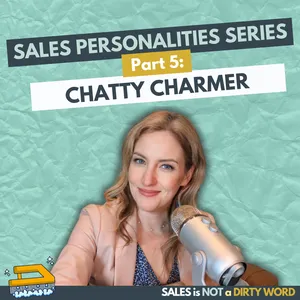
Sales Personalities Series Part 5: Chatty Charmer
I'm closing out our five part Sales Personalities series with the one I think gets misread the most: the Chatty Charmer. This is the person who has never met a stranger - they’re warm and easy to talk to. I could put a Chatty Charmer on a call with a prospect for forty five minutes and that prospect would walk away saying, "I really like that person." And then never buy. I see this get mistaken for sales talent constantly. Charm and connection do not equal sales - but they can with the right structure added in. In this episode, I break down: Why being liked and being trusted are two entirely different currencies, and only one of them results in sales The real reason Chatty Charmer calls run long, in multiples, and still stall out The anchor phrases I teach this personality type to gently rein a conversation back in without losing the warmth that makes this personality magnetic in the first place The overlooked skill of asking what's actually behind a prospect's question, instead of just answering it at face value The surface level where sales die, and what going two or three layers deeper actually sounds like The organizational habit most Chatty Charmers skip that costs them never ending follow up If you've ever finished a sales call feeling like it went beautifully, only to get ghosted, or if you manage someone whose calendar is full of "great conversations" that never convert, this episode will show you I what's missing and how to fix it without losing the very warmth that makes this personality so good with people to begin with. Every sales personality, including yours, has sales strengths that convert when leveraged correctly. That’s what this series is all about. Take the Sales Personality Assessment here: https://assessment.aleashabahr.com/salespersonality Curious why your own sales conversations are converting less than 50%? Book your sales audit with me here and let's find out how to fix it. 01:35 — Introducing the Chatty Charmer and how it differs from the Passionate Persuader02:45 — Why likability creates the illusion of sales skill03:15 — The real symptoms: long calls, rabbit holes, and inconsistent results04:15 — Likable versus trustworthy, and why only one gets you paid05:00 — How I build anchor phrases that rein the conversation back in06:20 — The habit of answering questions without understanding what's behind them07:45 — A real example from a client's sales rep and what almost got missed08:45 — Why surface level is where sales die09:15 — The organizational gap that costs follow up without anyone noticing until it's too late10:00 — What a Chatty Charmer looks like once these tools are in place #SalesIsNotADirtyWord #BlackSheepSales #SalesPersonality #ChattyCharmer #SalesTraining #SalesTips #SalesStrategy #SalesCoach #SmallBusinessSales #B2BSales #EntrepreneurPodcast #SalesPodcast #ConversionRate #SalesLeadership #AuthenticSelling #SalesSkills #TrustBasedSelling #WomenInSales #BusinessGrowth #SalesMindset
10 MIN