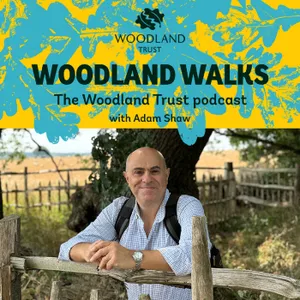
Woodland Walks - The Woodland Trust Podcast

Woodland Walks - The Woodland Trust Podcast

Details

Welcome to the Woodland Trust podcast, 'Woodland Walks'. We'll be exploring some of the greatest woods, forests and sites in the Woodland Trust estate. Join our host, Adam Shaw, as we discover the stories and characters that make each of our woods so very special. We'll explore awe-inspiring ancient woodland and get lost together in the rich habitats that support our native wildlife. We'll meet the site managers and the magnificent volunteers who protect woods and plant trees. For wildlife. For people.

Recent Episodes

MAY 8, 2026
17. Superstar Nile Rodgers visits Faughan Valley Woodlands
Did you know American music legend Nile Rodgers is helping the Trust plant and protect woodland in Northern Ireland? Alongside generous donations to Faughan Valley Woodlands from the We Are Family Foundation (WAFF), Nile has got stuck in with planting on site. Nile and the foundation he co-founded with his partner, Nancy Hunt, are working with us to reconnect fragmented native woods in a region where less than 1% of ancient woodland remains. We caught up with the multiple Grammy Award winner on his latest visit to find out why. We also hear from David Saddington, trustee of both WAFF and the Trust, on why empowering young people to take direct action is key to this work, and we chat to some of those volunteering at this special event. Please note this episode contains references to drugs. Don't forget to rate us and subscribe! Learn more about the Woodland Trust at woodlandtrust.org.uk Transcript You are listening to Woodland Walks, a podcast for the Woodland Trust, presented by Adam Shaw. We protect and plant trees for people to enjoy, to fight climate change and to help wildlife thrive. Nile: But it just made me feel so good. It was so real, it was almost like a drug. So my parents were doing heroin, I was doing music *laughs*. Nile: So I always thought that an artist was the guy trying to be the smartest person in the room, that everybody said, 'well, I wish I could play like him, I wish I could do that'. No, it was the person who touched people's hearts. Nile: We actually had them locked out the studio because we still hadn't finished the lyrics to We Are Family. Nile: Trees do, all plants, but trees, you know, especially, do so much for life. Let's not just talk about the overall environment, life, all life forms that exist. Adam: For 40 years, if you've been on a dance floor, you'll have been dancing to the music of one of our guests today. He co-founded Chic, produced and collaborated with David Bowie, Madonna, Richard Jackson, and well, to be honest, too many others to mention. But to give you an idea of the sort of musical success he's had, I can say that he has produced and performed on records which have sold more than 750 million albums and 100 million singles. Born to teenage parents in an environment where drug use was very much part of his every day, he has come from that background with an attitude to life which is as upbeat and as positive as his music. And together with his partner, Nancy Hunt, they have established the We Are Family Foundation, focused on empowering young people around the world. Together, they're in Northern Ireland, in Derry, to support and protect and indeed restore woodland in this country, and indeed Nile is on the Woodland Walks sofa and joined by one of the trustees of the We Are Family Foundation and indeed the Woodland Trust, David. So we'll come to David in a moment. Why don't we start now where it all started with the music? Reading about you and listening to stuff you've done, my impression is you're the most positive person I've read about and that surprises me because of the disjointed background you grew up in. So two questions. Do you think that's a fair description and if so, why? Nile: So the... the interesting thing about my childhood was that though my parents were heroin addicts, they were extremely loving and they believed in me so much so that, believe it or not, I was never, ever told what to do. They knew that I instinctively would figure it out. Or I was just one of those nerdy, nice kids that they knew would never get into trouble. I mean, I have never stolen anything. I've never, I bullied one kid once and the reason why is because everybody bullied me because I was a nerd. And when I bullied this kid, he started crying and I started crying. He's probably forgotten that incident. I will never forget it. It'll bother me my entire life. I could not believe that I did that. So my childhood was actually on one level very happy, but at the exact same time, and I don't know how these two situations could have coexisted, except only now forensically, but it was super happy, but then I actually called my childhood a fear-based childhood. I was afraid of things, so I did things to make me unafraid or happy. And music was that thing. But it just made me feel so good. It was so real. It was almost like a drug. So my parents were doing heroin. I was doing music *laughs*. Adam: I mean, it's weird you describe yourself as a nerd. You're the least nerdy-looking nerd I've ever come across, but fair enough. Nile: Oh God, test me. Adam: Oh really, okay, we'll do a nerd off *both laugh*. Fair, fair enough. But that positivity, I mean, you talk about being nice, but what I think is striking about your music, and perhaps problematic for some of it, is that it's relentlessly positive. And I think sometimes it's seen as sort of very surface level because of that and yet you talk about the deeper meaning behind the music, which I think some fans of yours perhaps don't see, or that's not what they're getting from it. Nile: But that's okay, though. Adam: That's fine. Nile: It's okay. Yeah, you're so correct. I mean, I'll try and quickly just tell you this story. So when I said I was a nerd, believe me, I studied music on a level that was so intense, that was ridiculous. So I thought it was my job to prove to my tutors and various teachers how smart I was, how well I learned the rules and the discipline of music. I wrote symphonic music when I was a child, I wasn't even 10 years old yet. And I remember I was going to one of my tutors. I was around 22 years old and I was a very serious jazz student. And I went into him one day with a very sourpuss attitude and look, and that was not me. He just was like, no, you're always so happy and you're always so upbeat. What's wrong with you today? And I said, well, look at this ******** pop music that I have to play tonight. Now, maybe I thought it was sort of ******** but maybe I was just trying to score brownie points with him because I always thought being a great musician was being the smartest guy or the greatest virtuoso in the room. So what happened was my teacher, I showed him the list of songs that I was playing that night. And I said, look at what I have to start my set with. This song by The Archies called Sugar, Sugar. He said, yeah, but now what's wrong? Why are you so sad? And I said, because I got to play Sugar, Sugar. You know, I want to play straight ahead jazz. He was like, that's okay that you want to play straight ahead jazz, that's what I love. But why is it bothering you to play Sugar, Sugar? And I said, because it goes, *sings* Honey, do, do, do, do, do, do, oh sugar, sugar, do, do, do, do, do, do, you are my candy girl, and you got me wanting you. And he said, Nile, that's a great composition. I went, you call Sugar, Sugar a great composition? He said, absolutely. He said, what do you think about it? He says, and I went, well, it sucks. It's some ******** bubblegum pop music. And he went, now, do you know that Sugar Sugar's been number one for about three weeks? And I said, yeah, but what does that got to do with anything? And he went, so those millions of people around the world, they're wrong, but you, Nile Rodgers, are right? And all of a sudden I felt, uh-oh, *laughs* something weird's getting ready to happen. So he held me behind my head and he pulled my face close to him and he said, Nile, let me explain something to you. Every record in the top 20 is a great composition. And so remember, we're going back now 50 years. I'm 73 years old, so we're going back a long time. And I say, every record in the top 20 is a great composition? He says, yes. I said, why would you say something so absurd? He says, Nile, because it speaks to the souls of a million strangers. And I literally started crying at that moment because in one spark, in a nanosecond, he explained to me what an artist was. So I always thought that an artist was the guy trying to be the smartest person in the room, that everybody said, well, I wish I could play like him. I wish I could do that. No, it was the person who touched people's hearts. It was the person who made people feel something, be it happiness, be it sadness or whatever. But a lot of my friends who are virtuosos, we just would go, wow, he can play his *** off. That was the thing. We didn't feel anything necessarily. Sometimes we did, but I was determined to try and make people feel something every time. And to me, I wanted people to feel happy because I wanted to feel happy. Why do I want to write sad music? Adam: So that phrase, speaking to the souls of a million strangers, it's clearly an iconic thing about your music. The other striking thing, I think, which you've talked about, is about life, not just your music, but I think obviously connected, is not about surviving the storm, but learning how to dance in the rain. Is that one of the tenets of your approach to music and life? Are they the same thing? Nile: That's exactly it. That's why people wonder why I do so much music, and it's because I believe that I could always, I honestly, and this is not an egotistical statement, I always believe that I can add something to the song. I believe that I can make it better, even if it's just a little better, but you can hear it. I mean, five minutes before I came down here, I asked an artist that I sent a piece of music to, I said, you never wrote me back. How do you feel about the guitar streams that I sent you? And Kygo just wrote me, he said, he just literally just wrote me, where the hell is it? I went, cool. He went, oh, yes sir, sounding really cool *laughs*. Minutes ago. Adam: Okay. So look, we need to talk more about that, but I want, you're here not for the music, but for the work of your, and Nancy, your partner's, foundation. And David Saddington, sitting next to you, is a trustee of that foundation. You also happen to be a trustee of the Woodland Trust as well. So the purpose of the We Are Family Foundation is what? David: I mean, the We Are Family Foundation, Nile and Nancy started 20, 25 years ago now, which is insane *both laugh*. And Nile, I mean, you'll tell it better than me in terms of sort of your origin story, which came from, you know, a horrendous event of 9/11. And Nile and Nancy wanted to do something positive for the world, to heal the world. And thankfully, you know, when they sort of asked that question around how do we sort of have more peace in the world, how do we have more harmony, young people came out as the answer and actually finding that hope, finding that positivity, finding those solutions. So the foundation really is built upon curating, nurturing and growing this talent and giving these young people visibility. Adam: And the work that the We Are Family Foundation is starting to do in Northern Ireland, we were today at a planting with Nile and Nancy and you. What is the project here? David: Yeah, my God, like, you know, I work on climate change every day. It's really sort of hard and difficult, but actually by doing something very local with the Woodland Trust, you make such a tremendous difference, not only just about place, but the communities which you bring along. So this partnership just made a lot of sense. And then when we started talking after that visit around sort of why it made sense to support from the foundation, Northern Ireland came out really as a winner. And the beautiful site we visited earlier in the Faughan Valley is so special because, in a sad way really, because so little of the ancient woodland is left in Northern Ireland, less than 1%. And the vision of the Woodland Trust in Northern Ireland to preserve those tiny fragments of ancient woodland, but protect them by restoring the land around it, letting them expand, is so special. And particularly given that site is, what, I mean, like 10 minutes away from Derry? That's so cool. It is right on the doorstep of so many people to restore such a precious habitat, but make sure that people can actually enjoy it and be part of that as well. Amazing. Adam: A little before Nile and I sat down to speak, we both visited Faughan Valley Woodlands with a group of young people who were there to help plant some trees. Now, this is an important area. Since 2000, the Woodland Trust has brought small clusters of native woodlands, including Brackfield, Oaks, Red Brae, Burntollet, Killaloo and Auter, all fragmented along the Faughan Valley, which is a site of special scientific interests. And it's been a vision of the Woodland Trust Northern Ireland for well over a decade, really, to try and connect these fragments for both people and nature. And so when I met the younger people who are busy planting trees, I asked them why they felt what they were doing was important. Speaker 1: So usually it's around every Sunday morning. We go around and it's just odd jobs, like it's never the same thing every week. It's usually planting trees, but recently we've been building fences to keep sheep out and removing tree guards. Adam: And why are you interested in that instead of watching TV or playing Xbox or whatever? Speaker 1: Well, I've always kind of liked outdoorsy stuff in nature and usually I wouldn't really do much on a Sunday. So it's just better to get out rather than do nothing on a Sunday morning so. Adam: And you're about to plant a tree. Speaker 1: Yeah. Adam: Do we know what type of tree that is? Speaker 1: I think it's oak. Adam: Oh, there we are see, I don't know, but you know, go on plant away. Speaker 2: I'm Sophie McGee. Adam: And what are you doing, Sophie? Speaker 2: Well, we're planting trees today for the 30th anniversary. It's just more interesting because we're actually doing something that's worthwhile for the environment and for ourselves. Adam: And do you feel you're making a difference? Speaker 2: Yes, every tree will help. No matter if it's a wee tiny stick or a big massive one. Speaker 3: Well my name is Evie, I'm 13 years old and I've always been interested in nature and plants and animals and stuff and then my auntie decided, or she showed me the Woodland Trust young volunteers so I thought that sounds right up my street. So I joined, I've only been here for a few weeks and so far I've really enjoyed it. We've been trimming down, we've been trimming away trees that'll grow back to let light into the forest floor. We've been looking at different kinds of moths and caterpillars and we've been for walks and here we are planting trees and meeting celebrities! Speaker 4: My name's Milo and you know we're with the Woodland Trust, you know, planting trees and stuff because, well, you know, trees are important and they support a lot of species and insects and wildlife and it's great for the water quality and soil erosion in general. And in my opinion personally, I think biodiversity is really important, especially in, the UK and Northern Ireland in general. It's just seem to be really sort of nature depleted and, you know, I kind of want to change that. I think it doesn't seem fair, you know? Adam: Nile, I think the phrase we've already used many times is We Are Family, the name of one of your most successful songs, but obviously the name of your foundation. And we've talked about your family. That's an obvious theme, family. I'm struck by that because of a disjointed background, even though loving and literarily full. Your family were artists and you had a full and rich literary life. The connection to family, clearly a theme for you. Why? Nile: It wasn't my idea. It was other people's ideas. And they talked me into it. I, as an artist, I wrote We Are Family for Sister Sledge and for Sister Sledge alone. I didn't write it for the world. I wrote it for them. And they, it was their job to now take it out into the world, which they did very well. But what happened as a byproduct of the composition was just the love that I put into the song that my partner Bernard Edwards and I put into the song, we were trying to talk about this wonderful family, you won't believe this, that we never met. We never met Sister Sledge until they came in to sing the song. The entire album was already produced. We didn't know any other way to make records except for by ourselves. So we made the record and said, okay, now sing this. And they were like, what? We've never been treated like this. We're like, we don't know any other way to make records. Me and Luther Vandross and Bernard Edwards and Tony Thompson, and we go in and we write and produce, and there you go, here's your record. But so the love that we projected onto Sister Sledge was something that we superimposed upon them. We don't know whether they liked each other or not. We just presupposed that they did. And that's what we wrote, this loving, anthemic, wonderful dance song. And Kathy Sledge, at 15 years old, came in and just gave the performance of her life. We actually had them locked out the studio because we still hadn't finished the lyrics to We Are Family *both laugh*. It was the final song that we wrote, right? So we wouldn't let them come in. We're inside trying to be professional. And they're like, why can't we come in and hear what you guys are making as demos? Making as demos? No, we made, it's the record. But anyway, what happened was, as a result of the popularity of the song, this baseball team in America, the Pittsburgh Pirates, adopted it as their theme song. And they're not women, they're men. And we saw these big burly men going, we are family, I got all my sisters with me. And I was like, whoa. And anyway, they won the World Series *laughs*. Adam: But I mean, that's a fascinating insight how you made that song. But what I'm struck by is that you have talked about this deeper hidden meaning, your phrase, right, behind your songs. So that's an obvious question to ask. You talk about family. It's a key song in your career. It hints of the deeper meaning here is about the importance of your family. And your family are unusual. Super talented people, not particularly stable, I hope that's not insulting or anything. But it's sort of, I'd expect you to maybe be more traumatised by that or to have, but no, it's all good. It's all good. Nile: It wasn't, you see, it wasn't traumatic because I developed my own survival mechanism and it was actually good. But I don't think you realise this. I said, everybody told me, oh, you got Grammys, you got this, you're the head of the Songwriters Hall of Fame, you're the Rock and Roll Hall of Fame, I said, you know what? The thing that I am the most proud of in my life is at seven years old, I set the national truancy record for the United States of America *both laugh*. I cut school 75 days in a row and went to the movies. I learned more at the cinema in 75 days than everybody in my class learned in an entire semester. You could see Fellini, you could see Truffaut, you could see anything. My mom, when she had her second child, suffered from postpartum depression and threatened to murder my brother every day. So after a few weeks, and I can't remember how long it took because I was a child, but after her going to psychiatrist every day, that's how bad it was, they decided that she had to be separated from her children. She was a danger to herself and others. So they sent me off to Los Angeles to live with my maternal grandmother. And my youngest brother, who was just born, was sent to live with his paternal grandparents. And so while I was in Los Angeles, I was treated ah man, boy, talk about bullying. Every place in LA was sort of run by gangs. And I didn't know anything about the gang culture. And I spoke like a New Yorker. And everybody in LA was, you know, street slang. And, you know, and now look at how big hip hop is. You know, that's the way that that everyone spoke. I didn't know half the stuff they were saying. So kids would try and beat me up. They only beat me up once, no, twice, sorry, twice. And then I just decided, I'm not going to where those kids are. I'm going to where adults are. Because I got along with adults and I went to the cinema every day for 75 days straight. Adam: There's lots to talk about, not much time. But I do want to ask one more question around this sort of area. In actually the podcast we've just done, I spoke to quite a significant business leader who has ADHD. And I said to him at the end of the chat we had, if you had a magic wand and could wave away your ADHD, would you do it? And he went, no, I absolutely wouldn't do it because it's part of who I was, I am, and it's informed and helped me. And I wonder if there's a similar question about your drug past, whether if you could wipe it away, would you? Nile: Never, never, ever, ever, ever. I, you know, I developed a very horrible drug habit. I actually, my heart stopped six times in one night. I don't remember the medical phrase, but it's called something like multiple drug interaction. Like, so if you take cocaine and then you take alcohol and then you take either LSD or something else, your brain doesn't know which one is dominant, right? So it starts going, it tells your heart, do I expand or contract? I don't know. And every time they tried to revive me, I would only stay alert or alive, my heart would only pump a couple of times and then stop again. Adam: So what did that bring you as an artist in retrospect? Nile: Nothing. Because to me, all I remember was driving home, Not getting into an accident, not getting a ticket, driving home, parking in my same parking space, going up to my apartment. However, I mistakenly pushed the number 14 instead of 28. That saved my life. I didn't know that I did, I didn't know I made a mistake. I was so high, I thought 14 was 28. The way that they emptied the garbage in my building, they started at the top and they went down floor by floor. When the elevator hit 14, the doors opened, I fell out onto the floor dead. They just happened to be on the 14th floor and they saw me lying there dead. They go over, I have no pulse. They probably tried to do, I don't know any of this for a fact because I was, out, yeah. So I just assumed they must have tried to help me. They liked me, so they must have tried to do something. Fortunately, the hospital was two blocks away from my house. And they get me to the hospital. The doctors revived me six times. After the sixth time, they figured this is hopeless because they did everything they could possibly do. And he said that, we worked so hard to save your life, but in fact, I was filling out the death certificate and the orderly in the room said, hey doc, we got a live one here. And my heart just started going automatically again by itself. Adam: Amazing. I want to bring you back to your foundation. So we're here because of the good work you're doing for the environment. But the environmental issue may be relatively new, but you've been a political activist since your early days. This is not a recent conversion. You're super plugged in to these sort of big debates, aren't you? Part of the Black Panthers in your early age? Nile: Yeah, I was a subsection of the Black Panther Party when I was 16 years old. Adam: So lots of political issues. Why now the environment? Nile: It's just one of many issues that We Are Family Foundation supports. You asked me about being a nerd. So I grew up as a scientist. I have a scientific background. So I understand how these things in our environment are fundamentally to life itself. That, if you think about it, in today's world, there are a million different species on this planet, but that's only 1% of all the life that's ever lived on this planet. So it just goes up and down and up and down. And prior to humans, we were never the cause. Now we're the cause of things dying and species going away. Before, it was just the fact that Earth was this very volatile planet and over millions, billions, in fact, years, things were changing. But now we're doing the bad stuff. We're killing ourselves, which is incredible. And it's mainly because most people don't know that all these life forms are dependent upon one another. Last night I heard someone talking about plankton. And I was saying, yeah, well, look at how important plankton is. You know, like hydrogen, we need, we don't have hydrogen, we have no life. You know, it's like, so, I mean, trees do, all plants, but trees, you know, especially, do so much for life. Let's not just talk about the overall environment, life, all life forms that exist. Adam: We're running out of time. Just one last question each. David, first, you set the context of what that foundation is doing here and what the Trust is doing here. What are your hopes for if Nile, us, we all gather, come back in ten years' time? Your hope for the project by then would be what? David: I mean, my hope for the project in that time is to see the forest grow, because what I find so encouraging is when you let nature recover with a little bit of help from us, it doesn't take that long to actually start putting it right, you know, to restore those habitats, to protect that ancient woodland, to let it regrow, rejuvenate, with the help of people supporting communities at the same time. It can recover in such a remarkable amount of time, which I just find really quite hopeful and empowering in the world we're in at the moment. Will it restore very precious nature here in Northern Ireland? Will it inspire people to make a difference with all the volunteers we're bringing in? Absolutely. And who knows what the catalytic sort of nature of that will be, which I think is sort of magical to see. So it's a pleasure to bring this partnership together between the We Are Family Foundation and the Woodland Trust and see that grow and grow over the years. Adam: And I think often with trees, people think it's 100 years, their great-grandchildren will come. That's not the case, is it? 10, 20 years is a reasonable time frame to see significant change in this landscape we just visited this morning. David: Yeah, absolutely. I mean, some of the trees we were walking around this morning, the beautiful silver birches, which looked like a woodland, were 20 years old. And actually, it is incredible, actually, it doesn't take a huge amount of time for nature to recover. Adam: Nile, last question. It's been an amazing life. It is an amazing life, perhaps a great life. Your third act? Hard to imagine what new things you could do, but do you, what are the, how do you see your future and what you want to spend that third act doing? Nile: Wow, I'm doing so much now. I'm almost going back to where I started, which was with theatre performances that are more story-ented instead of just going out and playing a whole bunch of hit songs. I think I got super inspired completely accidentally. I wrote a song for Diana Ross years ago. And the first time I worked for the Prince's Trust, he said, now, my dear fellow, I wish I knew more of your music, everybody seems to love it so much. And then he became the King and he printed out his top 10 favorite songs. Number 3 was one of my songs. And he didn't realise it because, you know, the King, what have you got time to sit around and read, you know *laughs* And I said to him, I said, you know, Your Majesty, I promise you, you know some of my songs. But then his list comes out and my #3 song, I mean my song, Upside Down by Diana Ross is #3. He was like, that's one of my favorite songs, and there's a whole video that we put out of him sort of like doing his best dance to Upside Down. It's quite funny. I just thought that the one thing I've not really explored or worked hard on, I'm at the part of my life where I really do want to do all the music that I can do. And I want it to have the same effect as the pop music that I do. So I want my jazz music to make people feel good. So I did Candy Dulfer's last record and she's just unreal. So that's really, I think, where I want to be. And honestly, and I'm being very, very honest, I never keep track of any of this stuff. I did a conference a few weeks ago, and it was all these billionaires and all these tech guys and blah, blah, blah. And I said, you know, I did the biggest selling Madonna album in the world, we sold 10 million copies. All of my memories are from when I first heard this stuff. And somebody hollered out from the back of the room, 23 million copies, you know Nile, it keeps selling and keeps adding up. And I went, oh. In the first few weeks, we sold 10 million copies. And that's all I remember. And I move on to the next record and the next record and the next record. I had huge success with the last two Beyoncé records. But I've done that, and obviously you can see with Kygo, I continue to do that. That's never going to go away. But when I think in terms of full projects, it's going to be more theatrical and maybe more film. David: There's about two things as well. There's one thing that you said to me before, which I think is just so great about the foundation, about how you want the foundation to be bigger than the song, which I think is a pretty epic aspiration there to have, the We Are Family Foundation and We Are Family the song, but I just think that's amazing to think around, the impact which has been achieved over twenty-five years and thinking about the years to come, and then secondly, because with your audience, Adam, we have so many obviously sort of people who love getting out on walks and nature. And my goodness, you won't be up as early as this guy doing his morning walks. And you definitely need to follow him on Instagram at a moment because he's on a roll doing sort of walks all over the world. Nile: It's true. I love, you know, I wake up every morning very, very early. Right now, life and enjoying nature and being out in it is really exciting. Like when I was younger, being indoors, like I used to, there was a joke I used to say, I used to go to like clubs every night and go, ah the great indoors *all laugh*. Adam: Well, look, a sample of how busy you are is I know you have other meetings to go to and other jobs to do, so I won't keep you anymore. Here's to the good times. Thank you very much indeed, both of you. Nile: Thank you. I hope I wasn't too long-winded. David: Thank you. Adam: You were brilliant. It's a real treat to talk to you. David: A pleasure. Thank you for listening to the Woodland Trust Woodland Walks. Join us next month when Adam will be taking another walk in the company of Woodland Trust staff, partners and volunteers. And don't forget to subscribe to the series on iTunes or wherever you are listening. And do give us a review and a rating. If you want to find out more about our woods and those that are close to you, check out the Woodland Trust website. Just head to the Visiting Woods pages. Thank you.

38 MIN
FEB 13, 2026
16. Flavours of the forest: drinking the taste of trees with Ben Branson
Have you ever wondered what trees taste like? That's the thought that spurred our guest, Ben Branson, to launch his latest venture, Sylva. We meet in Essex at his woodland, distillery and lab, where he crafts non-alcoholic drinks that capture the natural flavours of trees. Also the founder of Seedlip, the world's first distilled non-alcoholic spirit, Ben has now turned his focus entirely to nature to make Sylva 'a tree company that makes drinks'. Join us to explore the production process, admire a centuries-old oak that could offer a new flavour, and discover Ben's mission to encourage others to love trees as much as he does. We also learn how Ben's ADHD and autism help fuel his curiosity and innovation, and inspired him to launch The Hidden 20%, a charity, podcast and movement finding and sharing the truth about neurodiversity. Don't forget to rate us and subscribe! Learn more about the Woodland Trust at woodlandtrust.org.uk Transcript You are listening to Woodland Walks, a podcast for the Woodland Trust presented by Adam Shaw. We protect and plant trees for people to enjoy, to fight climate change and to help wildlife thrive. Adam: Well, in today's episode of Woodland Walks, I'm off to see a man who invented the world's first distilled non-alcoholic drink. It was called Seedlip and effectively he created it in his kitchen and took it to 40 countries and in the process, I think it's fair to say, helped change the world of adult drinks and it certainly spurned lots of imitators, which you may well know. He also has a different mission. Really, I think it's fair to say his mission is now at least partly to involve the environment in much of what he does. He has, for instance, won two golds at the prestigious Chelsea Flower Show, and last year launched Pollen Projects, which aims to continue to disrupt the drinks industry, in particular though, by harnessing the flavour powers of trees. And that's something I suppose I've really never thought about. Anyway, so I met him at his farm, his home, his laboratory - they're all more or less the same thing - somewhere in Essex. Ben: My name is Ben Branson. I'm the founder of Sylva. Adam: Fantastic. So first of all, we've lots to talk about. Ben: We do. Adam: Because we are sitting in an amazing, is this a laboratory? Ben: Yeah, I guess. Adam: It doesn't feel like a laboratory, it feels something much more designery. It feels like a Porsche should be made here or something. Anyway, looking over an extraordinary landscape, and we're going to go for a walk through that. But first of all, would you tell me a little bit about what, I suppose, what's brought you here and your history and why, why you're doing what you're doing. Ben: So I grew up on a farm and my family have been farming up in Lincolnshire for 320 years now. So that's nine generations and we're still farming. And I guess that meant I enjoyed a childhood largely outside and trees played a big part of that. Animals did, fields, produce, and hard work, I guess, not from me, but from my family. Adam: Right. So did you ever work on the farm? Ben: I did, yeah. And I would spend summers... Adam: So you got your hands dirty? Ben: Yeah, I would spend summers sitting on a tractor or going and sitting with my grandfather on a combine. Adam: Right. And you came to prominence for something completely different. I mean, not sheep or potatoes or anything, but the non-alcoholic drink called Seedlip. So briefly, how on earth did that happen? Ben: Yeah, Seedlip was a, I guess, a series of sort of curious accidents. Adam: I suppose we should pause, just tell, for those who don't know, what on earth we're talking about, what is Seedlip? Ben: So Seedlip was the, or is, the world's first distilled non-alcoholic spirit. Adam: Fine. Ben: So botanicals, distilled. and made into various different blends that you could have with tonic or in a cocktail. Adam: Will you get annoyed or too crude to describe it as a non-alcoholic gin? Ben: Too crude in that it is illegal to describe it as a non-alcoholic gin now *both laugh* Adam: Oh okay, not just too crude! Okay, incorrect. But okay, in my mind, I saw it as a... Ben: Akin to. Adam: Akin to. Ben: In that, in that world of a clear, botanical-driven liquid. Adam: Fine. So we know what it is. Ben: We know what it is. I've never worked for somebody else's drinks business before. I've never worked in manufacturing. Yeah, I learned how to distill ingredients partly through YouTube, partly through a book that was originally published in 1651. I have a 1664 copy of here called The Art of Distillation that details apothecaries' experiments for herbal remedies using distillation. So I, this started with me growing herbs at home and down the rabbit warren of Wikipedia looking at different lists of ingredients. Adam: So why did you want to do that? Ben: Because I'm the kind of guy that has a collection of 4,000 1940s Penguin books. And I'm the kind of guy that learned how to do taxidermy in an ancient church on a family farm in Lincolnshire. And I'm the kind of guy that likes to tinker and experiment and go really deep into things that I'm interested in. Adam: So it was just a, it wasn't, this wasn't, 'I'm going to be a businessman', you just fancied having a go? Ben: Nothing to do with drinks. I was just curious. Adam: Amazing. Ben: And taking mint from my garden and then making a liquid that smells and tastes like that plant was really magical. Adam: I mean, I don't want to talk about Seedlip a lot. Ben: Me neither *laughs* Adam: No, but just, I suppose, the last question on that, it must have come a point at which you've gone, this is a project in my garage to, hey, we could do this. How important was that? How significant a moment was that? Ben: Yeah, so the two key turning points were one, driving into London to go out for dinner, obviously not drinking alcohol and being served the most disgusting, pink, fruity, sweet, horrible mocktail and thinking, why is it so difficult to get a decent option? That was one key moment. And the second key moment was I made 1,000 bottles of Seedlip two years after I'd started distilling and I thought they'd last six months and they sold out in Selfridges in three weeks. And that went from my kitchen to, yeah, 35 countries and set this movement alight, which is all part of, yeah, we're slowly meandering towards now where we've got to today. Adam: So you sold that to Diageo? Ben: I sold the majority of that to Diageo in 2019. Adam: You own a bit of it. Ben: Yes. Adam: And now you're starting a new venture. Ben: Yes. Adam: Which is? Ben: Which is a company called Pollen Projects that has two brands. Seasn, which is a pair of cocktail bitters. So people may know Angostura. Very intense, concentrated, strong liquids that transform your sparkling water or your cocktail. And then my favourite, favourite project, which is Sylva, which is all about trees and making aged non-alcoholic spirits. Adam: So we'll talk about the trees, we'll, let's go for a trip about that. But before we get into all of those specifics, I think I'm right in saying that you, one of the purposes, one of the sort of foundations of the work you do is a sort of purpose-led business. Again, is that a fair description? Ben: Absolutely. Adam: And the business talks about that. Now, I'm a business journalist. It's now ubiquitous for businesses to go, we're purpose-led and we feel we're strong in the community. And one of the problems for journalists, and I think the public at large, is distinguishing between those who have some sort of genuine purpose here and those who feel we need to add that as our marketing strand. Ben: Yeah. Adam: Do you recognise that issue and if so, how do you overcome that? It must be very difficult to go, no no, I know everyone's saying this, but I really believe it. Ben: I am very, very clear that the reason why I'm doing this is because this is a way in which I can express myself. This isn't work for me. This is how I express myself because it's what I'm interested in. I'm very interested in trees and I'm incredibly curious and I really want to learn. And so I believe that trees are this most incredible, underestimated source of flavour, as well as all the other wonderful things that we already know about trees. And I want people to love trees. And so that is, if I can make a product that meets a need in people's lives and tastes delicious and they want to drink again, that for me is a real win-win rather than, I don't know, any other kind of business purposes or made-up, I'm really clear, like half of this is really selfish. Adam: Selfish in what way? Ben: In the sense that I want to keep working with trees. And I want to explore trees in my working life rather than it being a hobby at the weekends. Adam: And is it about that? Is it about like, I like trees and I want to work in the environment and it's great because I've got a sort of commercial reason to do that. Is there something, I get that, is there something also about social purpose, about feeling that the business should do some good or not? I don't mean to judge it in either way because it's perfectly fine for business not to do that. Ben: Sure. I think it's baked in. Seedlip, Sylva, Seasn. Someone said to me, probably about 12 months ago, they're born good. They don't have any alcohol in them. They are there to offer choice and they are there to include people. That's already baked in, in terms of the product. And so, yeah, there's lots of details we have with Sylva of some of the environmental credentials around our packaging or what we do with our waste, all that, but they are sort of below the surface, as it were. Ultimately, we want people to have a delicious drink and a great option and great choice. Adam: And how important do you think the public feel that sort of role for companies? It feels to me that certainly since COVID, there was a bigger demand for the public to hear companies stand up for something. Do you see that or do you think that was there and has gone away or what's your view on that? Ben: I, or we, are big believers that our brands or the company should have a point of view and part of your company having a point of view is how you're positioned in the market and against your competitors and ultimately what makes you unique and different. Adam: The weather's been so good to us, so I don't want to stay in too long. But I suppose the last question, I read other interviews you've done talking about other business leaders who've inspired you. Who and why? Ben: So David Hieatt was one of the team behind howies jeans. And then he went on to, he's a Welshman, he moved back to Wales to a town that used to be famous for making jeans. And over a, I don't know, 10, 12 year period, he got that town making jeans again. And those jeans were typically worn by lots of creative people. I hate jeans, so I never bought a pair. Adam: Sorry, here I am wearing a pair of jeans, you should have said. *both laugh* Ben: I just hate wearing them. I hate wearing them. And I just followed, I can't even remember how I came across him. I followed his work. He then, I was amazed to be included in one of his, he calls them mavericks and makers. I was included in one of his lists of people doing interesting things. And then I was invited to give a talk at his sort of cult following retreat called the Do Lectures. Adam: The Do Lectures? Ben: The Do Lectures. And it's an amazing retreat on a farm in Wales. Everyone's sort of in wigwams and you kind of, you're in this old, old barn giving this, giving this talk. And I sort of plucked up a bit of courage to actually talk to him, but was quite starstruck actually. And I've just followed his writing and and he came out with a brilliant phrase that we used or adopted or adapted, which was Hiut Denim was an ideas company that made jeans. And I loved that. And we adapted that for Seedlip to be a nature company that made drinks. And I've adapted it again for Sylva to be a tree company that makes drinks. And so we are not just our product and the thing that we make, I guess. So David is, he's a wonderful writer, great thinker, and yeah, I love him. Adam: Okay, brilliant. Which is a good point. You raised the trees, which is why we're here. Let's go hug some. Ben: That's the most important room. That's the wood room. Adam: Okay, so this is, right. Sorry, what's the dog called? Ben: The dog is Pesto. Adam: Pesto, enormous Pesto. Enormous Pesto. So we're in a shed. That's an ultrasound you can hear in the background, which Ben will explain why. So you've got bits of wood with numbers on, so you're just trying out, oh, so you chipped up the wood? Ben: Yeah, we chip up the wood, that's plum. Adam: Right. Ben: So everything's from the UK. That'll be probably apple... So we process all the wood here. Adam: Right. And then, okay, so we can hear the ultrasound next door. So you've got lots of chips of apple, let's say. You dry it out in a domestic oven. You've got a couple of ovens. The point of putting it in this ultrasound is what? Ben: Yeah, so we want to extract the flavour and the character from the wood. So we distill grain in the lab where we just were. And then we fill a keg with the wood chips and the grain distilled. So you've got liquid and wood together. We add lots of oxygen to that to make it a really rich environment. And then we put it in our ultrasound machine. Adam: And the ultrasound does what? Ben: And the ultrasound gets into the wood and forces out all of the aromatic compounds. So we're talking esters, the tannins, the colour, all the bits that taste yummy, we take out, and that's cycling on 28,000 kilohertz ultrasound at temperature for varying different amounts of time. Adam: And then you have a liquid. Ben: Then we have a liquid. Adam: Which has got flavours in it. Ben: Exactly. And then we're separating the wood from the liquid, and we want all the wonderful flavour from the wood to go into the grain liquid. Adam: And is that literally just, well, I've got a bit of liquid, I'm going to add a bit of flavour to that? Is that sort of... Ben: Yeah, I mean, this process for me started 14 years ago. There's nobody in the world doing this. I've had to basically develop and create a whole production process. Adam: Wow, amazing. Ben: I'm interested in the whole tree, yeah, and what flavour is there in different parts of the tree, different ages of tree, different growing conditions of trees. I mean, the scope when there's 73,000 tree species is enormous. Adam: So you've got that... Ben: And then we have silver walnut, which was a very small, we only made 300 bottles. All of the wood comes from here. And that was a real, I wanted to try and capture kind of the forest in winter, so a dormant forest. And that uses black walnut wood, sweet chestnut wood, elm wood. We had an elm tree fall down and so we took some of that. And then we sourced some reindeer moss, which is actually a lichen from Scotland. And so, yeah, silver walnut, which comes in packaging made of the forest floor. So mycelium, you get a couple of glasses. Adam: So are you never cutting down a tree? Are you taking bits of it? Ben: I'm not saying we're never cutting down a tree, but we are being very choiceful with how we source and where it comes from. And look, trees are falling down all the time. Adam: Yeah, no, I understand. Ben: And we don't need to... Yeah, we can, basically, we can use a very small amount of wood for a lot of bottles. Adam: And what happens, so you get all this wood, you've chipped it up, you're extracting all the flavours, now you have a lot of wood without any flavour in it. So what happens to all that stuff? Ben: So the spent wood, two things. One, at the moment, because we are small and new and kind of figuring out what we're doing, everything goes back to the forest. So to compost, back to the forest floor. Adam: You just spread it around? Ben: Yeah. What we'd, I mean, we can use it as mulch in the orchard. What we'd love to do is, you know, I know we could dry that wood out and make incense from it, for example. I know that we could dry that wood out and make a surface. And there are lots of, there is terrazzo type products called ferrazzo. Adam: I don't know what those are. Ben: Terrazzo is the, you'll see it, it's speckly kitchen surfaces that have got bits of ceramics and yeah, well, somebody's launched ferrazzo with bits of wood in. Adam: *laughs* Okay fair enough. Ben: So yeah, I think there's a lot that we could do in the future. We can't eat wood, because our bodies can't process lignin. But in terms of, yeah, the afterlife of what happens when we've extracted the flavour and the colour, there's going to be options. Adam: So this whole area of using trees for a drink, I've not, I mean, I'm ignorant of loads of stuff, so maybe this is common and I just don't know about it, but how novel is this? Ben: It's, if you think about maple syrup, birch water, we've tapped trees for a long time. And then you think about aged alcoholic spirits, specifically whisky, I guess. And then you think... Adam: And oaked wines. Ben: And oaked wines. Or you think about barbecued food, smoked food. We actually do have this connection and a lot of history in terms of the flavour and power of wood for things that we kind of consume. But in non-alcoholic drinks, yeah, not in the process that we're using or to the breadth of trees that we're working with. Adam: It's quite primal in a way, the way you describe it there. You can imagine early cooking would have taken place on wood, wouldn't it? Ben: Yes, yes. Adam: So, and then we go, oh, actually that tastes quite nice, that sort of woody flavour to it. Ben: I liken it to, or the picture I have, the most perfect rose-tinted picture I have in my mind is, I am sat by a fire, a wood fire, on a wooden chair, at a wooden table, with a piece of paper, and a pen that uses oak gall ink. Adam: Right, yeah. Ben: And I am drinking, probably from a wooden vessel, some Sylva. Adam: OK. Ben: And that is, you know, that's kind of, that's pretty heavenly, I think, in my head. Adam: Have you ever... Ben: Here's a sweet chestnut tree. Adam: Have you ever written with oak gall? Ben: I haven't. Have you? Adam: Yes. Ben: Have you! And? Adam: Yeah, I mean... *both laugh* We just did it in the forest, so I'm sure you can improve the quality of the ink. But it is extraordinary that you go, I think, I could have got this wrong, but I think Shakespeare wrote with oak gall. Ben: Absolutely. A thousand years of printing history. Adam: Yeah, I mean, it is extraordinary and it sort of worked. You know, it wasn't great, but then we didn't know what we were doing. So it is interesting that you just go, take that off the tree, grind that up, let's write. And you go, it worked. That's extraordinary that that worked at all, really. So yeah, yeah. *both laugh* Ben: All because of a little wasp. I mean, it's kind of... Yeah, it is it is wild. Adam: Amazing. So I know you're running a business and this is both your home and then the business and whatever, but what do you think about the environmental debate? We live in interesting times where, I mean, even really recently, people have been talking about moving to net zero and then lots of very serious political figures talking about, well, no, that's actually not going to work and stepping back from commitments to electric cars, and I think politicians are doing that partly because they feel there isn't the public support for the costs of supporting the environment. What's your take on all this? Ben: I've been probably a few, maybe three, four years ago, I was really hopeful. I think there was some real energy behind COP and there was some just, there was, it felt like there was just a lot happening. And then the last couple of years, I guess, I felt less hopeful in terms of the, sustainability has lost its edge and lost, maybe just lost being a priority. Or we've got bored of it or lots of things have been set up which are brilliant and there is a bit of lack of interest from the public. Or we've stopped worrying so much about the future of the environment because other things have come in for us to worry about. Adam: Right, so you think we have a limited scope for worrying and that's full? Ben: Yeah, I do. So I don't know, I kind of, you know, and it's obviously it's incredibly geopolitical and dependent on the time in terms of who's in charge and therefore what energy this gets given and therefore what then seeps into the media, the narrative, the public discourse on this. And I can't speak for everybody, but if I had a sense, it would probably be, I'm doing my bit now. You told me I need to recycle this or turn this off or get an electric car or I don't know, like I'm doing that. Adam: Yeah. Ben: So what are you guys doing? You know, I don't know. Not that I'm not hopeful, but I feel like the sentiment has become less hopeful. Adam: You think these things change? Ben: Absolutely. I mean, look at the, yeah, I, if I... hold on to the last 10 years of seeing our attitudes towards alcohol and the non-alcoholic drinks options to now where we are, things can change. Adam: Yeah. It is interesting. I mean, which way? Because we've got... Ben: I just wanted to draw this wonderful oak tree to your attention. Adam: Oh I see, yes. This is something from Harry Potter, the great whomping willow. Ben: The whomping willow. Adam: That's right, yeah, which it's not a willow, but go on. Ben: So our woodpecker... Adam: Oh, yes, look at that. Ben: Look at that. I mean, absolutely perfect, perfect hole. So this oak tree, probably at least 400 years old and struck by lightning last year. Adam: Wow, is that what the damage we're seeing? Ben: This natural char. Adam: Yeah, I was going to say, we can see this very charred bit of it. Gosh, and there's bits fallen down, is that from the lightning strike? Ben: This is what we've taken down. Adam: Oh, you've taken that down. Ben: So that is naturally charred. So to me that is... Adam: Ahh, is that flavour? Ben: Yeah. Adam: Everyone else goes, oh my God, the tree got hit by lightning. Ben rushes out and goes, fantastic, a new flavour! Ben: I am, that takes me to A, we've got some of that back at the lab. So we've, we've seen what it tastes like, which is wonderful. B, this is what barrels do to the, you know, it's what they do to the inside of a barrel, they char it. And 3, I start thinking, how can you engineer lightning to strike wood? Adam: Right. Ben: Not a tree, but wood. Adam: Right, okay. Ben: To create this natural char. Adam: Okay, amazing. So we might see that in a drink sometime soon. Ben: *laughs* Yeah, we love we love this tree. Adam: You also run, well not run, you present a podcast about ADHD. Is that correct? Ben: I set up a neurodiversity charity two years ago following my autism and ADHD diagnosis. And yeah, we set up a podcast called The Hidden 20% where on a weekly basis I sit down with everything from neuroscientists to top researchers, psychologists, celebrities, people running neurodiversity charities. And yeah, we kind of try and get to the truth. Adam: And you having ADHD, is that significant for you? Ben: It's significant in the sense that I didn't know that I was autistic and ADHD until I was 39. That's quite significant, and that's been a big learning. Adam: But whether it was diagnosed or had a label or whatever, is sort of separate from what I was trying to ask, you must have noticed some characteristics? Ben: Oh, I was the last to know, apparently. Adam: Right. You didn't feel, or even looking back on it now, you don't feel that your ADHD has had some sort of influence on what you've done? Ben: It's my brain, so it absolutely has influenced everything that I've done. But given that I saw my first psychiatrist when I was 8, and I've seen multiple psychologists, psychiatrists, you know, I've been in rehab in my early 20s, and no one ever, ever had talked about autism, ADHD. And so to get to 39, and I'm not alone, unfortunately, and a huge amount of people who've been missed, because we thought it was only little boys. Adam: Right. Do you think it's been, whatever challenges or difficulties that's brought, in looking in retrospect, do you think it's brought some positives as well? Ben: Oh, I think one of the biggest challenges around people and understanding or having more understanding around neurodiversity is that it's not all bad and that it's not a disease. And there are huge, you know, I have, I'm a synesthete, so I can taste colour and I see flavour and colour. Adam: Ok so that's a very clear benefit isn't it! Ben: Really helpful. I have a pretty photographic memory, which is incredibly helpful when you're analysing or trying to memorise lots of different plants or trees and behaviour around how a tree performs. Adam: Seems to me you're also very focused. Is that fair? Ben: Very focused. Adam: And that's often a symptom, isn't it, super focus? Ben: Yeah, so we talk about, in ADHD, people talk about hyper-focus. And in autism, people talk about special interests. Adam: Right. Ben: And I have both of those *laughs*. And trees, so trees is my special interest and being ADHD allows me to hyper-focus on that. I'm only learning that I can harness it and use it and I have a really good understanding of how my brain works now and that's massively empowering. Adam: Okay, brilliant. All right. Well, you've taken us on a circuit. We're back to, not the shed, that's a terrible... Ben: The lab. Adam: The barn. Very nice barn. So shall we go back in? Is there something to taste? Ben: Yeah, I think we should have a drink. Adam: I shouldn't leave without tasting it. Brilliant. Ben: No *laughs* You can go and see all this apple wood as well. Adam: Oh yeah. Oh look, the apple wood van is leaving. So has he deposited his apple wood? Yes. Okay, that was quick. So while Ben prepares some rather nice non-alcoholic tree tipples for us, I wanted to take this opportunity of thanking you for joining us on this particular podcast. And wherever you are and whenever you do it, I wanted to wish you from all of us, to all of you, some very happy wanderings. Thank you for listening to the Woodland Trust Woodland Walks. Join us next month when Adam will be taking another walk in the company of Woodland Trust staff, partners and volunteers. And don't forget to subscribe to the series on iTunes or wherever you are listening. And do give us a review and a rating. If you want to find out more about our woods and those that are close to you, check out the Woodland Trust website. Just head to the Visiting Woods pages. Thank you.

30 MIN
DEC 18, 2025
15. Reflections: CEO Darren Moorcroft and podcast best bits
As we head towards the New Year, we catch up with Woodland Trust CEO Darren Moorcroft to reflect on 2025 and look back at some of our favourite episodes. Darren takes us through some of the challenges and successes of the last 12 months and emphasises how the power of public support for woods and trees can create a greener, healthier future for people and nature. We also share some highlights from past woodland walks, including reading a tree with natural navigator Tristan Gooley, a former golf course being transformed into a thriving community space in Cheshire, and a visit to Welsh woodlands with Kate Humble. Don't forget to rate us and subscribe! Learn more about the Woodland Trust at woodlandtrust.org.uk Transcript You are listening to Woodland Walks, a podcast for the Woodland Trust, presented by Adam Shaw. We protect and plant trees for people to enjoy, to fight climate change and to help wildlife thrive. Adam: Well, as we head towards Christmas and New Year beyond that, many people will be looking back at what the past year brought them and indeed looking to the next year to see what things they want to do or what challenges they'll face. And I thought this was a good time for us to do that too on this podcast. Now, I have now done over 50 Woodland Walk podcasts for the Woodland Trust and so there's lots to pick from of some of my highlights over those 50 and I want to share just a few clips of those. But before we get to those clips, I wanted to share a chat I had with Darren Moorcroft, who is the chief executive of the Woodland Trust. And I began by asking him for his reflections on the challenges and achievements of the past year. Darren: So I think throughout 2025, probably the greatest challenges that we've faced have been a range of things, but I'd say probably the greatest has been the kind of political environment in which we're operating. Now as an organisation, we are apolitical so we advocate on behalf of woods and trees and it's felt a little bit like in 2025, there's been a growth agenda that's been versus nature and versus the environment and versus woods and trees, rather than thinking about them being an integral part of and actually underpinning our entire economy. So that's been a real challenge for us to continue to step up to and make the case for why woods and trees for people and nature are so really important. And I think that then plays into some of the great achievements that the Trust has had. It's not only been a case of taking the urgency of the cause that we are fighting for and growing the relevance and resonance of the organisation's voice so that we can stand up for people and who care about trees, the great thing about the Woodland Trust is our supporter base is really ethos sort of centred. So all of our estate is free and open to all, regardless of whether you are a member of the Trust. And that means that people aren't buying their way into the benefits that woods and trees give them. They are understanding that the benefits should be there for everyone and for nature. And therefore, it's really a strong argument when talking to decision makers at any level of government, whether that's local government, metro mayors or in the devolved administrations or Westminster, there's a real power to the voice that the Woodland Trust has for woods, trees, people and nature. And people care about woods and trees, as we saw with incidences like the Sycamore Gap and the Whitewebbs Oak in Enfield. When those trees are damaged, destroyed, then there's a real outpouring of grief, it's fair to say, because people care about this part of our natural heritage, which is really important in their individual lives, but actually for society as a whole. Adam: Well, there'll be more from Darren a little later on. But first, let's now go to one of my favourite clips. This is from a podcast where I met presenter and naturalist Kate Humble. Well, in early spring I went on a woodland walk in Wales with presenter, author and farmer Kate Humble, who was taking me around what promised to be some amazing woodland with her dogs. But as is increasingly common in these podcasts, We of course had to begin with me getting absolutely and entirely lost. Okay, this is an absolute disaster. Although I am bad at directions, this is not my fault. So Kate sent me a pin because she said, well, this is going to be hard to find my place. She sent me a map pin. I followed the map pin. Look, I'm here. I don't know if you can hear this. You probably can't hear this. This is the gate that's locked, which is across some woodland path. So I can't get there. And of course, there is no phone signal. So I'm going to have to drive all the way back to some town to find a phone signal and I'm already late. Okay. I have managed to find a village where there is a phone signal. I've managed to call Kate. And Kate...*laughs* Kate has clearly got the measure of me and has told me to give up. And she is now going to get in her car and find me in this village and I will follow her back. In the meantime, we have passed Google Map pins back and forwards, which apparently tell her that I'm sitting outside her house, but I really am nowhere near her house. So I seem to have broken Google, which, well, that's a first. Anyway, I've got a banana here. So if she's a long time, I have dinner. Meantime I'll just wait. This will never happen. This will actually never happen. We found Kate. We found her. So, yeah. So, well, you're leading me off with your two dogs. Kate: I am. I am. I'm leading you off into one of the most beautiful, I think. I mean, obviously I'm a little bit biased, but it is one of the most important areas of ancient woodland in Britain. This is the Wye Valley. We're the Lower Wye Valley, so we are the bit really where the River Wye is in its sort of last bit of its journey. It's risen in mid-Wales about... 136 miles from here. I know that because I've walked the whole route. Adam: Really? Kate: Yeah. Adam: We're not doing that today, are we? No, we're not. Kate: No, I promise. I promise, Adam *both laugh* So, yes, and we are basically about 5 or 6 miles from where it flows into the River Severn and then out into the Bristol Channel. And the woods around here are a lovely mix of broadleafs. So we're walking through broadleaf woodland now and this is literally, this is what I walk out of my front door. Aren't I lucky? Adam: You are lucky. Kate: I'm so lucky. So we've got a lovely mix of broadleaf woodland now and we're just coming into that time of year, which is the time of year that makes everybody's spirits lift because we are coming into spring. And if we actually just stop just for a second, you can hear that's a blue tit calling. And I mean, this isn't the perfect day for birdsong, but the birdsong is really picking up. And that's the lovely thing about living alongside woodlands. So even in the winter, even when you don't think there are any birds at all, what you hear in these woods is *makes ch-ch-ch noise* That's a very, very bad impression of a great spotted woodpecker. We're going to cut off piste a little bit and head down here. Adam: Is this a precursor warning that I'm about to get bumps and scrapes? Kate: This is a precursor warning that you might, yes, you might *laughs*. It's quite a steep descent. Adam: That's fine. Just as long as, my face is my fortune so as long as that's safeguarded throughout this, that'll be fine. Kate: *laughs* Of course. It'll be a soft landing. Adam: Okay, well that's good. Yeah, lots of leaves around. Kate: Lots of leaves. Adam: So, I mean, I thought we were going to chat about your conversion to nature and everything, but actually that's a lot of nonsense. This has been a constant in your life. Kate: Well, it's been, I mean, coming to Wales, so I did live in London, you know, after I left home. Adam: I mean, you didn't choose a nature career, did you? I mean, you're involved now, we can talk about that, but first, what was your first career? Kate: Well, I mean, career always seems such a grand word and that you've planned it. Adam: Yeah, OK. So your accidental career. Kate: So my accidental career. Well, I had this idea that I wanted to work in television, although, again, I don't really know where that came from. We're going just down here. Part of me also wanted to be a safari guide. Adam: Right, good. I can see the appeal of that. Kate: I went to, when I was 19, having never really been abroad at all, because again, our generation didn't really go abroad as a matter of course, and so I went to Africa when I was 19. Adam: Sorry, we're not talking on a holiday? Kate: No. It was a, it was a, it was probably a rebellion *laughs* Adam: You went as far away as possible, I'm not going out for the evening, I'm popping off to Africa. Kate: I'm popping off to Africa and I don't know when I'll be back. One of those. Adam: Good exit line. Kate: And I think it was that journey that turned my mind to really re-look and re-examine the natural world and think, it's extraordinary, it's extraordinary. It's mind-blowing in every way. And yeah, so even though I then came back and thought, I want to have this sort of career in telly, what I really wanted to do in my career in telly was work for the natural history unit. Adam: Right. And is that what you did? Kate: No. Adam: And do you feel, I mean, you feel passionate about it. Do you feel evangelical about it? Kate: Yes. Adam: So what, do you have a prescription to help to bring others on side? Kate: I wish it didn't mean, I wish you didn't have to ask me that question. I wish it didn't have to be an on side. Adam: Do you feel that's an unfair question? Kate: No, I don't. I think it's a very fair question because lots of people don't feel or don't, perhaps don't experience it, experience the advantages of the natural world or they haven't been given the opportunities to properly understand the impact that it can have on us and all those impacts are positive. I mean there's loads of science and you know it was talked about endlessly during the pandemic about how green spaces are good for our mental health, blue spaces are good for our mental health, being outdoors, being in nature, listening to birdsong, seeing plants grow, all those things are good for us. But we've got to a place where we've been so divorced from it, where we look for our pleasures in shopping malls and online, and we forget that actually all we need is right here. Adam: One of the themes that has come up over our 50 or so podcasts many times is the fact that a lot of people feel rather lost in the environmental debate. They know there's problems but don't feel they can do very much about it. And that's an issue I asked Darren Moorcroft, the Woodland Trust CEO, to address. Darren: I suppose in the face of some really big challenges that we face from climate change to nature loss, it can sometimes feel that that is such a big job, what can an individual do to play their part? And that might be that they can plant a tree if they have the opportunity, or if they're managing land, they are able to integrate trees into that land. But lots of us don't have that opportunity. So being a supporter of the Woodland Trust, giving a membership to the organisation, regular contributions adds real value. And it adds real value in a number of ways. The first of which is it gives that greater sense of voice when we as an organisation and me as chief executive can walk into what can be considered the corridors of power and say people care about woods and trees, they care about nature and they care about the benefits of those woods and trees for people. So it gives a real point to the sword when we're doing our advocacy. But the other way as well is, if you don't own large parts of, chunks of the UK, then actually what your contribution can do is be placed together with lots of others and we can make a difference with you and on your behalf. So, the individual, most individuals across the UK can't restore peatland. They can't plant new forests. But we can and we have done and we will do and continue to do so. And the only way we can do that is through those contributions that individuals make, which may on the surface only look like a small part of a bigger jigsaw, but without those small pieces, we don't able to create the picture that everybody wants to see in the landscape. Adam: Well that's Darren talking about landscapes, which reminded me of another podcast in which I met a famous explorer who had, I suppose, relearned the skill of navigating the landscape without any tools, maps, compasses or computers. Well today I'm off to meet a writer, navigator and explorer who has led expeditions in five continents and I'm told he's the only living person to have both flown solo and sailed single-handedly across the Atlantic. He's known as the natural navigator because he has learned how to find your way through the natural world, really by looking at the clues that nature provides us. Tristan Gooley: There's a very widespread feeling that we ought to connect with nature, that we should feel something, that if we just go and stand in a wood, that it should somehow magically make us feel something. But actually, our brains have evolved to be doing things and to be understanding things. And if we think about the animal kingdom, which we're obviously part of, we're not the fastest by a long way. We're not the strongest by a long way. We don't have the best senses. But the one thing we do really, really well, our one trump card, is an ability to take in a landscape and understand the patterns and build a more interesting and meaningful picture from what we see than any other creature can. So every single organism, including every single tree, is full of meaning, which is another way of saying nothing is random. And if we just come around the side of this one, I'll be able to show you, hopefully, and this one will be a good one to... So a nice introduction to the idea that that nothing is random is that if you ask anybody to draw a tree, you'll get a symmetrical tree. Symmetrical trees, of course, don't exist. When we think about it, we know that. Every single tree appears as a unique individual, and that means that there's a reason for all the asymmetries and the differences we find. I mean, as we look at this one here, we can see it's not symmetrical. There's more tree on the left side as we look at it, pretty sort of, pretty clear asymmetry. So noticing that it's not symmetrical on its own is not fascinating. But knowing that we get most of our light from the southern side and that every tree is harvesting light, we put those two pieces together and that tree is clearly showing us that south is out this way. Adam: Right. Is that true? Tristan: *laughs* It is, it is, yeah. I'm pretty confident on that one. Adam: Now, while a lot of the work of the Woodland Trust involves protecting what we have, a lot more is about creating new woodland in areas which didn't previously have it. And that's why I wanted to include this exciting podcast about a whole new landscape creation programme. Well today's podcast is a bit of an unusual one because I'm off to an abandoned golf course in Cheshire overlooking Liverpool, not far away in fact, and the vision is to create this once golf course into a thriving mosaic of habitats, including lush broadland, woodland, grassland meadows and wooded glades dotted with wild flowers. Throughout the site, they're creating a network of grassy paths so people can walk through them and get far-reaching views of the Welsh borders, the Western Pennines and the Bowland Fells, along with, of course, Liverpool and the Mersey Estuary. And very excitingly, the man actually who's all the tree planting there is also in a band and it's his music and his band's music you can hear in the background. More about that a little later. Tim: Imagine you've got an oak tree. And that throws down 40,000 acorns in usually every four years. So it doubles its weight above ground. Adam: Sorry, 40,000 acorns? Tim: 40,000. A mature oak, yeah. Adam: It's worth pausing on that. Tim: *laughs* I know, it's incredible isn't it. Adam: A mature oak drops 40,000 acorns a year? Tim: Every four years, roughly. Adam: Because it doesn't do it every year, do they? Tim: No. So, it has what they call a mast year, which is the year when everything's come together. It's usually based on the previous weather, weather conditions. So, that doubles the weight of the tree above ground, that throws all those acorns. Now you imagine they're gonna be a couple of centimetres apart on the ground. They're not all going to make it. What they're hoping is that something will take those away. So, a jay or a squirrel, they'll move those acorns away. Not all of them will get eaten. In fact, jays let the acorn germinate, and then they eat the remains. So, they wait to see where the oak tree comes up and then they come back and eat the remains of the cotyledon. So, you imagine if all those were going to germinate, there'd be a mass rush, and what they're waiting for is for the parent plant to die. And if that falls over, then they can all shoot up, but they're not all going to survive. So maybe only one, maybe two will survive out of those 40,000 if they're close to the tree. Now, what we're doing here is, imagine there's the parent plant, the parent plant's not here. We've already spaced these out by this distance already. So, we've given them a better chance. Adam: Fantastic. Well, it's been a great day for me, a half day out here, and I'll definitely return. It's an amazing, amazing, positive place, isn't it? And the sun has shone on us, sort of metaphorical smile from above. Brilliant. Thank you very much. Well from Liverpool, let's go back to the home of the Woodland Trust in Grantham, back to its CEO, Darren Moorcroft, for a final word from him. Darren: I think my message for everyone as we enter into 2026 is think about the difference that you can make and how the Woodland Trust can help you. Now that might be providing a membership subscription to the organisation in order for us to underpin the work that we do. It may be taking advantage and being one of the 7,000 plus schools and communities that we saw in 2025 stepping up and asking for free trees to plant into their community. Or many other ways, but the real difference that you can make is to stand up for woods and trees and the conversations you have and the actions that you take, because we as an organisation are fighting for the health of people and the planet with every tree. And that means improving the lives of people where they live, improving the lives of nature where they live, and also making sure that we broaden and deepen the support that woods and trees get so that when people say should we protect that tree, the automatic answer is yes. Should we restore that woodland? The automatic answer is yes. And should we create more woods and trees? Absolutely, the answer is yes. So that would be my message to people going into 2026. Adam: And so, if you can afford it and want to become a member of the Woodland Trust, they would very much like to have you join up and in fact, maybe give it as a gift this Christmas. But even if you can't afford it or don't want to, just by being the voice of nature, you will be one of its greatest friends. From all of us, to all of you, this year and next, can I wish you many happy wanderings. Thank you for listening to the Woodland Trust Woodland Walks. Join us next month when Adam will be taking another walk in the company of Woodland Trust staff, partners and volunteers. And don't forget to subscribe to the series on iTunes or wherever you are listening. And do give us a review and a rating. If you want to find out more about our woods and those that are close to you, check out the Woodland Trust website. Just head to the Visiting Woods pages. Thank you.
23 MIN
NOV 28, 2025
14. A 20,000-tree revolution: transforming a Devon farm
Dive into the inspiring story of Hall Farm Estate in Devon, a fairytale land once owned by Trust founder Ken Watkins. We meet current custodian, tenant farmer Seb, to discover how crucial conservation work is continuing here as the 300-acre farm integrates more trees into a regenerative farming system. As we walk through picturesque heathland and wood pasture on the edge of Dartmoor, Seb tells us of the ambitious plan to get an astonishing 20,000 new trees in the ground and how they'll benefit his cows and the local landscape. Full of enthusiasm and love for the land, he hopes the project will encourage more landowners to adopt tree‑rich, nature‑friendly approaches. Don't forget to rate us and subscribe! Learn more about the Woodland Trust at woodlandtrust.org.uk We're supporting the sharing of farming activity at Hall Farm thanks to funding from Dartmoor's Dynamic Landscape, made possible with the National Lottery Heritage Fund and National Lottery players. Transcript You are listening to Woodland Walks, a podcast for the Woodland Trust, presented by Adam Shaw. We protect and plant trees for people to enjoy, to fight climate change and to help wildlife thrive. Adam: Well, for this podcast we're going to Hall Farm Estate in Devon, which is very special. It once belonged to the Woodland Trust founder, Ken Watkins, and it's where he brought to life his vision to protect and restore nature, which is continuing today. Five decades later, that vision is still at the heart, really, of what the Woodland Trust does. Now, the farm I'm going to sits on the fringe of Dartmoor at Harford. It's made up of Gorage Waste, Hall Plantation, Kingswood, and Hall Farm. And there's a rich mix of habitats, it includes ancient and veteran trees, mature hedgerows, ancient woodland, and even, so unusual, not just in the UK, but of course in the world, it also includes temperate rainforest species. And what's going on at Hall Farm is particularly exciting, and I think it's fair to say ambitious as well, because in addition to continuing the conservation work that Ken Watkins started, it integrates woods and trees within regenerative farming. And so it's bringing together a proper commercial farm and a sense of looking after the land and the environment around you in a very particular way. I'm going to find out how that works and to meet the people doing it. If you want to know where Hall Farm Estate is, if you know what you're doing with maps, it is grid reference SX632592, map reference explorer 28, OS Land Ranger 202. Or you can just go to the Woodland Trust website and look up Hall Farm Estate. That's woodlandtrust.org.uk. Enough from me. Let's go to the farm. Seb: Good morning. I'm Seb Powell and me and my partner Freya have just, well, six months ago taken on Hall Farm, the tenancy at Hall Farm. And we're going to show you around. Adam: Brilliant. And we're starting at the, his is really lovely. There's old farm buildings over there. It's all super picturesque, much more picturesque than many of the farms I've been on. Seb: Yeah, it's definitely a special place. I think, I mean, the first time I came here, I fell in love with it pretty much instantly. And I think it has that effect on most people. It's described as a fairytale land, I think, in a sort of historic book about Hall Farm. And why is that? I suppose it's just rich in natural character. There's these old walls, there's a beautiful lea, I think we'll walk past in a minute, so you've got this trickling sound of water in a lot of the parts of the farm. Lots of trees, obviously. And we're on the edge of the moor. Adam: We're going to go for a walk, but we're starting with a map to explain where on earth we are, the sort of... the journey we're about to go on. So just talk me through what we're going to see here. Seb: The map shows us, obviously, the farm, it's 300 acres of which about 80 acres are woodland and the rest is pasture. So it's an upland farm. And then we've just thought, well, how can we integrate all sorts of different types of tree planting? So on this map, we have an idea here, which is in one field called the dehesa, which is based on a Portuguese, Spanish, like cork oak, not plantation, but where livestock would basically live in amongst the woodland. So we're going to try and do that here. Not with cork oak, but with native oaks, but also walnut trees, for example. Adam: Oh, look, is that a neighbour passing through? Seb: That is actually, we've got an event here today, they're demonstrating the use of no fence collars. So yeah, part of the farm actually is we have quite a lot of sort of outreach stuff going on and it's great, it gets us involved with all the neighbours. Adam: Brilliant. Okay, so that noise of that Land Rover is a bit of the outreach. Very good. Okay, so you've got... That's about, okay, that's a great place to start. I want to talk to you about that. So lead on to wherever we should go first. Seb: Well, let's go, we're going to go down the hill a little bit. We're going to go to a place where trees have already been planted about 40 years ago. So when we were coming up with this map and the ideas of what we're going to do, we looked at what was here already and trees have already been incorporated here and we thought, well, we can learn from this. That's what we're going to do. Adam: Lead on. So one of the special things about this farm is its use of something called silvopasture. So what is that? Seb: Silvopasture, in essence, is integrating trees and livestock. So it's sort of bringing woodlands, where woodlands meet pasture, I suppose, and trying to integrate the two, merge the edges of where those blurred lines of woodland in theory can come into field and think of all sorts of ways how we can sort of recreate that. Adam: Okay, so I'll hold on. So, okay, so what is the purpose of silvopasture? Is it just a charitable thing to get trees into the ground or is it a different type of farming? I don't quite understand the benefit. Seb: Yeah, it really is a different type of farming where you incorporate trees into the farming system and then the trees will have benefit to the farming system or the livestock in the system. So in our case, we've got cattle and they will benefit in a dry, hot year from the shelter of the trees. And in the winter, if the cattle are outdoors, they will benefit from the, as you know, the trees acting as a windbreak. Adam: Which sounds sort of obvious and easy. So why doesn't everyone do that? I mean, just a tree providing free shelter rather than having to take the cows into barns or something. It sounds like a cheap way of doing it. Why isn't everyone doing this if it's so straightforward? Seb: Well, I think it's an old practice and most people know that, you know, we're in a modern time where we don't always use old practices anymore. So there's a bit of a revival of what in Devon used to be called the Devon Barn, which is basically just cattle up against the hedge. And we're just trying to revive that really and use it with a modern twist, incorporating trials of how trees could, you know new tree planting, not just traditional hedges, could be incorporated into fields in trees. Adam: And how complex is it? I mean, the way you describe it sounds very simple. Look, we need some shelter. We'll chuck some trees in the ground and wait a few years and then there'll be shelter. Is it that simple or is there something more complex going on? Seb: I think in essence, yeah, it is really simple. I mean, decide where you want the trees and plant them. The only complexity probably comes in is how long is it going to take for those trees to grow? Did you decide that where you planted them was actually the place you wanted them or are you going to go in five years and decide that you want them over there? And are they going to be eaten by anything? Are they going to survive? Is there going to be a drought? So there's challenges, but I think that's part of our sort of journey in a way, is also to learn from the process. Adam: I want to ask you some more of that, but we've come to, not a puddle, I'd say this is a minor lake we've got to cross here! Okay, so there's a fence. So we're going to open the fence. Oh, are we going to climb across that? Seb: Yeah there's a very cleverly perched... Adam: Okay, right, we're crossing. Sorry, I'm just concentrating so I'm not talking or holding the microphone. We're crossing a sort of little stone bridge, which is very nice. I thought I was going to have to try and leap across that. Okay, so yes, we're talking about planting trees and everything. Is there any downside to it at all? Seb: I think in the short term, if you look at it, you look at tree planting with like a conventional farmer's hat on, you're losing potentially productive land. So you've got to wait, you've got to offset that, you know, for maybe five or ten years, there's going to be less, this land is going to have less pasture. And we're going to accept that and realise that, but in 10 years' time, there's going to be these trees and they're going to offer all these benefits. Does that make sense? Adam: Yeah, it does. Very good. Okay, we're through the... wettest part without opening to a much broader field. Is this one of your fields? Seb: This is, yeah, this is Welsh Hill, and this is actually one of the first fields, or the first field, where we put the cattle into when we moved here, because there was some grass here. And the cattle, the first thing they did was, in fact, we let them into those woods, which are about 40 years old. And they went in for the shelter, because there was a howling easterly wind, and they started calving in there. Adam: Wow, that's so the cows here are living outside all the time. Is that the idea? Seb: Yeah, try and keep the cattle out for the whole year. Adam: And the advantage of that is what? Seb: Well, so having the cattle out all year, the main benefit to us is it simplifies the system. In a traditional farming system, you'd make hay or silage or whatever to feed the cattle when they're in the barns in the winter. You'd also have to bed them. And there's a whole process there involved that you're making hay and then you bring it in, then you're feeding it every day in winter, then you're mucking out the sheds, then you're spreading the muck. We've kind of turned it a little bit on its head, and this isn't a new practice, it's just a practice that's being revived. You could call it regenerative agriculture if you want. You could call it traditional farming, you could call it organic farming. But basically it's just a very low input approach which simplifies our life and means that the cattle actually also have a simplified life as well. They're outdoors doing what they want to be doing. Adam: That sounds amazing. It just sounds so obvious to me. I'm just thinking it can't be that obvious because otherwise everyone would be doing that. And it sounds like your response to that is, well, people are just stuck in their ways. That's not how a lot of farmers behave because that's not how they behave, is it? Seb: Yeah, very good question and possibly one I can't answer. All I know is that it's working for us and that we try and upsell our end product as best we can, so we're getting the most value we can for our milk and our beef, and reduced as much as we can the costs involved in producing those products. So outwintering the cattle, having the cattle grazing, having, you know, I quite often think of myself as a human muck spreader, but I'm not muck spreading, I'm just moving the cattle, if that make sense. Is it replicable? I don't see why it isn't. And there's more and more farms now that are realising that they could actually adapt this system with whatever numbers of cattle you have. And actually, weirdly, works better with higher stock numbers, believe it or not. So the concept of mob grazing, which you might have heard of, which is something we're using to graze our cattle, which is basically move them around in little mobs so that they put fertility into the soil in concentrated doses, and then they have the soil and the grassland has maximum rest period. It's basically replicating what happens in like the Savannah where like herds are, will they be wildebeest? Adam: Yeah. Wildebeest in the Savannah, yeah, not in Devon, but in the Savannah, yeah. Seb: That's what they're doing. And they are like having that sort of almost like slash and burn effect like happens in the Amazon of rejuvenating the soil and then giving it a rest. So we're just duplicating something that is a natural process. Adam: Great. So, but you've not got any trees in this field. I can see a couple over there. Seb: Yeah, interesting. So there's existing tree planting that's happened before us. So 200 years ago, maybe plus, where the temperate rainforest down in the valley along the River Erme has been buffered with trees. And we're going to basically do another tranche of buffering that woodland again, so doing our little bit to extend existing woodland around this farm. Adam: And it's interesting, you said that the trees over there were pre-existing, but you said how long ago? Seb: I think only 40 years ago. Adam: Yeah, that's what I thought you said. I mean, I think often we think about forests and trees, I'll plant them now and it's always that old phrase, you know, you plant it there for your children, not you will never benefit from the shade. But these aren't small trees, these are huge trees. And that's grown in a few decades. That's surprising, isn't it? Seb: Yeah, it's surprising and it's also quite topical in that I think the person who had the foresight to get those trees planted was Ken Watkins, who's founder of the Woodland Trust. So we can learn from what his vision was on this farm. He was like, I think trees might fit in the corner of this field. Little did he know that 40 years later, a farmer comes along and he's like, they're really useful and we're going to put our cattle in there. In the summer, I think it was August, the cattle were here and I actually came to check them and I couldn't see them anywhere. And initially they were all in the bottom of that barn. And the reason they were in the bottom of that barn was because it was a cool place. They'd all crammed into the bottom of the stone barn. But then I thought, well, why don't we let them into the trees? They don't have to be jammed in the bottom of a barn. So we cut open the fence of this 40-year-old tree planting and they went in. Adam: And they don't damage the trees? Seb: I mean, these are now established trees. You know, they're, what are we talking, they're like 12, 15, 20 metres high. If anything, they have, like the trampling effect they have in there is almost having a positive effect. The hooves will clear a bit of ground. In theory, then if we close that off, there would be some natural regeneration would happen. You know seeds could take in the areas that the cattle had disrupted the surface of the ground. Adam: Okay, where to? Seb: I think where we're going to go next is into a place called Blacklands Corner, which is at the bottom of a really beautiful bit of heathland. Quite wet. Adam: Okay, I'm prepared for wet. Off we go. Okay, so we've come into what we were talking about, the wood pasture, which is lots of trees and some grass. So the cows come in here and graze amongst the trees. All very picturesque, isn't it? It's a beautiful part, I wish I had a proper, we were just saying, I wish I had a camera crew here, we could have made a beautiful video, so maybe next time. But it's a nice place to pause for a moment, just as the cows find it nice, I too find it nice to stop here. I'm just interested in how, your journey here. So were you always a farmer or were you always interested in this area? What brought you to this farm in Devon? Seb: Good question. I was brought up on a farm. My dad was a farmer and then we left the farm. I loved everything about the farm and I followed my dad like, you know, like he was just everything he did was gold. And we left the farm when I was about 10 and I just always knew I wanted to farm. Skip forward 20 years, I did all sorts of other things, driving buses around Scotland and tourists around South America and having a great time and avoiding real life. And then I met my partner Freya and someone inadvertently said, you don't fancy milking cows? And I said, yes, that's the ticket. And then it all began eight years ago and we bought some cows and away we went. Adam: That's a huge change from driving tourists around the Highlands of Scotland and Latin America to farming in Devon. What is the appeal of this lifestyle then for you? Seb: I think, I mean, I've got a lot of nostalgic memories, I suppose, of growing up on a farm. I love the outdoors. I've always loved the outdoors. I like good food. Farming combines a lot of those things. It's loving the outdoors, like you're basically just, you're in the outdoors, so you're doing something really nice, feels wholesome. It's quite direct, what you're doing, you know, producing food whilst looking after a beautiful place. It just ticks a lot of boxes of things that I'm interested in, really. Adam: One always hears it's a hard life being a farmer, is it? Seb: Depends which day you ask a farmer on, I suppose. I think you can sometimes find yourself being a bit of a jack of all trades. So, one day you might be trying to work out your invoices or, the price of your yoghurt and the next day you're trying to work out where you're going to plant however many trees. I think yes and no. There's lots of amazing moments of beauty and then there's bits where you're like, God, what am I doing? Normally I start off at get the kids off, they're off at 7.30 to school, and I go off and get the cows and milk the cows. We only milk the cows once a day, so in theory, when you milk them, could be midday, could be six in the evening. So kind of the system we're designing is also one that's sustainable for our life, if that makes sense. Adam: Okay, that also surprises me. You see, I'm a city boy, I used to present breakfast news and we had to start at 3.30 in the morning. And I always thought, me and the milk farmers, we're up at 3.30 in the morning, but that's not true. It's just breakfast news presenters who are starting that shift. So that's really interesting. So this farm is different and special because of its connection to the Woodland Trust. How did you get involved in the Woodland Trust and, not your farming journey, but what made you interested in the importance of trees? Seb: I think I've always known that trees are important. They're a good thing. I was actually born in Finland and Finland is covered in trees. So whether it's like in my genetics, I don't know. But as we started farming, we soon started integrating trees as part of our farming. And now, being tenants of the Woodland Trust, we've got the full backing of all their, I suppose, knowledge and know-how and passion to support us in integrating more trees. Adam: I mean, we never want to be too political, but we happen to be talking on the day that I hear the Conservative Party is perhaps thinking of dropping net zero targets for lots of reasons that they feel will be popular amongst a lot of people that are worried about cost of energy and the competitiveness of British industry. But I think it'd be worrying to a lot of the environmental movement. So I'm just interested in your view, not on that policy, but generally on how tuned in the nation is to the environmental message, do you think everyone's on board, there's still people to be brought over, or that it is a live debate? And you know, well, maybe planting trees everywhere isn't the right thing. I don't know. What's your view about this debate in the nation and what people feel about it? Seb: Interesting. Definitely a political question, which I don't feel I'm very connected to, living out here in like a bit of a rural idyll. I'm also conscious that some of our customers are, it's quite a niche custom, you know, if you decide you want to eat good food and you're willing to pay a little bit more for it, that's already a decision or almost a liberty that you're able to do. Actually, just driving back to the farm yesterday, I was thinking that we're still reliant on fossil fuels, like we still use, you know, we've got our car we use to take the kids to school and we've got the pickup we use to take the cattle to slaughter. So there's always more we can do. I think we need to keep focused on those targets and maybe we need to raise the profile of what's currently going on to reach those targets. For example, what we're trying to do here, which is low input farming and tree planting. Adam: Talking of which, whilst we're paused here, we've been talking a lot about planting trees and the importance of trees on farms like this. What's the scale of the plan here? I mean, how many trees are we talking about you planning on planting and the sort of timescale we're talking about? Seb: So the plan we've got is take our 300 acre farm, I think a third of it will have trees, new trees on, in various different densities. So some will be really low density, like, you know, 25 trees in a small field. Others will be 1,000 stems per hectare, which is, if you're in old money per acre, that's like 2,500 trees per acre. It's quite a lot of trees. In total, I think it's 20,000 trees we're going to plant, is the plan, all going well over the next two years. So 10,000 trees a year. Adam: Wow. That's not just you and Freya planting those, are you? Seb: No, I'm hoping that all the Woodland Trust volunteers are going to come along and have a day out and anyone else who's interested. Adam: I was going to say, because you should be busy planting, you shouldn't be talking to me, go get a shovel! Okay, that's a lot of trees. And the sorts of trees going into the ground here are what? Seb: It's predominantly native trees. So we're wanting to recreate the trees that fit into this landscape, like, we're in the national park, so there's also like a visual, it's got to look aesthetically okay, but we can also play within that little bit with, I mean, something really interesting we've been looking at actually with the Woodland Trust is climate projections for 2080 and what temperature are we going to potentially be dealing with and what tree species might like it here. So we spoke earlier about this idea of the Spanish dehesa, which we've called now the Devon dehesa, which is, in theory could have a few cork oaks in there and in 2080 they might be doing just fine. Adam: So actually you're planting trees really to anticipate climate change and which might do well in half a century's time or so. So that's really interesting. So sort of the Spanish cork oaks might go in here. And predominantly you've talked about native trees. What sort of trees are we talking about? Seb: Yeah, so there'll be, I mean, we're looking here at oaks, hazels, what else have we got? There's a lot of beeches here, but I don't think we're planting too many beeches. Yeah, rowan, willow, wlder, alder. Adam: Right. All of them. Rowan, my favourite, I think. Rowan, my favourite. Okay, very good. Where are we off to next? Seb: I think we're going to go through this little heathland, which is again one of my, one of my favourite bits of the farm. We're going to pop out and we should see the cows, which... Adam: Cows, of course. We've been talking about cows and I've not seen any. It could all be an elaborate con, that he hasn't got any cows, so we will have a look *laughs* I spy cows in a field. They're all sitting down. How long would they be in this field for before you rotate them? Seb: This field, they'll probably be in, they went in Tuesday morning. Where are we, Thursday? I'll probably move them this afternoon or tomorrow morning. Adam: So they're only two or three days in a field? Seb: Yeah, and the rotation speeds up at different times of the year. So now the grass growth is slowing down. So the rotation will either, like, we either start excluding fields or we'll go faster and then totally stop. And then you'll see as we go into the next field, you'll see bits that we've made for hay and where we're going to graze in the winter, which will be rolling out bales of hay called bale grazing. A bit of a revolutionary practice. Adam: Tell me about that, but I tell you what, strikes me is I know nothing about cows. Could you give me a one-minute primer? You're just closing the gate, hold on. Now, yes, what do I need to know about cows in a minute or so? Seb: I can tell you about our cows? Adam: Yes, yeah, your cows. Seb: So we've got, what breed have we got? We've got Jersey crosses, which are like a New Zealand cross. So they did originally come from Jersey. Adam: Jersey crosses? Seb: Yeah. Adam: I think they said Jersey clotted, like that's where clotted cream comes from, straight out the cow. Okay, Jersey crosses. Seb: Kiwi crosses, you can call them as well. So they're bred predominantly in New Zealand on a place which is very wet and grows lots of grass. And that's all they do. So we've got Jerseys, we've got a Beef Shorthorn bull, which is a British breed. And so then we have these crosses, which we get a Jersey and a Beef Shorthorn cross, which is the little calf you're looking at here. Adam: Right, so are there bulls as well? No, there won't be bulls in this. Seb: The bull is with the milking herd, which is the other gang we'll go up and see in a minute. These are all the young stock, so these are all sort of 15 months old. There's younger calves, the smaller ones, which some of them have just been weaned. And there's a few beef suckler cows in here. So the big shorthorns, the big red cows in there, they've got their calves on them all the time. Adam: And that's also different here, isn't it? Because often in large scale dairy farming, the calves get taken away from the mothers very early on. But you don't do that, do you? Seb: Yeah, so that is a practice that actually Freya has like basically insisted we start with because she's a mother. We thought that it would have, yeah, it would go down well with some of our customers and it has done. We try and keep the calves on their mums. So we're basically sharing the milk up to three or four months. At three and a half months old, the calves are basically drinking all the milk. So then we go, all right, we're going to now sell some of that milk. But it's definitely better than, or we feel it's better than, weaning them at, you know, a day old and then having a whole other process of having to rear those calves on milk, which is a process. You need someone to do that. Whereas the cows are just producing milk anyway. Adam: Interesting. And so again, ignorant question, but these are not bulls, they're cows, but they've got horns. Seb: Yeah. Adam: So it's not just bulls that have horns, cows have horns? Seb: Cows can have horns, yeah. Again, another practice that we've thought we don't really feel we believe in or fits with what we're doing, de-horning cattle, we think they've got horns for a reason, like they grow, let's let them have them. We don't, we're not pushing our cattle in any way that they're stressed, so they're not coming to basically jab us with their horns. Touch wood! Adam: I was going to say, it's interesting because I think quite recently I've started reading about how dangerous cows are and how people don't, they wander across fields and don't realise these are big animals and they can squash you and stuff. Is that something you have to be aware of when you're dealing with them? Seb: I mean, I'm totally at one with these guys and they know me and I know them and yeah, I never had any issues. If you have to get them all into a little pen for some reason, like the one day the vet's here to do the TB test or something, that's a bit of an unusual situation. You're getting them in and it's not their normal sitting out in the field. They could be a bit edgy and you might not want to be in amongst them. So yeah, I think it's just, yeah, I mean, footpaths, that's quite often what comes up, isn't it that people are walking through fields of cows and the cows, if anything, are just curious, they're coming over and it's probably just daunting to have 10 big cows come to you. Your instinct is to run away. But more often than not, I think, cattle are pretty friendly, and if anything, they're scared of humans. Adam: Well, personally, I think it's always better to be safe than sorry, and I'd advise people to be careful of cows. They are large animals, after all, but I know I'm a bit of a townie, so it's not my natural environment. Anyway, that all aside, what is happening here isn't just important in its own right, but as a sort of model for what others can do. So for those with land, those farmers interested in this kind of approach, what are the lessons that have been learned here that could apply elsewhere? Seb: I suppose really just to be open-minded to some small changes, or big changes. I don't think there's any prescriptive size of change that counts as a valid change, you could plant an acre of trees and that's brilliant. You could plant 300 acres of trees and that's amazing. So, I mean, do whatever feels right for your farm or for your circumstance. Yeah, so the Woodland Trust are obviously our landlords here, so we have them on speed dial, but any farmer can go to the Woodland Trust for advice on tree planting. And it's great advice, I mean, I'd say hand on heart, even though you don't always speak totally openly about your landlords, like the advice they're giving us, you know, as outreach advisors is amazing and has given us basically the confidence to go and plant the 20,000 trees we've just basically signed up to plant and the what and the how and the where of how to do it. Adam: Which is a lovely way of ending. And of course, the Woodland Trust website has tons of information you may find useful and it's a great organisation to be part of anyway. So, until next time, wherever you are, whatever you're doing, happy wandering. Thank you for listening to the Woodland Trust Woodland Walks. Join us next month when Adam will be taking another walk in the company of Woodland Trust staff, partners and volunteers. And don't forget to subscribe to the series on iTunes or wherever you are listening. And do give us a review and a rating. If you want to find out more about our woods and those that are close to you, check out the Woodland Trust website. Just head to the Visiting Woods pages. Thank you.
31 MIN
OCT 22, 2025
13. Products made from plants: surprising stories with Jonathan Drori
You might look at everyday items in a different light after this episode, as we hear best-selling author and Woodland Trust ambassador, Jonathan Drori CBE, reveal some of the fascinating things we make with plants. From the well-known coffee bean to the tree bark that's used in spacecraft, he shares some of the amazing relationships between familiar objects and the natural world as we meet beneath a beautiful beech tree on Parliament Hill in London. These stories and more feature in Jonathan's latest book, The Stuff That Stuff Is Made Of, which aims to spark an interest in nature for younger readers. He explains how discovering the wonder of nature in a fun, exciting way as a child can inspire a lifelong connection, just as it did for him. We also discover why fruit is sweet, the value of the mandrake plant, how beech is thought to resist lightning and more. Don't forget to rate us and subscribe! Learn more about the Woodland Trust at woodlandtrust.org.uk Transcript You are listening to Woodland Walks, a podcast for the Woodland Trust, presented by Adam Shaw. We protect and plant trees for people to enjoy, to fight climate change and to help wildlife thrive. Adam: Jonathan Drori CBE, is a man of many talents. He's a trustee of the Eden Project and of Kew Gardens, a member of the Royal Institution, a man who used to be a senior commissioning editor at the BBC, and he's also an ambassador for the Woodland Trust and a best-selling author of books such as Around the World in 80 Trees and his latest, The Stuff That Stuff Is Made Of, a book for younger people about the plants in their lives and the things they make which are all around them. And whereas these podcasts often take me on long journeys, this time, well, it's just a hop, skip and a jump away in London at Parliament Hill, where we met to talk about his book and the things we didn't know about the stuff around us all. Right, we are... it's a bit windy right here. It actually sounds windier than it is, but we are in Parliament Hill, or thereabouts, with Jonathan Drori, who has written the stuff that stuff is made of, and is also a big noise, essentially, in the Woodland Trust itself, of which we can talk lots about. But we're standing by a beech tree. So, Jonathan, why did you write this book? Jonathan: I wanted to do something that would make kids kind of interested in the natural environment. Starting with the things they're interested in, which are kind of ice cream and chocolate and sport and dinosaurs and all that kind of thing. And use their own interests to sort of spark other interests in nature, in trees and plants, and also actually in history and folklore and culture, which are all sort of bound up with those things. One of the things I've tried to do with the book is to explain things from the plant's point of view as well as from a human point of view. So there are all these qualities that we desire plants for, whether that's sort of sweet things to eat or things to build with or things to make musical instruments out of. And they're all in the book and that's fine. But I've also tried to explain, you know, why has bamboo evolved in the way that it has? And why has a beech tree evolved the way it has? Why does chocolate have sweet mush around the seeds? You know, why do the grasses feed us? Why is sugar cane sweet? And why do we love it? Adam: And so through this book, you're trying to attempt to do that by explaining stuff like tea and chocolate, indeed, where it comes from. Jonathan: Yeah, I mean, there are 30 different species that I deal with in the book. And on the right-hand side of the page, there's a whole lot of information about the way that the plant grows, how it's cultivated, the relationships that it has with other plants, with the little critters that might pollinate it or disperse the seeds. And on the left-hand side, there's a whole lot of stories about the plant, all kinds of kind of fascinating facts and really about the human relationships with that plant. Adam: Do you think we have lost that connection with the plants around us. So that this sort of stuff might have been really obvious a few generations ago or not. Jonathan: *laughs* A leading question, m'lud! Yes, I mean, you know, with urban living and things being in packets at the supermarket, you know, we perhaps don't think very much about where the basic materials for our existence come from, whether it's things we eat or things we build with or things that we just sort of like looking at and playing with. Adam: Is it important to know those connections? I mean, you as someone who likes nature, I can understand why you might feel that's important. But is it important for us all to rebuild that connection? Jonathan: I think that my love and interest in nature came from my parents, actually, at the time, dragging me around Kew Gardens and Richmond Park and telling me stories about the trees and plants that were growing there. And they did that in such a way that I would be interested because they knew who I was and so they found the things that would sort of excite me. And I think I want to do the same for young people so that they grow up with a kind of interest and admiration and some sort of understanding of nature. But you can't sort of ram it down people's throats. It needs to be fun. Adam: Yeah. But why is that important? I understand that's what you want to do, but why is it important? Jonathan: Well, we've only got one planet. And if we don't look after it, then, you know, our lives and livelihoods are doomed. So that's the sort of very basic reason. And also we are part of nature, so just, not having an understanding or rejecting nature is kind of rejecting part of ourselves, I think. Adam: So it's a soft environmental message here. And that's also seems to me important because, well, from my perspective anyway, it feels like a lot of environmental charities and environmentally minded people push a sort of narrative, the world could end, it's all a disaster. And actually, I worry that, although it's well-meaning, it might turn people off. Now that isn't what you're doing with this. Jonathan: No, there's none of that in the book, none of it at all. What I've tried to do is to excite people about the stories of pollination, of the little critters that live in and around plants, the relationships that the plants have with other plants and so on in the environment, and make that sort of exciting and fun and interesting enough that people will just say, say to themselves, that's kind of something that's worth protecting. Maybe they won't think that for 10 or 15 years. Adam: There's lots of interesting stories here. I think the one that really struck me, I think, was about vanilla. So vanilla, obviously, people use it in cooking, they might use essence of it or whatever. But am I right in saying, you think it's in the book, you actually go, there was a boy, and you name this boy... oh sorry is that a bird I can hear? *laughs* sorry! Jonathan: It's the parakeets. Adam: Oh it's the parakeets, I thought there was a squeaky wheel behind me! No no. All right, parakeets in the background. A named boy who taught the world how to pollinate vanilla. Tell me that story. Jonathan: Yes, it was an amazing story actually about vanilla that in about the sort of 1840s, when they brought vanilla plants over from Mexico where they were native, to Africa where they wanted the plantations to grow and the little bee that pollinates vanilla didn't really travel. And so they had to find something else that would pollinate the vanilla plants so that the vanilla plants would propagate and grow. And sadly, they couldn't find any insect that would do that. No local insects would do this in Africa or outside Mexico. So all the vanilla plants had to be pollinated by hand. And it was a 12-year-old boy, Edmond Albius, who worked out how to do this. And by basically sort of cutting a bit of membrane and then squidging the two bits together and right to this present day, that's the way that vanilla is pollinated, by hand. And that's why it's so expensive. Adam: It's amazing, isn't it? Apart from the vanilla story, do any others stand out in your mind? Is there ones your favourites? Jonathan: Oh, it's like asking your favourite children, isn't it? I mean, there are all sorts of things in there that I notice when I talk to young people, to sort of eight, nine-year-olds, they sort of come alive. Those who've read the Hogwarts stories and Harry Potter, they're amazed to discover that mandrake is actually a real plant. And of course, mandrake used to be very, very valuable because it was one of the very few plants that could be used as an anaesthetic. And people used to, back in the Roman days, they used to mix it with wine and then sort of do minor operations and things. Don't try this at home! It's actually a real plant. It grows somewhat, I've seen this in this country, but it grows in Italy quite well and it has these rather sort of mind-altering attributes to it, which are a bit odd. Adam: So it might be used by people who want that sort of druggy effect, but does it have any other purpose? Jonathan: Well, not now, but it was an anaesthetic, and anaesthetics were so sort of unlikely, you know, if you think about it, you take something and it makes the pain go away, that people associated the plant with witchcraft, especially as it gave you the impression of flying. And so a plant that could alter your outlook and the way that you see the world so profoundly, and the way you perceive it so profoundly, was associated with witchcraft. And people made all sorts of stories about the mandrakes that they, that when you pulled it out of the ground, they said, that you could hear it scream because sometimes the roots look a bit like a person, especially with a bit of judicious whittling. And so people would say you've got to get a dog, tie the dog to the mandrake root and then kick the dog or throw it some food and it pulls it out. And the scream, they said, of a mandrake root could make you, could kill you. Adam: And weren't they doing that to stop people, scaring people away from getting their valuable mandrake? Jonathan: That's right. It was such a valuable plant that the ideal thing to do would be to put these superstitions around, these notions around, so people wouldn't pull them out, because it's very valuable. Adam: Hippy dragon sort of thing. Well, look, we are here in London, a park in London, a beautiful park. But you've taken me to one of the few trees that actually appears in the book, because so many of the, well, I think almost all the trees really, you wouldn't find in the UK, is that right? Jonathan: Well, you can certainly find eucalyptus. You can, you know, it's not a native, but you can find them here. And any other trees that are in there, you'd certainly find in botanic gardens. And there are fir trees, Christmas trees in there as well. But here we are by a lovely, lovely beech. And I mean, there are lots of reasons I love beech trees. In the book, one of the reasons that it's in there is because beech wood is made for, is used for veneer and it's used for making furniture and so on in a sustainable way, so it's a very pleasing wood. Adam: And why is it good for furniture then? Jonathan: It's stable, it doesn't shrink too much. Adam: Is it bendable, is it one of those trees that you can... Jonathan: Yeah and you can sort of use steam to bend it into the shapes that you want. And there are these fantastic machines that make veneer by sort of peeling off a kind of onion ring, rotating the trunk and then sort of peeling off the wood underneath to make veneer. As I say, using sustainable beech forests. But one of the things that I love about the beech is the link with superstition because in Germany, and actually in quite a few countries in Europe, there's this saying that lightning never strikes a beech tree. And in actual fact, lightning strikes beech trees just as often as any other trees that are of similar height. But beech trees seem to survive. And the reason they survive is because of this wonderfully smooth bark. The bark continually renews itself, unlike other trees. And so you've got a layer that is sloughing off all the time and leaving this very smooth bark. And that smoothness means that during wet weather, during a storm, the outside of the tree has a continuous film of water on it. It's wet all the way and that can act as a lightning conductor, whereas the craggy old oak, that has dry bits in it and so the electricity from a lightning strike is diverted through the middle of the tree and would blow it asunder. So the beech tree can survive. Adam: Fantastic. Talking about the bark on the tree, one of the other things I spotted in your book was, I think it's cork trees and how the bark of that is special in the way we use it, but also in the way that the tree regenerates, just explain a bit about that. Jonathan: Yes, I mean, most trees, if you sort of cut a whole ring around the tree, it'll die. But cork actually regenerates itself. So you can harvest the cork every 10, 12 years or so. And cork forests in the Iberian Peninsula, in Portugal and in Spain have a fantastic sort of ecosystem around them. The lynx and wild eagles and all sorts of wonderful things that live in and around. And also pigs go rooting for the for the acorns. And that ecosystem is a very important one. And it depends on us all using cork. So don't use plastic cork. Adam: Right. Oh, I was going to say, unfortunately, a lot of wines now have plastic. Jonathan: Try and go to the ones which are made out of proper traditional cork. And you're doing the planet a service by doing that. Another interesting thing about cork is that it's a fantastic insulator and it's actually used in the nose cones of spacecraft. Adam: So why? That is, I did read that and that was extraordinary that something as advanced as a spacecraft would be using cork. It seems unbelievable. Jonathan: Well, you know, millions of years of evolution have given the cork oak this way of resisting fire. So it's got tiny, tiny air pockets, minuscule microscopic air pockets in a non-flammable kind of medium. And that is an amazing insulator. And it's light, it chars on the outside and then flames just can't get through. Adam: And it's soundproofing isn't it? Jonathan: Yes, it's used in recording studios. Adam: Yes. Well, when I was 17, I took a fancy to corking my whole bedroom in cork tiles, which looked terrible to be honest *laughs*. It took my father years to pry it off the wall again. Jonathan: Was that in the seventies perhaps? Adam: Yes exactly. It was trendy then for a short period. Jonathan: Roman women used to wear cork-soled sandals, which you can still get, but so they didn't sort of walk in the poo and whatnot. But they're very good, very light, very insulating. Adam: One of the ones I suppose we should talk about, interesting, is cotton, because it has an interesting background, a natural background, but also one, of course, deeply connected with slavery and everything. Jonathan: So, you know, it was used in... South America among the Aztecs and so on to make armour actually. They made very, very thick cotton twill that they used as armour. And then it became fabulously valuable in the sort of 17th, 18th century especially, as a textile for our clothing. And unfortunately, as you say, it's got this link with slavery along with sugarcane and tobacco, these were the big crops that people grew, slave owners grew, in the Caribbean and in the southern states of North America, and then made the finished products in Britain that were then sold all over the world. Adam: And I mean, you have some nice, lovely illustrations here of actually the cotton on the plant and it's a puffball. It doesn't look real, actually. Jonathan: It's bonkers! It's an absolutely bonkers plant. Adam: Yes but didn't people, when they first saw it, thought they were actually little sheep or something? Jonathan: Yes *laughs* Well, the writers of the time, you know, they were all sort of knew that they would get a big audience if they made up some stuff so I'm not sure whether they really believed it. But certainly there was a textbook of the, I think it was the 17th century or early or late 16th century, where they sort of wrote, had diagrams of, because they thought it must be some kind of wool, they had diagrams showing little tiny sheep at the end of twigs on the plant *laughs* which supposedly would, you know, sort of the twigs would reach the ground in the evening and then the little sheep would, I don't know, wander off or something. Adam: No one actually ever believed this, you're saying? Jonathan: Well, I mean, no, well, I think it was created as a spin, but I think a lot of people did believe it, actually, in the same way that they believed in sea monsters and all those sort of naval stories that were brought back. And it was a very, yes, people believed all sorts of kind of nonsense and about where cotton came from. But the plant itself is very real and quite an odd one because you have these lovely sort of pale creamy flowers. It's sort of quite big, the size of a walnut kind of thing, you know. And then you get the seed pod which is absolutely bursting with all the fibre inside and the fibre's there to help the seeds carry on the wind. That's what the plant wants it for. But these burst open with this sort of great wodge of, I suppose, it looks like cotton wool. And it pretty much is cotton wool. And then the seeds are removed in a process called ginning. And the fibre that's left is then spun into thread. Adam: Amazing story. The last one I suppose I really want to talk about is something you started with saying, you know, engaging younger people in things they know like chocolate. Chocolate doesn't come from Tesco or Sainsbury's, it comes from the cacao plant. Now, tell me a bit about that, but specifically what surprised me, if I remember this correctly, you said the chocolate we know was invented in England, is that right? Jonathan: Well, the chocolate bar was invented by Fry back in the middle of the 19th century. And before that, people would have chocolate drinks, which were quite popular, especially at the time when coffee houses were very sort of blokey places. Adam: This is about the 1800s, is it? Jonathan: Yeah. Coffee houses were places where, you know, men would go. Adam: Yeah, they were they were risky places, they were sort of like pubs almost, you know, like... Jonathan: Yes, whereas families and women would go to chocolate houses. And some of those chocolate houses then became, you know, well-known clubs in London around Pall Mall and so on. They, but chocolate originally from Central America was a drink that would be taken quite bitter, mixed with maize, very, very nourishing, and was sometimes coloured with red dye, sort of symbolizing blood. And it was part of kind of rituals that they had where they, some of them were quite unpleasant rituals actually and then when it came, when chocolate came through the Spanish to Europe in the sort of 16th century, people immediately started adding sugar and milk and things to it, made it a lot more palatable. Adam: Right. So it wasn't just the chocolate bar, so we really made it into the sweet drink that everyone knows. Maybe not England, but Europe. Jonathan: Yes, and the and the chocolate bar was, that started in Britain. That was a British thing, with Fry and I think you can still get Frys chocolate? Adam: Yeah, I was going to say, I do see it every now and then. It's not as popular as Cadbury's and all the others, but one does still see it. Jonathan: You know, if you think about it from the plant's point of view, the reason that it's got this amazing fruit, which is about the size of a junior rugby ball, that grows very peculiarly on the stem of the plant, on the tree trunk, the reason it's got this amazing fruit is so that it can find something to be attracted to it that will disperse the seeds. That's why fruit is sweet. And the original thing that dispersed these fruit were probably sort of large, large mammals, which may not be around anymore. But the fruit is, the seeds are in this sort of sweet mush inside the cocoa pod. But your sort of big mammal would come along and gulp the whole thing down because it's lovely and sweet and then poo out the seeds somewhere else or spit them out because the seeds themselves are very bitter. And with coffee and chocolate and quite a few other things like apples even, the seeds are very bitter but the actual fruit is lovely and sweet. And the reason for that is so that something gobbles it but doesn't chew up the seeds. And then those get either spat out or pooed out together with a bit of fertiliser. Adam: Right, amazing. And also, I mean, we've talked a bit about the social aspects of a lot of these plants. Chocolate itself had a huge social impact, wasn't it? It was seen as sort of an alternative, wasn't it, to alcohol and sort of bringing people into the fold of the righteous living and away from terrible drinks. Jonathan: Yes, yeah, and it's a much gentler drink than coffee, which would have been quite a strong stimulant. Chocolate also has stimulants in it, but it's a bit more gentle. Yeah. Adam: So it's an interesting book. I know this is part of something very important in your life about reconnecting with nature and spreading that message. Are you optimistic that things are looking up in that way, that people are engaging more? Jonathan: I think, you know, I could make an argument for being pessimistic or optimistic, depending on the day, actually. But I do notice that young people have a kind of care for the environment that seems to be growing. And I think that's for obvious reasons, that they see it as their future. I'd say, essentially, I'm an optimist. And when you see plants growing and think about, the fact that they've been growing for zillions of years and will be growing for zillions of years, that is a sort of kind of optimistic thing. I think that young people are much more caring of the environment and sort of interested or I would say open to being interested. So if you kind of open their eyes to things, they're genuinely keen to know more and to do something. So all these schools projects that there are, all these things that the Woodland Trust actually does with schools are very, very valuable because I think with a lot of young people it just needs a little bit of a nudge and they're quite willing to go in a good direction. Adam: That's a great note to end on and we've, I was worried this morning it looked like it would pour down but we've been spared that. So Jon, thank you very much. Jonathan: Thank you. Thank you for listening to the Woodland Trust Woodland Walks. Join us next month when Adam will be taking another walk in the company of Woodland Trust staff, partners and volunteers. And don't forget to subscribe to the series on iTunes or wherever you're listening to us and do give us a review and a rating. And why not send us a recording of your favourite woodland walk to be included in a future podcast? Keep it to a maximum of 5 minutes and please tell us what makes your woodland walk special. Or send us an e-mail with details of your favourite walk and what makes it special to you. Send any audio files to [email protected] and we look forward to hearing from you.
24 MIN