Mere Mortals Conversations

Kyrin Down & Juan Granados

Details

What is Effective Philosophy? Juan and I simplify hard to grasp concepts into pragmatic takeaways that can be applied to every day life (fitness, goal setting, work, parenting, travel, hobbies, finances, etc.,).

Recent Episodes

NOV 8, 2026
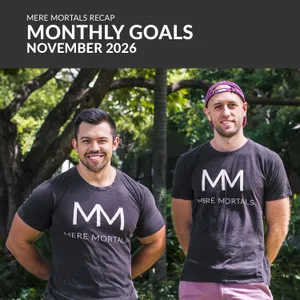
Monthly Goals | November 2026
In this monthly goals check-in, we reflected on October 2026 and mapped out what’s ahead for November. Juan shared a strong month of progress, ticking off all eight of his goals, including rebuilding his strength training, making recovery work more automatic, massively increasing content creation, and wrapping up his monthly review process. He also unpacked his Vanuatu trip with Jas and the girls, where the focus was less on sightseeing and more on slowing down, being present, and creating meaningful family memories through simple moments like pool time, beach games and long conversations without digital distractions. I also ran through my own October review, touching on getting out to a couple of events, learning more about teaching yoga, improving my systems for tracking kindness and habits, and continuing to refine my fitness despite a few setbacks. We then both shared our November goals, with Juan keeping momentum on his strength and recovery work while preparing for a new job, and me focusing on starting community yoga classes, improving calisthenics form, restarting Bitcoin-related admin, and beginning a new Moonbound podcast venture. It was a wide-ranging conversation on discipline, family, transitions, training, and building a smoother rhythm into the final stretch of the year. What do you do differently (and why?), reach out and let us know! Timeline: (00:00:00) Intro (00:00:10) October goals and a strong month overall (00:04:13) Vanuatu holiday and family moments with Jas (00:08:55) Kyrin reviews events, yoga and missed goals (00:19:36) November goals for training, family and robotics (00:29:09) Preparing for yoga teaching and community classes (00:34:49) Moonbound podcast idea and other November plans (00:39:31) AR glasses, fitness trade offs and training limits (00:50:14) Wrap up and next episode preview Connect with Mere Mortals: Website: https://www.meremortalspodcasts.com/ Discord: https://discord.gg/K99e8fysBn Twitter/X: https://twitter.com/meremortalspods Instagram: https://www.instagram.com/meremortalspodcasts/ TikTok: https://www.tiktok.com/@meremortalspodcasts Value 4 Value Support: V4V: https://www.meremortalspodcasts.com/support Paypal: https://www.paypal.com/paypalme/meremortalspodcast

50 MIN
NOV 4, 2026
You're Building a Better Life. Are You Actually Living It?
Are you building a better life or waiting until everything is finally sorted to start living it? After a month of family adventures, broken sleep, grief and unexpected stress, I went back through my daily journal and pulled out five practical life lessons about ambition, overwhelm, productivity and parenting. In this Mere Mortals episode, I unpack the October Codex: the reminders I'm taking into November, and the gap between understanding an idea and actually living by it. The five lessons: • Life is now: don't become so good at building a life that you forget to live it. • Good doesn't mean easy: a meaningful experience can still be uncomfortable. • Shrink the horizon: when everything feels too heavy, focus on the next useful action. • Systems should buy freedom: decide what your saved time is actually for. • Your reaction is the lesson: what you demonstrate matters, especially when your children are watching. These are personal reflections from an imperfect month, with ideas you can try in your own life. CHAPTERS 00:00 A full month: family, grief and broken sleep 00:59 The five lessons from October 01:39 Are you postponing your actual life? 04:42 Why good doesn't have to mean easy 07:16 Overwhelmed? Shrink the horizon 09:22 Are your systems giving you freedom? 11:43 Your reaction is the parenting lesson 14:35 Knowing the lessons vs living them Which lesson do you need most right now: living in the present, accepting difficulty, shrinking the horizon, protecting your freedom, or changing your reaction? Tell me why in the comments. Connect with Mere Mortals: Website: https://www.meremortalspodcasts.com/ Discord: https://discord.gg/jjfq9eGReU Twitter/X: https://twitter.com/meremortalspods Instagram: https://www.instagram.com/meremortalspodcasts/ Connect with Mere Mortals: Website: https://www.meremortalspodcasts.com/ Discord: https://discord.gg/K99e8fysBn Twitter/X: https://twitter.com/meremortalspods Instagram: https://www.instagram.com/meremortalspodcasts/ TikTok: https://www.tiktok.com/@meremortalspodcasts Value 4 Value Support: V4V: https://www.meremortalspodcasts.com/support Paypal: https://www.paypal.com/paypalme/meremortalspodcast

16 MIN
OCT 25, 2026
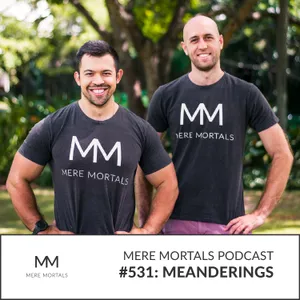
Modern Slavery For Modern Times | Debt & Ownership Of Humans
What constitutes a slave in the present day? In Episode #531 of Meanderings, Juan and I unpacked the idea of modern slavery. I reflected on some early ideas sparked by Debt: The First 5,000 Years, especially the link between debt, money and bondage. We explored how historical slavery was often justified through violence, while modern forms can be more hidden — showing up through debt arrangements, confiscated passports, exploitative labour systems and economic structures that ordinary people inherit without ever truly consenting to them. We also touched on examples like Argentina’s protests, inflation and the way national debt can feel like a burden passed down to citizens who never had a real say. From there, we wrestled with definitions: what actually counts as slavery, and what is better described as constraint, obligation or a reduction in freedom? That led us into a broader philosophical setup for a future episode — one that moves beyond humans and into animals, AI, robots and “uplifted” digital beings. If intelligence can be simulated, uploaded or expanded through technology, at what point do turning something off, restricting its choices or forcing it to serve start to look morally equivalent to slavery? This conversation sets the stage for a bigger follow-up on freedom, sentience and the ethics of control in a rapidly changing world. What are your thoughts on this, reach out and let us know! Timeline: (00:00:00) Intro (00:01:13) Debt, money and the roots of bondage (00:03:16) From war captives to debt based control (00:06:46) Argentina, the IMF and inherited national debt (00:10:02) What counts as slavery in the modern world (00:13:03) Passport seizure, trafficking and covert slavery (00:17:06) Work, freedom, consent and personal responsibility (00:21:21) Overt slavery versus hidden modern forms (00:26:33) AI agents, robots and the ethics of switching off (00:27:40) Uplifted beings, digital minds and simulation thought experiments (00:35:56) Preview of the next episode on machine slavery Connect with Mere Mortals: Website: https://www.meremortalspodcasts.com/ Discord: https://discord.gg/K99e8fysBn Twitter/X: https://twitter.com/meremortalspods Instagram: https://www.instagram.com/meremortalspodcasts/ TikTok: https://www.tiktok.com/@meremortalspodcasts Value 4 Value Support: V4V: https://www.meremortalspodcasts.com/support Paypal: https://www.paypal.com/paypalme/meremortalspodcast
36 MIN
OCT 18, 2026
Why Are We Building Robots That Look Like Us?
Why give a robot legs when wheels already work? Humanoid robots promise to fit the world we built for people. But walking, balancing and handling objects introduce engineering challenges—and someone has to pay for that complexity. In this October episode of Mere Mortals Robotics, I explore why companies build robots shaped like us, where simpler machines could make more sense, and which human features actually earn their place. We discuss: • Why human environments and demonstrations make humanoids appealing • Different approaches from Atlas, Digit and Figure • How carrying a load changes balance and centre of mass • Why reaching farther demands more torque • How small failure risks compound across a complete job • Cost per completed task versus the cost of adapting a building • Human preferences, the uncanny valley, privacy and trust • Why the next few years could favour a mixture of humanoids and arms on wheels This is an approachable exploration for curious people. I’m learning alongside you and working through the questions in plain English. CHAPTERS 00:00 Why humanoids? 01:11 Why copy the human body? 05:00 Atlas, Digit and Figure: different engineering bets 06:27 Fixed arms, wheels, quadrupeds and humanoids 08:10 Balance and the centre-of-mass problem 10:31 Reach, torque and power 11:52 Why long jobs compound failure risks 13:00 The economics of a completed task 14:06 A more complex robot—or a redesigned room? 15:40 Do people want human-looking robots? 16:36 Privacy, trust and responsibility 17:59 My outlook: a mixture of robot bodies 19:20 Which human features earn their place? Subscribe for more Mere Mortals Robotics: useful questions about machines, physical AI and the future of work. Which would you choose for your home: a humanoid, an arm on wheels, or several specialised robots? with Mere Mortals: Website: https://www.meremortalspodcasts.com/ Discord: https://discord.gg/jjfq9eGReU Twitter/X: https://twitter.com/meremortalspods Instagram: https://www.instagram.com/meremortalspodcasts/ Connect with Mere Mortals: Website: https://www.meremortalspodcasts.com/ Discord: https://discord.gg/K99e8fysBn Twitter/X: https://twitter.com/meremortalspods Instagram: https://www.instagram.com/meremortalspodcasts/ TikTok: https://www.tiktok.com/@meremortalspodcasts Value 4 Value Support: V4V: https://www.meremortalspodcasts.com/support Paypal: https://www.paypal.com/paypalme/meremortalspodcast
21 MIN
OCT 14, 2026
Get Stronger, Stay Calmer | 5 Life Lessons from My Monthly Codex
Building strength, staying calm under pressure and being present with the people I love. These are the ideas I’ve been working through over the past month or so. In this Mere Mortals Learnings episode, I share five lessons from my monthly notes and personal codex: developing physical and mental strength, bringing warmth home after difficult days, making creative habits small enough to repeat, appreciating ordinary family moments and taking action on what I can influence. There’s also a bonus observation about technology and the skills we lose when we stop practising them. These are lessons I’m putting into practice through training, parenting, relationships and creating Mere Mortals content. Which lesson connects with your life right now? Let me know in the comments. CHAPTERS 00:00 Monthly learnings and the personal codex 00:56 Bonus: skills fade without practice 01:39 Get strong, stay useful 03:54 Lift heavy, land soft 07:12 Make it small, make it happen 09:06 Ordinary today, irreplaceable tomorrow 11:31 Take the step, drop the loop 13:15 Turning reflections into a personal codex Subscribe to Mere Mortals for more conversations about practical philosophy, personal growth and living deliberately. Connect with Mere Mortals: Website: https://www.meremortalspodcasts.com/ Discord: https://discord.gg/jjfq9eGReU Twitter/X: https://twitter.com/meremortalspods Instagram: https://www.instagram.com/meremortalspodcasts/ Connect with Mere Mortals: Website: https://www.meremortalspodcasts.com/ Discord: https://discord.gg/K99e8fysBn Twitter/X: https://twitter.com/meremortalspods Instagram: https://www.instagram.com/meremortalspodcasts/ TikTok: https://www.tiktok.com/@meremortalspodcasts Value 4 Value Support: V4V: https://www.meremortalspodcasts.com/support Paypal: https://www.paypal.com/paypalme/meremortalspodcast
13 MIN