About the Rest

Joe Rodriguez

Details

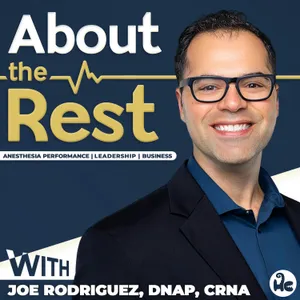
I'm Joe Rodriguez, CRNA. After co-hosting the podcast Anesthesia Deconstructed for years, I kept running into the same problem. I was told that if I stayed clinically excellent and kept my head down, the rest would take care of itself. If you're reading this, you know all too well… IT DOES NOT. Unfortunately, time and time again, I discovered that the most impactful tools to leverage throughout my career in anesthesia (e.g. money, influence, deal negotiations, power) are never taught to us in school or in practice. I had to pick it all up at dinners, off the record, wherever the valuable conversations take place but go unheard. Honestly, my issue with every other podcast in our field is that clinical teaching and polite leadership talk are…are a little boring. I figure if it bores me, it bores you. So then, where can we learn how groups do or don't make money? How do hospital deals get structured? Why do subsidies keep climbing? What separates a holding company from private equity? What does it take to build leadership that holds up under pressure? The list goes on. Which brings us here. I present to you the show I've been wanting to see and got tired waiting around for. About the Rest is a twice-monthly inside baseball podcast for the people who run things. Join me as I sit down with fellow anesthesia business leaders Randy Moore and other key voices from the field to take real positions and hash out the big questions, warts and all. If it's in the public record, it's on the table: announcements, policy changes, lawsuits, the big RFP nobody will explain, the conference moment everyone clocked. If you want to learn how to get into the OR, this isn't it. About the Rest is about, well, the rest! Learn More: www.abouttherest.com About the Rest is a Human Content Production

Recent Episodes

OCT 27, 2026
Anesthesia Business in 2026: AI and Group vs. Payer Trench Warfare
Anesthesia groups and payers have always fought over reimbursement. AI just changed the weapons. Joe Rodriguez sits down with Randy Moore of NorthStar Anesthesia and Gary Keeling of Coronis Health to break down the AI billing arms race, what a new BCBS study revealing $942 million in AI-driven billing means for premiums, and why insurers may not actually want perfect billing. They also cover the latest CRNA opt-out news, the state of independent dispute resolution (IDR) under the No Surprises Act, and the factor that quietly decides which anesthesia groups thrive: leadership and culture. Takeaways: AI is escalating the oldest fight in healthcare. Providers use AI to capture more revenue; payers are building AI to deny more claims. BCBS alone points to $942 million in AI-driven billing. Insurers may not want perfect billing. Errors create room for denials. Expect humans in the loop for a long time. Patients pay for the arms race. Higher billing costs to payers move into premiums. AI makes knowledge cheap. The premium shifts to people who frame the right questions and execute. IDR works, but it isn't free money. Fees, months of float, contract exposure, and payer pushback make execution the difference. Leadership decides which contracts survive. Site-level clinical leadership and culture matter more than most groups treat them. _____________ Want more Dr. Joe Rodriguez? Tik Tok: @jrodcrna21 Instagram: @jrod.crna & @abouttherestpod YouTube: @AboutTheRest Thanks for my co-hosts: Randy Moore (EVP & National Chief CRNA, NorthStar Anesthesia) Gary Keeling (VP of Anesthesia Services, Coronis RCM) To Learn More about Human Content Visit: ⁠⁠⁠http://www.human-content.com⁠⁠⁠ To Learn More about About The Rest Visit: www.abouttherest.com Got a Question? [email protected] Part of the Human Content Podcast Network Learn more about your ad choices. Visit megaphone.fm/adchoices

48 MIN
OCT 13, 2026
Office Hours: Anesthesia Stipends Rising: Are Anesthesiologists and CRNAs the Cause? Insourcing, GI Self-Dealing
Anesthesia stipends are rising, and the contract structure may be part of the cause. When a facility guarantees revenue, the anesthesia group has less reason to chase collections or negotiate payer contracts. Facilities respond by insourcing, and the cycle starts again. Joe Rodriguez answers listener questions in Part 2 of Office Hours. Stipends. Every anesthesia stipend is either flat or dynamic. The real question in any dynamic deal is who absorbs the risk. Joe explains why subsidies are the norm for the foreseeable future, and how revenue guarantees can quietly reward groups for doing less. Insourcing. In-house anesthesia was supposed to take over hospital systems. It mostly stalled. Joe breaks down the 20 to 30% cost gap between insourced and external anesthesia, and why every contract faces renewal risk on a 3 to 5 year cycle. His rule for groups: if you can't do it better than the hospital, there's no reason for you to exist. The company model. The busy GI center had zero anesthesia revenue while the subsidy got pushed onto the ortho center. Then came the question: who owns the billing company? Joe covers self-referral, the $66M Tenet settlement, and why "our lawyers approved it" is not protection. CRNA reimbursement. Why are commercial payers getting away with paying CRNAs 85%? There's no enforcement mechanism, the market has adjusted, and the fix likely requires a statutory change. Clinical site barriers. Are anesthesiologists blocking student training because of guidelines, or because of power? Joe's take is that it's a power flex. AI in anesthesia. AI won't replace anesthesiologists or CRNAs. It will split them. Judgment, execution, and accountability become the whole value proposition, and the 95% who coast fall behind the 5% who don't. Plus: why the follow-the-surgeon model is fading in the West, and why credible, in-person conversations are making a comeback. Takeaways: Every anesthesia stipend is either flat or dynamic. In a dynamic deal, the only question that matters is who absorbs the risk. Revenue guarantees can make anesthesia groups worse. When the facility fills every gap, collections and payer contracting stop mattering, and subsidies grow. Insourcing anesthesia stalled because success requires focus. A hospital running anesthesia is managing a business it doesn't specialize in, and the 20 to 30% cost gap shows it. Every anesthesia contract runs on a 3 to 5 year cycle. Groups lose contracts by getting comfortable, not by getting outbid. When a referring physician owns the anesthesia billing company, that's self-dealing. Legal sign-off doesn't protect you. Only a judge's ruling does. AI will split anesthesiologists and CRNAs into two groups. The few with judgment and accountability will pull further ahead, and the rest will fall behind. _____________ Want more Dr. Joe Rodriguez? Tik Tok: @jrodcrna21 Instagram: @jrod.crna & @abouttherestpod YouTube: @AboutTheRest Thanks for my co-hosts: Randy Moore (EVP & National Chief CRNA, NorthStar Anesthesia) Gary Keeling (VP of Anesthesia Services, Coronis RCM) To Learn More about Human Content Visit: ⁠⁠⁠http://www.human-content.com⁠⁠⁠ To Learn More about About The Rest Visit: www.abouttherest.com Got a Question? [email protected] Part of the Human Content Podcast Network Learn more about your ad choices. Visit megaphone.fm/adchoices

32 MIN
SEP 29, 2026
Office Hours: Peak CRNA Locums? Is MD Supervision a Convenience? 1099 vs W2, Hospital Execs Who Shrug
CRNA locums pay has been on a steep curve, and curves correct. The internet says 1099 vs W2 CRNA conversion is 50%. Real conversions land at 20 to 25%. And some CRNAs are supervised all week, then trusted to run solo every weekend. Host Joe Rodriguez, CRNA and anesthesia group co-founder, answers your questions in the first About the Rest Office Hours. Locums and new grads. Joe breaks down the three curves that set locum rates (education, locums, and anesthesia group economics) and explains why falling rates don't mean fatter margins for groups. He also makes the case that new grads going straight into locums are entering the most dangerous years of their careers alone. 1099 vs W2 CRNA. The real conversion range, the tax factor everyone misses, and why most CRNAs who go 1099 never go back. Supervision when convenient. A listener asks why the care team model flips from ACT to independent on nights and weekends. Joe explains the two bets behind it. Hospital contracts. Joe covers what happens when contract volume comes in 20% short and the hospital shrugs, and who should control anesthesia contracts. He also walks through how anesthesia RFPs are actually won: on the denominator, by small margins. Plus: the $40K-per-CRNA misclassification trap, and why Joe's own group nearly failed in 2021. Takeaways: Locum rates move on a curve, and curves correct. When the correction comes, anesthesia groups don't keep the difference: revenue guarantees cap their margin, and a competitor underbids at renewal. New grads need two to three years of mentorship, and locum work doesn't provide it. A locum assignment is built to fill a gap on the schedule, not to develop the clinician filling it. 1099 vs W2 CRNA comes down to conversion, tax savings, and risk. Conversion ranges from 16 to 35%. The bigger advantage is tax treatment, conservatively about 10% more of every dollar kept. The risk is misclassification, which has cost groups about $40K per CRNA. Supervision that disappears on nights and weekends reflects convenience, not acuity. The model bets that no one will check and no one will put the contract at risk. Anesthesia RFPs are won on the denominator. Everyone models payer mix and volume; the winner understands service requirements and labor cost, and the margin between winning and losing is small. Every group needs a mission beyond money and an operating margin to protect it. A mission without margin nearly failed in 2021. Change is how the mission survives. _____________ Want more Dr. Joe Rodriguez? Tik Tok: @jrodcrna21 Instagram: @jrod.crna & @abouttherestpod YouTube: @AboutTheRest Thanks for my co-hosts: Randy Moore (EVP & National Chief CRNA, NorthStar Anesthesia) Gary Keeling (VP of Anesthesia Services, Coronis RCM) To Learn More about Human Content Visit: ⁠⁠⁠http://www.human-content.com⁠⁠⁠ To Learn More about About The Rest Visit: www.abouttherest.com Got a Question? [email protected] Part of the Human Content Podcast Network Learn more about your ad choices. Visit megaphone.fm/adchoices
52 MIN
SEP 15, 2026
The CAA Certification Debacle, the Locums Bubble, and Why Anesthesia Groups Keep Losing Contracts. They Shouldn't.
20 exam windows invalidated. Roughly 150 graduates who thought they had a job in September now retaking a national certification exam. And a workforce gap between CRNAs and anesthesiologists that's up to 11,000 and accelerating. Joe Rodriguez sits down with Randy Moore and Tracy Young, three days into Tracy's term as president of his professional association. They don't agree on all of it. That's the point. The docket opens with the CAA certification crisis: what NCCAA found, why Tracy says the CRNA community shouldn't take a victory lap, and what it means for hospitals already stretched thin. From there, Randy walks through the supply and demand curves reshaping the locums market, Tracy lays out the data on the widening CRNA-anesthesiologist gap, and both agree a locums company bubble is forming, even if they disagree on the timeline. The sharpest moment of the episode: Randy makes the case that anesthesia groups have spent years selling themselves as a cost to minimize instead of an investment that drives OR volume, and argues that's the real reason contracts get lost. Plus: a difficult conversation about a real-world medication error making national headlines, handled from a systems and second-victim lens rather than a blame lens, and Joe closes with a personal reflection on what changes when you stop trying to win every argument. Takeaways: Test-bank leaks don't just fail an exam. They retroactively threaten seven years of certifications. Confidentiality isn't a control, it's a hope. Anesthesia supply is exploding on a delayed timeline. Cohort increases decided during COVID take three-plus years to hit the market. 2025's record graduate numbers are the first wave, not the peak. Pricing anesthesia is not a simple supply and demand exercise. Margins are sticky. Recruiting gets easier before rates ever move, and the real correction only lands when a hospital's actual costs force the renegotiation. Anesthesia groups lose contracts for one reason about 70% of the time: they can't cover the points of service. Cost is rarely the actual failure point, even though it's the stated one. Framing anesthesia as a cost to minimize instead of an investment that unlocks OR volume is the biggest strategic error facility partners make, and anesthesia groups reinforce it every time they lead with price. Power without discipline just wins arguments. Power used well finds the best answer and lets the argument go. _____________ Want more Dr. Joe Rodriguez? Tik Tok: @jrodcrna21 Instagram: @jrod.crna & @abouttherestpod YouTube: @AboutTheRest Thanks for my co-hosts: Randy Moore (EVP & National Chief CRNA, NorthStar Anesthesia) Gary Keeling (VP of Anesthesia Services, Coronis RCM) To Learn More about Human Content Visit: ⁠⁠⁠http://www.human-content.com⁠⁠⁠ To Learn More about About The Rest Visit: www.abouttherest.com Got a Question? [email protected] Part of the Human Content Podcast Network Learn more about your ad choices. Visit megaphone.fm/adchoices
58 MIN
SEP 1, 2026
USAP Paid Envision $9 Million to Stay Out of Dallas per FTC; Union Updates, Krewe Acquired
USAP allegedly paid a competitor $9 million to stay out of the Dallas market. A Texas teachers' pension system says it's paying twice the going rate for anesthesia because of it. Joe Rodriguez (Chief Growth Officer, Guide Anesthesia) is joined by Tracy Young (COO, Essential Anesthesia) and Gary Keeling (VP, Anesthesia Services at Coronis Health) to unpack the USAP consolidation fallout, why anesthesia pay works the way it does, and the debt mechanics behind CHG Healthcare's acquisition of Krewe Anesthesia. First: Representative Tom Oliverson's Houston Chronicle testimony and the Texas Teacher Retirement System's claim that USAP charges double the going rate, including the allegation that USAP paid Envision $9 million to stay out of the Dallas market entirely. Tracy makes the business case for what USAP did before making the ethics case against how they did it. Second: why anesthesiologists and CRNAs actually get paid what they get paid, and why "fair" isn't a market principle derived from your length of training. It's derived from what two parties subjectively determine. Third: CHG Healthcare's acquisition of Krewe Anesthesia, traced back through Leonard Green Partners and the collapse of Crozer Health. Tracy breaks down how debt-funded acquisitions work and why the model only survives as long as interest rates stay low. Plus: Joe's three-part fix for what's actually driving healthcare costs, and a listener question on practicing anesthesia in New York. Takeaways: Comparing anesthesia rates to "the market average" is meaningless. Most rates are too compressed to cover the actual cost of staffing anesthesia care. Anesthesiologists and CRNAs get paid what they get paid for one reason: that's what the market is willing to pay. Supply and demand, not sympathy or spin. Fairness is not a market principle, per se. Compensation is only ever what a buyer is willing to pay and a provider is willing to accept. Locums companies are becoming management companies because hospitals want one vendor to own the whole staffing headache, not five vendors to coordinate. Solving healthcare costs at the system level takes three things: real investment in public health, broad coverage delivered privately, and better use of the professionals already in the system. Want more Dr. Joe Rodriguez? Tik Tok: @jrodcrna21 Instagram: @jrod.crna & @abouttherestpod YouTube: @AboutTheRest Thanks for my co-hosts: Randy Moore (EVP & National Chief CRNA, NorthStar Anesthesia) Gary Keeling (VP of Anesthesia Services, Coronis RCM) To Learn More about Human Content Visit: ⁠⁠⁠http://www.human-content.com⁠⁠⁠ To Learn More about About The Rest Visit: www.abouttherest.com Got a Question? [email protected] Part of the Human Content Podcast Network Learn more about your ad choices. Visit megaphone.fm/adchoices
63 MIN