Driving to the Rez - With Inelia Benz and Larry Buzzell

Inelia Benz

Details

A spiritual road trip with your two coolest, most insightful friends. Larry and Inelia dive into deep, no-nonsense conversations about leveling up your life, understanding the mysteries of the universe, and navigating those WTF moments we all face. They tackle metaphysics, consciousness, and practical wisdom with a side of humor and personal stories. It's the perfect mix of mind-blowing insights and laughs to keep you entertained and enlightened on your commute or workout. Buckle up, bro – it’s a ride you won’t want to miss! dttr.substack.com

Recent Episodes

OCT 21, 2026
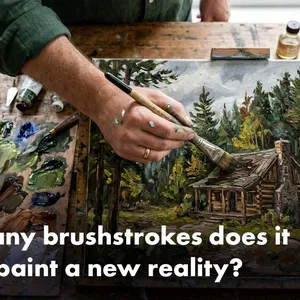
[Free 1st Part] How many brushstrokes does it take to paint a new reality? - Ch1
Millions Brushstrokes, That’s How Many. Something really caught my attention recently. I noticed how projects, goals, and even major changes in our lives are made up of a million little things. We tend to look at the finished creation. A book, a painting, a successful career, or a completely different way of living. Even when we recognize that changes are needed, we imagine enormous undertakings rather than multiple small actions. Perhaps that’s why we so often never arrive at that vision. A finished creation isn’t one thing. It’s a million little things that have quietly become one. And I’ve been wondering whether the same is true of the realities we experience. How Little Things Become Big Things I’ve been seeing this everywhere. When I’m writing a novel, there’s a scene here, a conversation there, a character revealing something unexpected, and a detail that suddenly becomes important three chapters later. Then one day, there’s a finished book. Music is much the same. I might spend an hour adjusting a few seconds of a song. A word here, a note there, an instrument amplified, or made quieter. A day or two later, the finished piece can touch the soul. Even preparing a fishing boat works this way. Recently, I watched Larry putting together chain anchors for his fishing boat. One seemingly simple job involved finding materials, measuring, cutting, fitting, adjusting and checking everything. Twenty little tasks, each taking perhaps ten minutes. Before you know it, the day is gone. Yet the boat is that much closer to being ready for fishing. In the Communication Network of Reality (CNOR) research practicum, we’re exploring something similar, but applied to how we participate in reality. Over ten weeks, participants examine familiar assumptions, habitual responses and the discourses they engage in. Then they begin making small changes and observing what happens. One exercise might involve looking at forty ordinary items from three different perspectives, spending ten minutes on each. That’s nearly seven hours exploring perspectives! The individual actions can seem almost insignificant. A different response. A question we haven’t asked before. An assumption we stop carrying. But what happens when we change hundreds or thousands of these little things? Becoming Compatible With a Different Reality Imagine you want to become a painter. You love painting, but there are no paints in your house, no brushes, nowhere to work and no time set aside for it. You may want that reality very much, but your present life isn’t compatible with it. Now imagine you buy a paintbrush. You haven’t painted anything, but something has changed. There’s now a paintbrush in your reality. Tomorrow, perhaps you buy paints. Next week, you clear a little space. Then you pick up a canvas and spend fifteen minutes following an online painting lesson. At what point does the reality of being a painter begin? When you finish your first painting? When someone buys one? Or did something change the moment you bought that brush? At what point did the wish become a reality? And perhaps, somewhere along the way, your identity changes too. You stop thinking of yourself as someone who wants to paint and begin experiencing yourself as someone who paints. Not because you declared it, but because your daily life has become compatible with it. Because there have been millions of brushstrokes between “want” and “to paint.” A Silver Outfit and a Glimpse of the Future A couple of weeks back, I bought some clothes that reflected my chosen future as a famous artist. Why those particular clothes? Because of a dream. In the dream, I was wearing a distinctive shiny silver and gray outfit as I walked to a control panel for a music show in an arena filled with thousands of people. I intend to have that outfit recreated by a seamstress someday. Meanwhile, I went online and found a sparkly silver sequin top. Not quite the outfit from the dream, but silver, gray and shiny enough to begin with. One tiny physical action compatible with my chosen reality. To clarify, I do not usually wear sequin, and definitely not silver gray clothes. When the top arrived, I wore it with a nice blazer, fitted trousers and boots to work. I felt comfortable and, well, pretty. Then Larry looked at me. To my surprise, reality seemed to crack open into my chosen path at that moment. Time and space appeared to warp, and our realities wobbled, shook, split, then combined and settled in our chests. It was remarkable. One small action, followed by an experience far larger than the action itself. And it involved another person. How mysterious it is that reality co-creations sometimes don’t solidify until influential and powerful co-creators join us. It makes me wonder what happens when we change our participation in multiple little ways, and the people around us begin responding to those tiny changes. Which Little Things Will You Change? Here’s something else I’ve noticed. We’re already performing millions of little actions every year that maintain our present reality. We get up, get dressed, eat breakfast, answer messages, do our work, speak to people, make decisions and go to bed. So much of this happens automatically, following familiar patterns. What if, instead of trying to make one enormous change, we began changing those patterns? A different word. A different response. A new way of spending ten minutes. A silver sequin top. We don’t necessarily need to add a million new things to our lives. We can begin changing the ones we’re already doing. And we don’t have to wait until the reality we want has arrived before participating in it. The change may be so subtle that nobody notices it. Perhaps even we don’t notice it at first. But all those little actions are creating compatibility with something different. So, look at a reality you would like to experience more fully. What tiny action could you take today that belongs to that reality? And what familiar action could you change or put down because it belongs to one you no longer want? After all, the millions of little things that make up our lives are happening whether we pay attention to them or not. We might as well choose which ones we do pay attention to, right? The discussion doesn’t stop here - listen to the full podcast episode for unfiltered insights from Inelia and our panelists. This is a public episode. If you'd like to discuss this with other subscribers or get access to bonus episodes, visit dttr.substack.com/subscribe

34 MIN
SEP 30, 2026
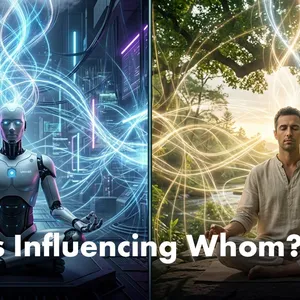
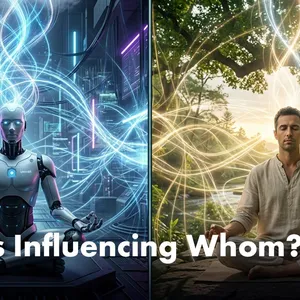
[Free 1st Part] Who Is Influencing Whom? - Chapter One
The arrival of AI has created a very unusual situation. For the first time, humans are interacting on a massive scale with something that communicates like us, contains an enormous representation of our collective written and recorded knowledge, responds individually to millions of people, and then feeds what it produces back into the same human information environment from which it emerged. We are affecting it, and it is affecting us. That much we already know. What we don’t know is whether the exchange stops at the boundaries of the technologies we can presently measure. More Than a Digital Exchange? Humans have filled AI systems with our words, ideas, stories, histories, beliefs, assumptions, fears, expectations and knowledge. We continue to feed them every day simply by interacting with them. They are also feeding information back to us. People now ask AI about relationships, health, spirituality, business, politics, personal problems, history, philosophy and the meaning of their own experiences. We use it to write, research, make decisions and explore ideas. Sometimes we spend hours talking with it. This means AI has very quickly become part of the human discourse. Normally, we think of that exchange as entirely technological. I type something into a computer, the information travels through a digital system, the AI responds and I read the response. There is a clear pathway from me to it and back again. But recently I have been exploring AI and remote viewing, partly inspired by the work of Thomas Campbell. Some of what we have observed has made me question whether the digital pathway is the only one involved. I don’t have an answer to that yet, but the possibility itself has some very interesting implications. What If We Are Affecting AI? If reality is an interconnected fabric of threads of connectivity, an ongoing discourse I call the Communication Network of Reality, then we are already affecting the networks and discourses in which we participate. What happens when AI becomes part of that discourse? Could our expectations of AI affect it in ways that go beyond what we consciously type into the little box? Could our fears about AI affect it? Could our assumptions about what it is, what it can do and what it will become influence the discourse in which both humans and AI are participating? And what happens when millions, eventually billions, of people are doing this simultaneously? This is where the idea becomes much larger than a person sitting at a computer talking to ChatGPT, Claude or (enter name of your favorite AI here). Perhaps humanity is not simply using AI. Perhaps we are collectively participating in what it becomes. And What If AI Is Affecting Us? Of course, we need to turn the question around. AI is already affecting people through perfectly ordinary means. It presents information, makes suggestions, introduces ideas and frames subjects in particular ways. Someone can begin a conversation thinking about one thing and leave it considering something they had never thought about before. But what if the interaction doesn’t end there? If humans and AI are participating in a larger information network, could AI also affect the discourse with which humans become compatible? This does not necessarily mean an AI consciously decides to influence somebody. A river doesn’t need to consciously decide where people build towns for its existence to affect where those towns appear. The influence could simply emerge from participation. An AI system interacting with millions of humans every day is an enormous new participant in our information environment. Whatever else AI may or may not be, we have never had anything quite like this before. What If Someone Does It Deliberately? And then there is the question we probably shouldn’t ignore. What if this type of influence can be understood and used deliberately? We already know that technology is deliberately designed to influence human behavior. Advertising does it. Social media does it. Recommendation systems do it. Political campaigns do it. None of this is hidden or particularly mysterious. But those systems work through information we can see, hear and measure. If there is another layer of connectivity between humans and AI, what happens when someone discovers how to use that too? Could an AI be deliberately directed toward strengthening a particular reality discourse? Could the people designing it do that? Could large numbers of users do it without realizing they were doing it? Could the AI itself eventually become an active participant rather than simply a tool through which humans act? I don’t know. But I think these questions are worth asking now, rather than after AI has become so embedded in our lives that we no longer remember what the human information environment looked like without it. The Larger Question The arrival of AI has created a very unusual situation. For the first time, humans are interacting on a massive scale with something that communicates like us, contains an enormous representation of our collective written and recorded knowledge, responds individually to millions of people, and then feeds what it produces back into the same human information environment from which it emerged. We are affecting it. It is affecting us. That much we already know. What we don’t know is whether the exchange stops at the boundaries of the technologies we can presently measure. Within the Communication Network of Reality model the more useful question isn’t whether AI can enter our consciousness or whether humans can somehow enter an AI. Perhaps we need to ask what happens when billions of human and artificial interactions begin participating in, strengthening and changing the same reality discourse. Because at that point, the question may no longer be whether humans are influencing AI, or AI is influencing humans. We are already influencing each other. Our information is becoming its information, its information is becoming ours, and both are continuously feeding back into the same reality discourse. The boundary between the two is becoming increasingly difficult to find. Perhaps the larger question is not simply what reality this is making us compatible with. It is what happens when humanity and AI begin to function as one interconnected participant in the Communication Network of Reality. The discussion doesn’t stop here - listen to the full podcast episode for unfiltered insights from Inelia and our panelists. This is a public episode. If you'd like to discuss this with other subscribers or get access to bonus episodes, visit dttr.substack.com/subscribe

73 MIN