: lower black pain.

Jd Michaels - The CabsEverywhere Creative Production House

Details

Life’s lemons into rich, dark chocolate. lowerblackpain.substack.com

Recent Episodes

OCT 15, 2026
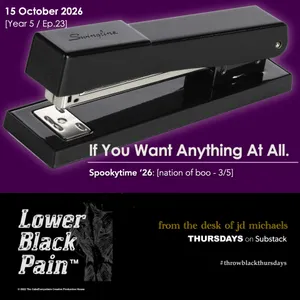
If You Want Anything At All.
I’ve had, according to my resume, 8 jobs. I’ve had a few more than that: some not worth mentioning and a few I really don’t need to remember. But the major ones, the places where I stayed for years and years - those have been pretty interesting because I entered those companies as one thing and left as another. I came in to the first one as a secretary, and four years later left as a “mechanical artist”. Five years at the next place and I was a “creative studio manager”. Then after 16 (yikes) years at another I was an “EVP Director”. There were a lot of other esoteric titles in the middle of all those. Most of my career mobility has centered on my enthusiasm toward doing stuff that nobody else wanted to. Need somebody to wash the dishes? / calm nervous people down? / fix a toilet? / make a meal for eight people with five dollars? / work past midnight finishing the report? Look no further. This tendency toward utility proved extremely useful in corporate situations. I was identified as a “work horse”, a boss told the clients I was a “swiss army knife”, and one manager described me as “an Ameri-can, not an American’t”. None of these sound great. I don’t think there’s any MasterClass about being the one who cleans up, voluntarily, after company parties. But I never minded the “American” thing: after all, America is not afraid of a little hard work. My key business assets: Endurance: I was raised to persevere - toil proudly, not stop until the job was done. On my very first day at a big job in New York City, the manager showing me around took me to my cube and told me to bring a sleeping bag. I thought it was a joke until I noticed that most of the other employees did have one stashed beneath their desks. My record at that place was a 33 hour shift. I was 27 years old. I started out strong at 9AM, didn’t even hit the caffeine until about two in the morning, then when the sun rose it re-invigorated us all for a while - some breakfast and lunch kept me going until about 4, but then I realized that I was no longer tired yet no longer awake in any traditional sense, so I tapped out and headed home. And no, there was no overtime involved - this was just…work. One person went for 47 hours, though I think she took some naps. Adaptability: I have a particular knack for taking not-so-useful things and putting them together to make a much more useful one. More than once this enabled me to come up with solutions that could never be bought, only made. Duct tape was sometimes involved. Also, I became the ad-hoc bartender at college parties because I could mix relatively obscure liquids together into something potable. Appreciation: Other people needed things like comfortable work chairs or bathroom breaks or respect - I found that I could exist on the much the simpler diet of purpose and paycheck. As the hoi polloi business tripped and expense accounted, I’d be trading quips over microwave popcorn with my team while we built something cool. We all really liked making things and enjoyed one another’s company - we’d bring our kids (and pets) in, celebrate holidays with hats and food and original songs (my contribution), and had a pretty good time for a grown-up type corporate office situation. Hey, I knew what was really important…they could keep the fancy chair. I didn’t have anything that fancy to put on it anyway. There was one business lesson that I was taught twice. I’ve always ignored it, because I do not agree with its basic premise, even if it’s true. The more robust version of this strategy was its second telling: a manager was walking past as I stood by the printers; he asked how I was doing. “I’m good! Busy, but good!” I thought this a fine comment to say to your boss. “Yeah, I wanted to talk to you about that… you always seem to have a lot to do.” “Well, yeah,” I replied, “there’s a lot of things I’m trying to make happen.” “Yeah…” He looked around to see if anyone was listening. “Yeah, you’re working too hard.” I thought that was an odd comment to hear from your boss. “Am I?” I asked. “Yeah. Listen, if you’re ever gonna be a manager or something you need to learn how to handle problems.” I enthusiastically launched into a list of solutions I’d come up with to recent workflow challenges. “No, no. See? That’s what I’m talking about.” he said. “You solved all those problems.” “Was that not you said?” “No,” he explained, “I said handle a problem. Look at this.” He picked up a nearby stapler. “This is a problem, right?” He began passing it from hand to hand. “What am I doing now?” “Juggling?” “No, I’m handling the problem. First it’s here…” It was in his right hand.“… and now it’s here.” It was in his left. “I can’t pick up anything else because I got this. But if I put it down…” He put it down, “…now I’m not doing anything.” Ok. “Ok...?” “See, I choose a problem, and I handle it for maybe like, six months, and then I solve it, and then pick up another problem. Everyone knows I’m busy because I’ve got this thing I’m doing. You have, like, seven staplers a month over there. People don’t move that fast. Business doesn’t work that way. You’ve gotta to slow down… handle one problem at a time… you get it?” Sure, I got it, what’s not to get, but it’s always been harder for me not to do things than to do things. I was trained to make things better, even when it wasn’t necessarily my job, and if that makes me some kind of stapler juggler, then fine. Though I don’t know where I’d put that on my resume. Maybe down next to “telephone psychic”. Get full access to :lowerblackpain at lowerblackpain.substack.com/subscribe
6 MIN
OCT 8, 2026
Say What You Mean And Say It Mean.
For over half of her four decade career, my mother taught fifth grade. A span of that length allows one to view societal trends and social constructs in detail: one class morphing into the next, bringing new behaviors, pressures, and responses. The perfect in-situ scientific laboratory to observe these shifts and changes was open every day - the playground. She shared an observation that early on, a few of the saltier children would insult each other during recess. “Your Mama…” the jibes would start with, or something similar, leading to a bout of impromptu oneupmanship… …but as reading and writing became less important to the school district, a different exchange would occur - one child would begin with the customary opening remark, and then the other would punch them. Often very hard. The addition of physical violence brought this tradition to an abrupt close, and while no fan of rudeness or impropriety, my mother expressed that this made her a bit sad, as the talking did hold a bit of creative integrity. But some children were no longer trained in that kind of thing, and a true battle of wits requires that both combatants are well armed. As her son, I was never allowed to insult or hit anybody. The only time I tried was on a bus trip back from a high school vocal contest, where a class bully called me names related to the size of my forehead. That gave him, no pun intended, a lot of ground to cover, and my reticence to engage with him intensified his attacks. Until I did engage with him, offering a slightly off-color response clever enough that the entire bus went “Ooooooooooo!”. I knew I was going to get it the second I left the bus, and sure enough when I stepped off the stairs he was waiting, hand outstretched to shake mine. When I reached for his hand, he sucker-punched me in the stomach. Another “Ooooooooooo!” from the crowd. But because I was a magician, I had long studied Houdini’s method of training abdomen muscles to rock hard consistency. Also, I was 15. The boy’s fist met a (then) immovable mass, and he shook his hand in pain. I slowly walked away, wincing only inwardly, enjoying what I knew would be the only time that being a magician would be high-school-cool. America is not afraid to speak its mind. Clarity isn’t a… hard rule, really: ours is a language of intent, rather than transparency. Take for instance the example of a woman, smiling, nattily dressed, superbly coiffed, smelling of lilacs or vanilla, just after Sunday service and before the football game, looking you directly in the eye and saying the most spine chilling phrase in the English language (as it spoken by Americans): “Well, Bless Your Heart!” We all know what that means. It does not mean what it says. It is not pronounced the way that it is spelled, as it is neither a religious well-wish nor a genuine concern as to one’s cardiac welfare. It is a direct statement where individually none of the words hold their traditional definition, yet in combination they create a new communication, where a direct insult - in most cultures expressed in two words - is somehow sharpened and thrust deeper into the belly by using four. There is no response. The dialogue preceding the comment has now ended, with whomever is on the receiving end of the statement is left to painfully grimace, and take an extremely slow / extremely deep breath through their nose. Or punch the person very hard, which almost never happens probably. It’s understood here that the words are the punch, with the punch-ee left to get in their car and screamily complain about whoever said this to them on the ride home. “How dare they!” we might say, but we know the answer to that: America is not afraid to speak its mind. However, the worm turns, what goes around comes around, and Americans do not enjoy revenge. We’re not “a dish served cold” culture - much more a kingdom of steam tables and hot wings. Suspense is unbearable here in any form… watch: Shave and a haircut… ten… … … … … … … … … cents. Horrible. Absolutely. I do apologize. But think of waiting for an insult to be returned - expecting a snappy remark or harsh look and only getting open kind handshakes and grins week after week. Terrifying. Each meeting without response increases the tension - then come the sleepless nights spent wondering when it might occur, knowing full well that a response is as inevitable as it is deserved. Yeah. America doesn’t like that. My personal favorite American insult is “You speak so well!”. It was first said to me when I was about eight - I gave a speech at a school function and afterward a very fancy woman came up to my mother and I. “Goodness!” she effused, “You speak so well!”. Then she looked at my mother, “It’s just so wonderful to see that!” I stood a little taller and said “Thank you!” enthusiastically, but my mom didn’t respond, but bristled. She is not an easy bristler. “That wasn’t a compliment.” she said later in the car. “But the lady said I did a good job!” “No she didn’t. That wasn’t what she meant by that. She meant that she was surprised one of us could speak proper English.” I was confused. “But you always make me speak proper English. You’re a teacher.” “I know that,” Mom said, “but she didn’t.” She turned to me at a stop light. “You did a good job, and she did acknowledge that by what she said… it’s not the good job that’s the problem, it’s the SURPRISE. She underestimated you when you stood up to speak because of what you looked like. She complimented you not for what you did, but for not being what she assumed you were.” “Aw.” I was disappointed. “Don’t be disappointed,” she said, “you did wonderfully well. You just keep on doing well for you, not for other people’s compliments. And if you want an honest opinion, you can just always ask me or Grandpa. We’ll tell you the truth, good or bad.” And they did, which was great because I solicited a steady chorus of “speak so well”s in my youth, and far after. Let’s see: I’ve been “one of the good ones” and “just like us” and “you know…different” and “very unique” and “just, special”, and in each case the circumstance, tone, and casting made clear what was meant atop what was being said… sometimes they’d double down and ask me about “the other ones”… you know, just to bond. But I never lashed back, never punched anybody (good heavens no)… just smiled and nodded and took slow, deep breaths through my nose. Though, on the exhale, I may have thought to myself, “Well, now… … … … …bless your heart.” Get full access to :lowerblackpain at lowerblackpain.substack.com/subscribe

7 MIN
OCT 1, 2026
Oh, Boo-tiful.
There are only two commercials for underarm deodorant. In the first, someone wearing a white shirt runs after a taxi, pushes their kid on a playground swing, or performs any other action requiring brisk movement: at the end they enthusiastically wave with their hand high in the air and give someone a tight hug. All is bliss. In the other, someone gets on a full elevator and when they raise their hand to push the button for their floor everyone faints. Confidence or Fear. A super legendary advertising person told me that these are the only two ways to speak to America. Both work incredibly well, changing behavior, motivating millions… …but fear works faster. America is not afraid, at least not enough for our own taste; thus theme parks filled with thrill rides, video games filled with peril, and movies filled with increasingly awful situations. And now it’s Spookytime™: over 1200 live haunted house attractions open this weekend, and well over 2000 Spirit Halloween™ stores opened last month. Fear, in the US, is a growing three billion dollar a year business, and it’s a truly American trend - data proves that there is no where else on planet Earth that so enjoys a good scare as the U.S. of A. America is not afraid, but it certainly enjoys pretending to be. Modern media is now a 24 hour panic machine: I know I should be terrified of, well, everything, but it all kind of blends together, like the Best Buy television display wall where they’re all playing something different so I can’t really see or hear anything. Fear is more powerful with a clear focus - a giant screen in a dark room so large that I can’t look away, or a roller coaster where I’m strapped in for the ride. It’s fun to be afraid of just one thing at a time. But for some of us fear is an indulgence, a luxury. Being forced to navigate through terrifying situations everyday creates a kind of burnout as years wear on. That’s what happened to me: fear cost too much energy, took too much to sustain, I couldn’t afford it, even if I bought generic. I mean, I understood that “they” (whomever they were) were coming to get me (for some reason or another) but there were just so many characters and the plot was so complicated that I admit I zoned out a little and now I’m not really watching that show anymore. I imagine the same is true for everyone whose life doesn’t fit vertically into a TikTok screen, behind them a background of spacious modern suburban living with little on the eggshell walls and plenty of floorspace for dancing. Years of consistent fear of walking home at night or random acts of an angry stranger (or an angry person we already know) wear us down and sort of short circuit our systems. With limited free time, I don’t normally choose to add stressful entertainment to the mix, but in honor of the season we’re picking out spooky movies to watch. The scary films I grew up with were all man vs. nature - natural disasters (in Sensurround™), giant insects and rodents, stuff like that. Then in the 80’s, horror conflicts shifted to man vs. man: normal folks against either the possessed, sociopathic, or murderously cranky. Now the films seem more focused on man vs. self: wide eyed protagonists battling isolation or loneliness or encroaching madness. Or even more spooky are the films where someone is forced to make a difficult decision between horrible choices and then is forced to live with the consequences. You know: adulting. Eeesh. Terrifying. America is not afraid of monsters. We’ve got guns. Americans aren’t afraid of giant monsters either. We have bigger guns. Godzilla wouldn’t last very long in central Texas. I find it strange that our zeitgeist hasn’t embraced “Frankenstein” considering modern AI is its real-life re-telling - or the insatiable thirst of the Vampire, which so tidily mirrors corporate avarice. Werewolves and ghosts and creatures? Not in this country, buddy. We’re not afraid of those. But zombies are huge in America, which is weird because they are made of us; they are our neighbors and colleagues and community members, just super hungry and not all that chatty. And babysitters, housekeepers, and nannys, both human and robotic, are the ultimate bad guys in dozens of American horror films. Huh. Go figure. Get full access to :lowerblackpain at lowerblackpain.substack.com/subscribe

4 MIN
SEP 24, 2026
autumnatic.
Calendars were not invented on “day 1”. That’s what I thought as a kid - that if you wanted to know how old “calendars” were, you just counted backward from, well, now until you were back at 1. Then I remembered about all that “B.C.” time, and then… I just looked it up. The Gregorian Calendar, which we purchase each year on sale in mid-January in the Barnes and Noble bargain section, was created in 1582. The Julian calendar that it replaced had begun in 45 B.C., and there is apparently a calendar in Africa from 8000 B.C.. Calendars are great, but they bother me. The human race celebrates specific holidays because of where they are on the calendar, not in alignment with the sun or the stars anymore. Our birthdays mark the beginning of our personal year. Thanksgiving is celebrated the third Thursday in November. Easter is a bit more organic, as it’s the first Sunday after the Spring Equinox, a specific scientific circumstance (once I did the experiment where you balance an egg on its end EXACTLY at the moment of the Spring Equinox - it stayed there for 90 seconds and then fell over - couldn’t get it to do it again - science is cool). So calendars define days, but do not dictate the seasons. I think this includes the Holiday seasons, as they are not tied to the calendar - “Christmastime” used to begin the day after Thanksgiving, or the moment that Santa waved from his sleigh in the Macy’s Parade, but is now shifting steadily backward - last year the first Netflix holiday princess movie was released well before Thanksgiving, though I was expressly forbidden by my daughter to watch it until the appropriate time. Folks are open to begin their Christmastime whenever they choose - defined by stores being decorated, holiday music being played on the radio, or Hans Gruber plummeting from Nakatomi Plaza. But we’re not quite there yet. Our first stop is Autumn (keeper of Spookytime™), which for me always begins with a mystery. Fall officially starts on the Autumn Equinox, but we all recognize that cinnamon, clove, nutmeg, ginger, and mace define summer’s end. “Pumpkin spice lattes” were introduced in 2003: those smart enough to invest in the odd new trend probably profited like crypto bandits, as millions of folks enthusiastically associated it with the shift of seasons. But similar to Christmastime, the official date that Pumpkin Spice Everything is introduced each year keeps getting pushed earlier and earlier, moving from mid-September back to mid-August. I mean, who doesn’t enjoy a gourd-based beverage, but I choose not to recognize this indicator. Autumn is my favorite season. I was born in Autumn. I love the Autumn weather. I’ve always looked best in sweaters, which have subtlety bulked up my scrawny “Steve Rogers Before The Super Serum” frame, annually allowing me well defined (although pillowy soft) shoulders. Autumn means a lot to me, and cannot be defined by corporate trend. I truly love the season, and the best part is, I never know exactly when it’s going to get here. …there’s a day every year when the wind changesthe humidity dissipates entirelyreplaced by this wonderful snap in the air an exhale is not yet visiblebut inhaling becomes fresh and the smell of leaves and the sound of them all on the streetssomehow insulates cars passing by this is my beginning of Autumn and once THIS mysterious day happens afternoons don’t warm up anymoreso you really need that extra layer of clothesand you’re very glad you remembered your hatand to be honest you could actually appreciate a nice hot beverage in a paper cup with a derivative of your name written on it that day is the perfect timefor a nice, hot cup of coffee embellished with the flavor of a seasonal gourd. Get full access to :lowerblackpain at lowerblackpain.substack.com/subscribe
4 MIN
SEP 17, 2026
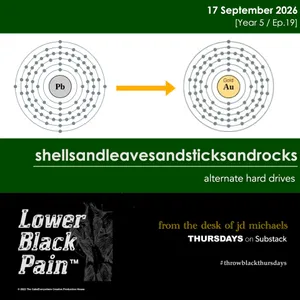
shellsandleavesandsticksandrocks
Spring Cleaning: the opening of windows and freshening of linens and dusting off of bookshelves and vacuuming in the corners of ceilings, an annual frenzy of “getting ready” for the longer and warmer days of the year - which ironically are most frequently spent outside. ’Tis the season for that kind of thing in New Zealand right now, where Winter is just ending, which is odd (also, the water there twirls down their drains counter-clockwise? Utter madness.). But in our Northern Hemisphere it is time for Fall Cleaning, a necessary re-negotiation with living spaces many months neglected, passed over for picnics and hikes and visits to other people’s living spaces. O, but winter is coming, and the time has arrived to store away our short pants and prepare for when that throw blanket on the couch (which serves as decoration the rest of the year) at last becomes a treasured necessity. We are deep in the throes of Fall Cleaning at our home, along with our preliminary decorating for Spookytime™, which the family has agreed is not quite here yet but just around the corner - that corner, there, at the end of that long and dark alley, just a few steps beyond the dimly flickering street lamp. Fall Cleaning is always a bit of a refocus. We store away objects of leisure and comfort to make room for more items of practicality and utility, trading long sleeves for short sleeves, sweaters for swimsuits, and in our case cleaning up the various random items we’ve collected over the summer. For instance, I’ve been banned from ever purchasing those popsicle molds from Whole Foods once we found three layers of their various plastic pieces at the bottom of a drawer. To make things worse we found seven random regular popsicles hiding the back of the freezer. We're not even really a “popsicle family”, if there is such a thing. So all that had to go. We end up collecting a great deal of nature in the summer. Sticks. Rocks. Leaves. We’ve gone for a walk and seen something interesting and brought it home to share. Maybe we had a really great conversation on that walk, and that little stick represents it, or the sky was an incredible blue holding unbelievable clouds through which the sun shone on this particular rock on the shore of the lake. So we brought it home, like a photo we didn’t choose to take, but instead stored the moment in wood or mineral form instead of film or digital space. Trouble is, by the end of summer some of those sticks are just sticks again, since we can’t remember quite exactly where or when we found it. The meaning of these objects depends only on their time interacting with us. Random memories triggered by random objects hold varied permanence. We end up with a lot of that stuff by the end of the summer, and not just natural items, but tiny plastic models of frogs making oil paintings and collectible ICEE™ cups and kawaii hair clips. After we go through the house collecting them all, we place each item on the dinner table for analysis - if we no longer can remember its story, then we no longer keep it. There are other categories of summertime detritus (Books We Intended To Read, T-Shirts less Comfortable than Threadbare, Interesting Soda Cans): it takes about a weekend or two to pull everything together and reset the apartment. Then, of course, we cover the entire place with pumpkins and black cats and skeletons for the next month or so. In pursuit of even more extra space, I decided to clean the closet in our little office room, the one that hasn’t been re-negotiated since we moved into the apartment over eight years ago. There I found plastic bins containing precious oddities, including train tickets, foreign receipts and coins, dried rose petals, a glass fountain pen and a vintage yo-yo. Every one with a story (not that I actually remembered them all). I also discovered box after box of Old Writing, some of it from ten years ago. Then I found pages from twenty, thirty, forty, and even fifty years ago. Now technically, all this is just trash - either the ideas aren’t finished or the stories are dated. It’s just paper that matters to absolutely nobody else on the planet. Ream after ream of 90’s prose with 80’s plots and characters: certainly this can all be recycled and made into new notebooks for someone else to take their narrative shot. But I couldn’t just throw them all away. A few of the ideas weren’t that bad, and some stories had been in my head for so long that it was comforting to see how much work had been put into them - inspired me to even polish a few, if only to see them finished. And it was here, in this great pile of potential art, that I realized my Third Act goal: ALCHEMY. I don’t want to dwell in What Was, but I don’t want to just burn it like garbage. Instead, I’d like to upcycle the past, re-use and combine my previous art and experience to create something new. You see, if I can just make something good, and I mean REALLY good, then all these random papers would be transformed into museum worthy historical artifacts, like lead into gold. Each curious page would be a piece of the puzzle of my artistic journey, as we watch the young man from Kansas evolve into a unique talent reminiscent of a young Norman Lear. Or maybe, Aaron Spelling. It’s a good goal. And this year the Large Hadron Collider particle accelerator actually did make gold from lead (for a few milliseconds), proving that after centuries of attempts, alchemy is now possible, if not practical. That is scientific evidence in support of the longest of long shots. So, y’know… it could happen. Get full access to :lowerblackpain at lowerblackpain.substack.com/subscribe

6 MIN