Women Disrupting Tech

Dirkjan Hupkes

Details

Women Disrupting Tech features female founders, tech leaders, and women in tech building the next generation of technology companies. Each week, host Dirkjan Hupkes talks with a founder about how she's scaling a startup, navigating funding, building resilient teams, and tackling challenges from AI ethics to healthcare innovation to climate tech. Whether you're a female tech entrepreneur, aspiring founder, startup leader, or advocate for more women in technology, this show gives you actionable strategies and proven frameworks from women reshaping tech. New episodes every Thursday.

Recent Episodes

OCT 29, 2026
Building Emotion AI for Better Conferences with Vanessa Williams Saleh
Only 20 to 30% of event surveys get filled out. So how do organizers find out what landed with the audience? In this episode of Women Disrupting Tech, I talk with Vanessa Williams Saleh, founder of Attenlyx, who led global event strategy across 36 countries at Mars. We explore how she turned 12 years in event strategy into event technology that reads audience response with Emotion AI, and why AI built for different cultures and skin tones needs its own framework for each market. This episode is for female founders, women in tech and women in leadership building or buying technology for live events, and for event organizers and sponsors who want evidence of what their events achieve. What you'll learn in this episode: Why post-event surveys leave leaders guessing, from low response rates to vanity metrics How Attenlyx matches audience response to the speaker almost second by second and reports within 48 hours Why a model built on someone else's dataset showed low confidence, and why Attenlyx works with psychologists and regional specialists How emotional expression differs between West African and East African audiences with the same skin tone What organizers changed with the data, from panels of three to four speakers to shorter sessions Why an education-first sales process fits a new category such as Emotion AI Chapters: 00:00 Introduction 02:00 How Attenlyx grew out of event strategy 04:25 Why leaders ask what landed after events 06:28 AI leadership and event strategy at Mars 09:26 Why event feedback surveys get low response 14:57 Why event organizers stay stuck on ROI 17:39 Event technology that measures audience response 23:02 Emotion AI across cultures and skin tones 28:34 Which conference formats Attenlyx serves best 29:39 Why entertainment events are a harder fit 31:47 How event engagement shifts across a day 33:47 Benchmarking conferences across multiple markets 35:30 How many speakers belong on a panel 36:38 Audience fatigue, lunch timing and room temperature 38:05 Why an event strategist became a founder 40:21 Why events need evidence to be funded 44:04 Accelerators for a non-technical founder 47:52 Positioning as an expert in the room 53:42 Giving Gen Z and girls access 56:46 AI funding coach for female founders Show notes: Blog: https://womendisruptingtech.blog/2026/10/29/episode-174/ Substack: https://womendisruptingtech.substack.com/p/episode-175 Connect with Vanessa Williams Saleh and Attenlyx: LinkedIn (Vanessa): https://www.linkedin.com/in/vanessaowilliams/ LinkedIn (Attenlyx): https://www.linkedin.com/company/attenlyx Website: https://www.attenlyx.ai/#contact Connect with Dirkjan Hupkes and FundingCoach: LinkedIn: https://www.linkedin.com/in/dirkjan-hupkes/ Substack: https://womendisruptingtech.substack.com/ FundingCoach: https://fundingcoach.ai About Women Disrupting Tech Every week, Women Disrupting Tech covers the decisions, patterns, and structural realities that female founders and investors rarely discuss in public but run into every time they meet. Follow to get it in your feed. 🎧 Listen to Women Disrupting Tech on Spotify, Apple Podcasts, or YouTube. 👉 Subscribe for more conversations with women building the future of event tech.
63 MIN
OCT 22, 2026
Tackling Caregiver Burnout with Dovetail Founder Dr. Ashley Blackington
Caregiver burnout starts building when the care a hospital team shares falls to one family member at home. In this episode, Dr. Ashley Blackington, an occupational therapist and the founder of Dovetail, describes what happens after discharge, how that can lead to caregiver burnout and how she is building Dovetail to make it easy for people who need help and caregivers to ask for help and spread the caregiving workload. We talk about: How Dovetail allows the primary caregiver to build a flock of helpers around the person receiving care, How layers of access give helpers exactly the information they need, not more. Why Dovetail includes AI summaries that give caregivers a clinical voice in doctor appointments. The conversation also covers why people avoid asking for help, the case for prevention, the caregiver foundation, and her advice on starting the funding conversation two steps earlier. If you’re a founder or investor who wants to see how a clinician turned a pattern she watched for years into a product, from permission design to AI quality checks to distribution, this episode is for you. Chapters: 00:00 Introduction 02:05 Dr. Ashley Blackington’s path into occupational therapy 04:21 What occupational therapists actually do 07:52 Canadian and U.S. healthcare perspectives 09:29 Why family caregiving is reaching a breaking point 15:33 Moving from crisis care to sustainable support 18:11 The growing care gap and caregiver shortage 22:03 What happens when someone comes home from the hospital 25:11 Caregiver burnout and the “single point person” problem 30:19 How Dovetail helps families coordinate care 41:17 AI summaries for caregivers and clinicians 48:40 How Dovetail is available today and where it’s headed 52:03 Prevention, parenting, and the future of caregiving 55:58 Why occupational therapy should be more proactive 58:46 The caregiver foundation and making support accessible 1:02:35 Home Field Advantage and the And Both podcast 1:06:30 Getting more men involved in caregiving 1:08:58 Dr. Blackington’s advice for building prevention and community 1:11:41 Where to learn more about Dr. Ashley Blackington and Dovetail Show notes Blog: https://womendisruptingtech.blog/2026/10/22/episode-173/ Substack: https://womendisruptingtech.substack.com/p/episode-173 Connect with Dr. Ashley Blackington and Dovetail Website: https://ashleyblackington.com/ LinkedIn: https://www.linkedin.com/in/ashleyblackington/ Substack: https://ashleyblackington.substack.com/ Website Dovetail: https://dovetail.care/ Dovetail LinkedIn: https://www.linkedin.com/company/dovetailapp/ Dovetail Instagram: https://www.instagram.com/dovetail.care Connect with Dirkjan LinkedIn: https://www.linkedin.com/in/dirkjan-hupkes/ Substack: https://womendisruptingtech.substack.com/ FundingCoach: https://fundingcoach.ai/ About Women Disrupting Tech Every week, Women Disrupting Tech covers the decisions, patterns, and structural realities that female founders and investors rarely discuss in public but run into every time they meet. Follow to get it in your feed. 🎧 Listen to Women Disrupting Tech on Spotify, Apple Podcasts, or YouTube. 👉 Subscribe for more conversations with women building the future of health tech.
72 MIN
OCT 8, 2026
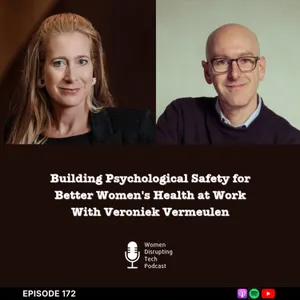
Building Psychological Safety for Better Women’s Health at Work with Veroniek Vermeulen
In this episode of Women Disrupting Tech, I talk with Veroniek Vermeulen, founder of Silatha, about why women's health is still expected to be left at the office door. Veroniek trained as an engineer in a field where 80 percent of her peers were men, and spent years trying to fit into a workplace that wasn’t suited for women. She founded Silatha to replace that silence with psychological safety, backed by real numbers on engagement and retention. This episode is for female founders and health tech leaders building company culture, women in leadership deciding what to share about their own health at work, and anyone curious what changes once women's health is on the agenda. What you'll learn in this episode Why fitting in at work can mean adapting so well you lose track of what you would build differently How psychological safety becomes measurable: Silatha's programs report 93 percent higher engagement and 92 percent better psychological safety among participants Why cycle-related symptoms only seem unpredictable, and what changes once people track them What staying silent about women's health costs at work: stress, isolation, absenteeism, and disengagement Why policy should follow the 80 to 99 percent of people acting in good faith Her three-part advice for founders in perimenopause: learn your own patterns, find a qualified specialist, and be intentional about what you share with your team Chapters: 00:00 — Introduction: Women’s Health, Psychological Safety & Silatha 02:11 — Meet Veroniek Vermeulen and Silatha 02:42 — From Corporate Engineer to Founder 05:03 — Fitting In vs. Adapting at Work 06:41 — Burnout, Belonging & Being Valued 07:53 — Purpose, Viktor Frankl & Letting Go of Control 13:38 — How Silatha Evolved from Wellbeing to Women’s Health 17:41 — Why Psychological Safety Matters for Health at Work 19:59 — Breaking the Taboo Around Women’s Health 25:59 — How Organizations Build Lasting Support 27:02 — Nura: Private, Always-On Health Support 32:15 — Privacy, Trust & Responsible Health AI 38:10 — Men’s Mental Health and Inclusive Health Conversations 41:00 — The Cultural and Business Impact of Support 43:50 — Women’s Health at Work: Regional Perspectives 46:14 — How Founders Can Build Psychologically Safe Startups 55:15 — Advice for Founders Navigating Perimenopause 56:47 — Priorities, Pressure & Getting Important Work Done 1:01:26 — Finding Purpose Through the Work 1:01:58 — Designing Safer Founder Communities 1:04:06 — Where to Connect with Veroniek Vermeulen and Silatha 1:04:40 — Closing and Episode Outro Show notes:Blog: https://womendisruptingtech.blog/2026/10/08/episode-172/ Substack: https://womendisruptingtech.substack.com/p/episode-172?r=2v0lts&utm_campaign=post&utm_medium=web&showWelcomeOnShare=true Books discussed in the episode Man’s Search for Meaning: https://amzn.eu/d/07Dj5X9M Four Thousand Weeks: https://amzn.eu/d/0fyR6E7E Connect with Veroniek Vermeulen and Silatha Veroniek on LinkedIn: https://www.linkedin.com/in/veroniek/ Silatha on LinkedIn: https://www.linkedin.com/company/silatha/ Silatha on Instagram: https://www.instagram.com/SilathaJourney/ Silatha Middle East website: https://silathajourney.com/ Silatha Europe website: https://silatha.com/ Silatha on YouTube: https://www.youtube.com/channel/UCMEvuobvsmkMqGlv8ndZucQ Connect with host Dirkjan Hupkes LinkedIn: https://www.linkedin.com/in/dirkjan-hupkes/ Substack: https://womendisruptingtech.substack.com/ FundingCoach: https://fundingcoach.ai/ About Women Disrupting Tech Every week, Women Disrupting Tech covers the decisions, patterns, and structural realities that female founders and investors rarely discuss in public but run into every time they meet. Follow to get it in your feed. 🎧 Listen to Women Disrupting Tech on Spotify, Apple Podcasts, or YouTube. 👉 Subscribe for more conversations with founders building healthier, more honest workplaces.
66 MIN
SEP 24, 2026
Closing the Safety Gap by Turning Feelings of Unsafety into Data with Anniek van Veldhuizen
Every day, women make safety calculations - which route to take, where to sit - that never show up in the data. What happens once that invisible data gets collected? In this episode of Women Disrupting Tech, I talk with Anniek van Veldhuizen, CCO and co-founder of MyHives, about turning daily, unmeasured safety experiences into objective, actionable data. Anniek and her co-founder Nelson built MyHives, and its AI guardian Beekon, to capture safety concerns before they escalate, using privacy-first technology that keeps all processing on the user’s own device. If you’re a founder navigating fundraising bias as a woman, a leader responsible for workplace safety, or simply curious how privacy-first AI can turn subjective feelings of unsafety into evidence that actually gets acted on, this conversation has something for you. What you’ll learn in this episode: Why daily safety calculations, from choosing a route to picking a seat, never show up in official data, and what that costs system design How MyHives captures both physical and social safety signals without cameras or continuous listening, keeping all processing on-device Why traditional panic buttons fail the moment someone freezes, and how Beekon is built to act autonomously instead How unsafe environments cost the Dutch economy an estimated €8.3 billion a year, with roughly €5 billion linked to psychological and safety-related incidents What it took to bring MyHives into pilots onboarding around 33,000 home care workers and station cleaners Why translating lived experience into numbers moves corporate decision-makers more than personal stories alone What it’s like fundraising as a woman founder alongside a Black co-founder, and how being underestimated became an advantage Chapters: 00:00 Introduction 04:00 Anniek van Veldhuizen on building MyHives from lived experience 05:49 The daily calculations people make to stay safe 08:08 Why unsafe experiences go unreported 10:04 The gender data gap and how missing data shapes safety 14:50 Safety, participation, and learned helplessness 17:15 Building trust into a tool people can actually use 19:52 How MyHives works: app, BEEKON, and BEEKON+ 24:00 Triggering help discreetly when someone cannot act 28:08 How escalation works across languages and locations 30:57 Why privacy is central to the product 34:58 Preventing false positives and training the system 40:32 Trials, pilots, and the workplace safety use case 48:09 The business and societal case for better safety data 53:16 Pricing, monetization, and the impact model 1:00:01 Working with security partners without being absorbed 1:04:20 Fundraising as a woman founder and a Black co-founder 1:07:36 Designing Fundicoach to feel safe and inclusive Show notes : Blog: https://womendisruptingtech.blog/2026/09/24/episode-171 Substack: https://womendisruptingtech.substack.com/p/episode-171 Connect with Anniek van Veldhuizen and MyHives: LinkedIn (Anniek): https://www.linkedin.com/in/anniek-van-veldhuizen-27731514a/ Website: https://www.myhives.nl/en-GB LinkedIn (MyHives): https://www.linkedin.com/company/myhives-nl/ Download the Hyves app Google Play Store: https://play.google.com/store/apps/details?id=app.myhives Apple App Store: https://apps.apple.com/app/myhives/id6751838174 Connect with Dirkjan Hupkes: LinkedIn: https://www.linkedin.com/in/dirkjan-hupkes/ Substack: https://womendisruptingtech.substack.com/ FundingCoach: https://fundingcoach.ai/ About Women Disrupting Tech Every week, Women Disrupting Tech covers the decisions, patterns, and structural realities that female founders and investors rarely discuss in public but run into every time they meet. Follow to get it in your feed. 🎧 Available on Spotify, Apple Podcasts, YouTube and Amazon Music. 👉 Subscribe for more conversations with women building the future of tech.

68 MIN
SEP 17, 2026
How FLTRD's PureScore Makes Healthy Food Choices Easy with Anke Kuik
More than half of Dutch citizens live with a chronic disease, and over 70% of supermarket products are ultra-processed. In this episode of Women Disrupting Tech, I talk with Anke Kuik, co-founder and CEO of FLTRD, about turning a personal interest in nutrition into a tool that helps people navigate the supermarket. Anke walks me through the science behind PureScore, why popular nutrition labels can be misleading, and the founder decisions that took FLTRD from an outsourced prototype to more than 30,000 downloads. This episode is for female founders and women in tech building health tech products, women entrepreneurs curious about the science behind nutrition apps, and any startup leader deciding when to bring technical development in-house. What you'll learn in this episode: Why more than half of Dutch citizens live with a chronic disease, largely driven by lifestyle. How the "food matrix" explains why isolated vitamins or fiber don't work like whole food does. Why FLTRD built its own PureScore instead of relying on nutrition scores that can be gamed. Why outsourcing app development early on slowed FLTRD down and cost more than expected. Why bringing a technical co-founder in-house was Anke's best decision for FLTRD. How FLTRD keeps its scanning tool free while building a B2B model with supermarkets. What Anke looks for in investors beyond capital: retail, FMCG, and dietary network expertise. Chapters: 00:00 Introduction to Anke Kuik and FLTRD 06:55 Developing the concept and building the first app 12:01 Why healthy supermarket choices are so difficult 14:21 What "ultra-processed" food really means 18:09 PureScore vs. Nutriscore 22:56 Personal responsibility, pricing, and the food system 25:10 How the PureScore works 29:03 Scanning products and choosing better alternatives 31:19 Keeping the app free and building a business model 34:40 Working with supermarkets and the B2B opportunity 37:35 Fundraising, traction, and growth plans 39:52 Health impact and scientific validation 43:18 Publicity, media attention, and founder visibility 46:40 How bringing a CTO in-house changed the company 49:00 Finding investors with strategic value 50:10 Advice for an AI-powered founder funding platform 54:06 Where to find FLTRD & closing Show notes: Blog: https://womendisruptingtech.blog/2026/09/17/episode-170/ Substack: https://womendisruptingtech.substack.com/p/episode-170 Connect with Anke Kuik and FLTRD: LinkedIn: https://www.linkedin.com/in/ankekuik/ Website: https://www.fltrd.nl/App: Download the FLTRD app in the Apple App Store or Google Play Store. Instagram: https://www.instagram.com/fltrd.nl/ Connect with Dirkjan Hupkes: LinkedIn: https://www.linkedin.com/in/dirkjan-hupkes/ Funding Coach tool: https://fundingcoach.ai Substack: https://womendisruptingtech.substack.com/ About Women Disrupting Tech Every week, Women Disrupting Tech covers the decisions, patterns, and structural realities that female founders and investors rarely discuss in public but run into every time they meet. Follow to get it in your feed. 🎧 Listen to Women Disrupting Tech on Spotify, Apple Podcasts, or YouTube. 👉 Subscribe for more conversations with women building the future of health tech.
56 MIN