The On The Rise Podcast

Jeremy Dyer & Nick Stromwall

Details

Hello and welcome to The On The Rise Podcast! We created this podcast to educate you on passive investing in real estate whether that's active or passive investments, residential single family homes or commercial apartment buildings. Our goal is to provide clarity, insight, and practical guidance as you work toward growing your wealth, expanding your real estate portfolio, and continuing your journey upward. This is where investors come to learn, take action, and stay on the rise.

Recent Episodes

OCT 27, 2026
Real Estate With a Kingdom Mission
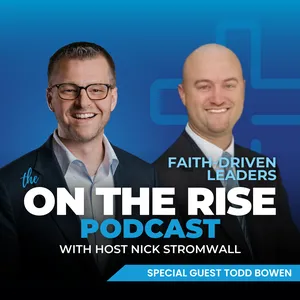
On this episode of the On The Rise Podcast’s Faith Driven Leaders series, host Nick Stromwall sits down with Todd Bowen, a Michigan real estate investor and founder of Trinity Investment Group. Todd shares how a podcast-fueled education and a surprising conversation with his financial advisor led to his first rental in 2017, and how an early wave of evictions pointed him toward partnering with local agencies that house domestic abuse survivors, the chronically homeless, and people reentering society. He opens up about overcoming judgment, hard lessons in trust, raising his sons around the business, and building the time freedom to be present for his family. KEY TAKEAWAYS 1. Put what you learn into action. After a year of learning through podcasts, Todd asked the seller at his first closing if he had more properties. That one question led to his second deal, a three-unit. 2. Let early struggles reveal your mission. Going from zero to five units in two months brought three evictions. Researching agency housing programs turned a unit count into a mission to serve. 3. Partner where the need is greatest. At one point, 19 of Trinity’s 22 units were leased to organizations serving abuse survivors, the homeless, reentry, mental health, and young adults with disabilities. The demand is nonstop. 4. Protect the asset while serving people. Working with reentry and substance abuse programs required careful lease language. Most leases run 12 months with the agency, which moves clients in and out as needed. 5. Replace judgment with relationship. Meeting tenants and hearing their stories showed Todd they want what everyone wants: a clean, safe place to live. As he puts it, “Work is worship.” 6. Get it in writing. A nonprofit CEO verbally committed to a property, Todd bought it, and the board rejected the deal. Now he requires a signed lease or LOI first. 7. Build systems that protect your time. Agencies contact Todd’s handyman directly for routine repairs, and management stays within business hours. That frees him to drive his kids to school and be at their games. 8. Keep your why and your lifestyle in check. Pray about it, get your spouse on board, and expect hard work and persistence. Live below your means and don’t let cash flow fuel lifestyle creep. LINKS Website: https://trinityrei.com/ Instagram: https://www.instagram.com/trinity_reig/ Email: [email protected]
33 MIN
OCT 20, 2026
Understanding the Capital Stack as a Passive Investor
On this session of the On The Rise Podcast’s “Passive Investing Made Simple” series, host Jeremy Dyer, VP of Capital Formation at Rise48 Equity, is joined by Chad Ackerman, a longtime passive investor, educator, founder of Chad Ackerman Real Estate, and co-founder of Left Field Investors, acquired by BiggerPockets. Chad breaks down the capital stack using a simple bucket model, explaining how senior debt, preferred equity, and common equity differ in payment priority, risk, and upside. Jeremy adds how today’s market cycle is reshaping deals and how Rise48 structures its share classes. The session closes with live Q&A on distributions, 1031 exchanges, and investment types. Essential listening for any limited partner who wants to know exactly where their money sits. 1. Every investor sits in a seat. The moment you invest, you become a layer in the capital stack. That seat decides when you get paid and what happens if the deal struggles. 2. Think of a deal as a bucket. Cash fills from the bottom up: senior debt first, then preferred equity, then common equity. The bottom looks least important but is first in line and the safest seat. 3. Safety and upside run in opposite directions. The safest seat is paid first but earns the least; the riskiest is paid last but can earn the most. No seat offers both first pay and the biggest upside. 4. Not every “pref” is the same. Preferred equity is a separate layer paid ahead of common equity. A preferred return inside common equity pays LPs before the GP. Read the documents to know which one you have. 5. Common equity is high risk, high reward. It’s paid last and absorbs losses first, but it captures nearly all of a deal’s upside. It can also carry greater tax benefits, such as bonus depreciation. 6. Capital stacks shift with the market. In 2021–2022, common equity swelled as deals sold at the peak. As rates rose, senior debt swelled, creating financially distressed sellers. Capital calls can even add new layers after you invest. 7. Simpler stacks are easier to evaluate. Rise48 deals use only senior debt and common equity. Class A earns a 10% preferred return, paid first with no equity upside, while Classes B and C sit on equal footing with a greater profit split. 8. Find the waterfall before you commit. Every offering states your seat and class. The waterfall section is the seating chart of who gets paid, when, and in what order. Choose the seat that matches your goals, not the “best” one.
48 MIN
OCT 13, 2026
Leaving Security to Follow God’s Call With Angela Wang
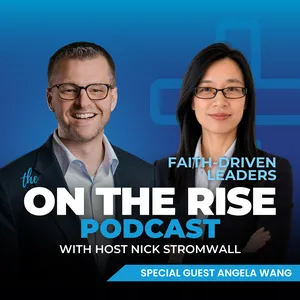
On this episode of the On The Rise Podcast’s Faith Driven Leaders series, host Nick Stromwall sits down with Angela Wang, a finance professional with 20 years of experience who now calls herself a “finance missionary.” Angela shares how her family’s faith took root in China, why she resisted God’s call to leave a stable career for two years, and how a series of personal “exoduses” shaped her. She explains how pension consulting and private wealth management led her to bring wealth-level guidance to everyday families, pairing an AI financial steward with human advisors. A grounded conversation on surrender, stewardship, and what money is really for. Content note: Angela briefly describes grief and a dark period after her mother’s death. KEY TAKEAWAYS 1. Comfort can hide what’s missing. Angela had a loving family, a dream job, and a role at church, yet felt a deep unhappiness. Outward success doesn’t mean you’re on the path you’re called to. 2. Fear of financial dependence is a real barrier. She turned away from God’s call for two years because she didn’t want to give up a stable income. Naming the specific fear is the first step past it. 3. Growth comes through many small exoduses. Using Exodus-to-Canaan as a framework, Angela describes letting go of education, family, place, prestige, money, and people-pleasing as sources of identity. Each smaller release prepared her for the bigger call. 4. Let go of good things, not just bad ones. God asks us to release dependence on anything that isn’t Him, including healthy things like a career or a degree. Your value isn’t defined by income, schools, or others’ opinions. 5. Every season prepares you for the next. Pension consulting taught her that technology can scale personalized advice. Private wealth management showed her how complex every household’s finances are. Both became the foundation for her business. 6. Attention is the scarcest financial resource. The industry naturally concentrates advisors, tools, and attention on the wealthy. Everyday families still need a trusted go-to for basic questions and spotting fraud, even without large assets. 7. Use AI to scale care, not replace it. One advisor can typically serve 100 to 200 households. Angela pairs a client app and an AI-powered workspace with human advisors so more families get responsive, personal support. 8. Resources have a shelf life. Money, time, and health are entrusted to us temporarily and lose their value if hoarded or poorly managed. Steward them generously, and make daily time in Scripture the foundation. 00:00 Welcome & How We Met 02:00 What It Means to Be a "Finance Missionary" 03:50 Resisting the Call to Leave Security 06:21 Surrender and Leaving Her Job 08:38 Exodus to Canaan: Life's Many Egypts 17:20 How Her Career Prepared Her 23:16 Bringing Wealth-Level Attention to Everyday Families 27:10 Technology and Annie, the AI Financial Steward 32:12 Why Everyone Deserves a Financial Steward 37:19 Spend for Souls & Starting Each Day in the Word

44 MIN
OCT 6, 2026
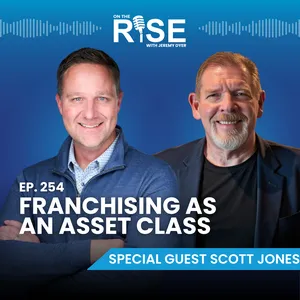
Franchising as an Asset Class
On this episode of the On The Rise Podcast, host Jeremy Dyer talks with Scott Jones, who has spent over 30 years in franchising as a multi-unit franchisee, a franchisor executive, and CEO of a supplier serving 80,000+ locations. For the last 21 years he's advised mid-career professionals and business owners on whether franchise ownership fits their portfolio. Scott explains why he treats franchising as an alternative asset class rather than "buying a job," what separates a good semi-passive candidate from a poor one, where AI genuinely helps franchisees — and where ChatGPT gets franchise economics flatly wrong. KEY TAKEAWAYS Franchising isn't "slinging sandwiches." Senior executives often equate franchising with buying themselves a job. Scott points to heavy institutional activity at the unit level — private equity acquiring franchises and rolling them up — as proof of real opportunity, and notes not every brand requires $3 million. Treat it as an alternative asset class. Scott allocates across real estate and business ownership the same way, asking where he can get a superior return on investment and time. The discipline you'd apply to any investment shouldn't disappear because you like the product. Semi-passive has a real definition. Scott's benchmark is 5 to 15 hours a week — a term he says is thrown around loosely. The business is built around a team and an infrastructure you hire, not around you running the counter. Availability matters more than hours. The bigger question isn't how much time you have but when. If you can't take a five-minute call from your manager during the day, you need an operating partner with equity, a capable GM, or a spouse who can. Rigid schedules aren't automatically disqualifying. Scott has worked with pilots, who have intense on-periods followed by real flexibility, and a functional medicine physician running a robust practice. The structure can be designed around the constraint. AI is a genuine tailwind for operators. Scott sees AI absorbing the busy work that franchisees never had hours for — turning training manuals and the institutional knowledge in leaders' heads into something a brand-new franchisee can access on demand. But AI gets franchise economics wrong. Scott asked ChatGPT what an average franchisee earns at a large brand, hit return five times, and got five wildly different answers — none correct. The reason: the FTC mandates a disclosure document, but Item 19 earnings representations are the one unformatted section, and many brands include nothing at all. The real diligence is talking to franchisees. Scott takes whatever is in the disclosure document, speaks with a handful of existing owners — most will share their numbers if approached right — and only then builds projections he trusts. Franchising is also where he gets control: he can't control interest rates or markets, but he can control his business, and eventually own the real estate under it. LINKS franchiseguidegroup.com LinkedIn: Scott Jones Franchise 00:00 Introduction 01:04 30 Years Across Every Side of Franchising 03:49 The Biggest Misconceptions 05:27 Franchising as an Asset Class 09:34 Who Should (and Shouldn't) Take the Leap 12:36 Designing Around a Rigid Schedule 16:24 Where AI Helps Franchisees 19:15 Why ChatGPT Gets Franchise Numbers Wrong 23:56 Franchising as a Hedge Against Layoffs 29:42 Where to Start With $250K
34 MIN
OCT 3, 2026
Why We Keep Buying Apartments When Others Are Quitting - Bonus Episode With Zach Haptonstall
Why would a multifamily operator keep buying apartments while so many peers are handing properties back to lenders? In this sit-down, Rise48 Equity Capital Formation Manager Jason Kish asks CEO Zach Haptonstall how the firm has kept operating through what Zach calls "multifamily purgatory," and why Rise48 keeps acquiring in the Sunbelt. Zach starts with the factor he believes matters most: the team. Many sponsors bought at the end of 2021 and in early 2022, right before interest rates spiked, and since then it has often made more economic sense for them to give deals back. Zach explains why Rise48 chose to keep fighting to protect investor capital instead. He also explains why the firm sees itself as having a 50-year runway rather than being in the business of quick flips. From there, the conversation turns to acquisitions. Zach points to the familiar investing idea that the best opportunities show up when others are fearful. He explains how Rise48 is finding deals priced below some sellers' loan amounts, with a strong basis and attractive cap rates. Rather than trying to predict interest rates, the team focuses on what it can measure: the new construction pipeline. Zach walks through why supply data points to potential tailwinds for multifamily from 2027 through 2031. He also acknowledges that good deals are still hard to find in today's capital markets. Jason and Zach also dig into Sunbelt migration. Is the movement of people out of California, New York, Illinois, and Washington a real driver for markets like Arizona, Texas, and the Carolinas, or just a headline? Zach breaks down how net in-migration, corporate relocations, and business-friendly policy connect to job growth, population growth, and apartment demand. They touch on major projects like TSMC in Arizona and the rise of Dallas-Fort Worth as a corporate hub. Zach also explains why Rise48 stays politically agnostic while watching how legislation shapes where people and jobs go. Whether you are an accredited investor researching multifamily syndications, a passive investor evaluating sponsors, or someone following the real estate market, this conversation offers a direct look at how one Sunbelt operator is approaching the current cycle. In this video: How Rise48 has kept operating through the multifamily downturn Why some sponsors are giving properties back to lenders Why Rise48 keeps acquiring apartments in this market What the construction pipeline suggests for 2027 through 2031 Whether Sunbelt migration really affects multifamily performance How corporate relocations and policy drive job and population growth Interested in investing in multifamily with Rise48 Equity? Visit rise48equity.com or email Jason directly at [email protected]. Subscribe for more real estate market updates, interest rate breakdowns, and investing insights from the Rise48 Equity team, including The Rise Report with Zach Haptonstall. This video is for informational purposes only and is not investment advice. 0:00 Introduction 0:10 Operating Through the Downturn 1:14 Why Operators Give Properties Back 2:01 Why Rise48 Keeps Buying 2:44 The Supply Pipeline and 2027 Tailwinds 3:06 Is Sunbelt Migration Real? 4:31 Corporations Leaving Delaware 4:58 Mega Projects in Arizona and Texas 5:15 How Policy Moves Jobs and People 6:10 How to Invest with Rise48
6 MIN