What's the Alternative? Meet the Manager

Shana Orczyk Sissel

Details

Welcome to "What's the Alternative?" hosted by Shana Orczyk Sissel, Founder and CEO of Banríon Capital Management, and widely known as the “Queen of Alternatives.” In this insightful podcast, Shana engages with leaders who are redefining the landscape of alternative investments, diving into the intricacies of strategies that often leave investors perplexed or hesitant. Each episode tackles complex and sophisticated topics, bringing clarity to misunderstood products in the alternative space. Shana isn’t afraid to confront controversy or current events, posing the tough questions that many are thinking but few dare to ask. Through candid conversations with industry experts, listeners gain a deeper understanding of the dynamics at play in alternative investments and how these strategies can fit into their portfolios. Join Shana as she unveils the realities of investing in alternatives, educating and empowering listeners to navigate this vital sector with confidence. Whether you’re an experienced investor or exploring new opportunities, “What's the Alternative?” promises to deliver thought-provoking discussions that challenge the status quo and elevate your investment IQ.

Recent Episodes

OCT 6, 2026
What's the Alternative? | Episode 34 | Understanding GP Stakes: A Unique Approach to Private Equity with Clark Edlund
Host Shana Orczyk Sissel kicks off season four of What's the Alternative? (a Wealthies Awards finalist) with Clark Edlund, Partner at CAZ Investments, to explain GP stakes, buying an ownership interest in an alternative asset manager to access "house" economics (management fees, carried interest, balance sheet) rather than only LP fund returns. The episode breaks down common private market terms and fee mechanics (management fees on committed vs deployed capital, preferred return/hurdles, catch-up, high watermark, and American vs European waterfalls) and why alignment and underwriting matter. They discuss diversification benefits across strategies and vintages, structural realities like slow capital calls and illiquidity, evolving liquidity tools, and the need for advisors to document liquidity expectations. Key takeaways: * GP stakes invest in asset management firms, capturing firm-level economics across past, present, and future vintages. * GP vs. LP economics differ materially: LPs pay management fees; GPs receive fees plus potential carry and balance sheet returns. * Understanding waterfalls (American vs. European), pref/hurdles, and catch-up provisions is critical to evaluating incentives and alignment. * GP stakes can offer broad private-markets diversification and mitigate vintage timing, but require comfort with illiquidity and slow deployment. * Advisors should set expectations, document liquidity budgets (e.g., in an IPS), and compare performance using metrics appropriate to the structure (IRR/MOIC vs. evergreen reporting). Subscribe for more episodes of What's the Alternative? Connect with us! * Clark Edlund on LinkedIn [https://www.linkedin.com/in/clark-edlund-caia-b592894/] * CAZ Investments [https://cazinvestments.com/] * Shana Orczyk Sissel on LinkedIn [https://www.linkedin.com/in/shsissel/] * Shana Orczyk Sissel on X [http://www.twitter.com/shanas621] * Shana's Website [https://www.shanasissel.com/] * Banríon Capital Management [https://www.banrioncapital.com/]
53 MIN
MAY 5, 2026
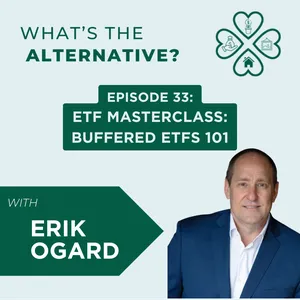
What's the Alternative? | Episode 33 | ETF Masterclass: Buffered ETFs 101 with Erik Ogard
Join host Shana Orczyk Sissel, Founder & CEO of Banríon Capital Management, as she sits down with Erik Ogard, Founder of BufferLabs, for a deep dive into Buffer ETFs — what they are, how they work, and when they can make sense in a portfolio. Erik breaks down the options mechanics behind these products, explains the risks and opportunities, and shares how active management and better analytics can improve outcomes for advisors and investors. Key takeaways: * Buffer ETFs offer defined downside protection and capped upside but are more complex than marketing suggests. Know the mechanics before you invest. * These products are built from options strategies (put spreads, call options); understanding the Greeks (Delta, Theta, Gamma) is critical to managing behavior over time. * Performance can deviate before expiration; active monitoring and dynamic management can improve results versus static laddered approaches. * Advisors must educate clients transparently about trade-offs and set realistic expectations to avoid misunderstood risk exposures. Listen now to learn how BufferLabs approaches engineering and managing Buffer ETFs, and why complexity demands expertise. Subscribe for more episodes of What's the Alternative? Connect with us! * Erik Ogard on LinkedIn [https://www.linkedin.com/in/erik-ogard-cfa-a5014a161/] * BufferLabs [https://bufferlabsetfs.com/] * BufferLABS US Equity Dynamic Buffer ETF (BFLB) [https://bflbetf.com/] * Shana Orczyk Sissel on LinkedIn [https://www.linkedin.com/in/shsissel/] * Shana Orczyk Sissel on X [http://www.twitter.com/shanas621] * Shana's Website [https://www.shanasissel.com/] * Banríon Capital Management [https://www.banrioncapital.com/]
69 MIN
APR 7, 2026
What's the Alternative? | Episode 32 | Beyond the 60/40: Navigating the Complex World of Return Stacking with Corey Hoffstein
In this episode of What's the Alternative? host Shana Orczyk Sissel sits down with Corey Hoffstein Co-Founder and Chief Investment Officer of Newfound Research, to demystify return stacking, a modern evolution of Portable Alpha that layers diversifying strategies onto existing portfolios using capital‑efficient instruments. They contrast long‑run diversification benefits with the short‑term pain clients feel, and explain how modest, well‑structured stacks can preserve core allocations while improving risk‑adjusted outcomes. Corey and Shana walk through the role of leverage, practical implementation choices, and sensible sizing heuristics to minimize client friction. The conversation delivers actionable guidance on designing stacks that enhance diversification without triggering performance anxiety, plus perspectives on where this trend is headed in wealth management. Key takeaways: * Return stacking lets you add diversifying exposures via leverage and derivatives without cutting core holdings. * Prudently used leverage can be a diversification tool, not just a risk amplifier. * Practical sizing: modest, diversified stacks tend to balance benefits and client acceptance. * Designing for behavioral time, reducing visible short‑term pain, is crucial to keeping clients invested in statistically sound strategies. Like, subscribe, and turn on notifications to stay up to date on future episodes of What's the Alternative? Connect with us! * Corey Hoffstein on LinkedIn [https://www.linkedin.com/in/coreyhoffstein/] * Corey Hoffstein on X [https://x.com/choffstein?s=20] * Newfound Research [https://www.thinknewfound.com/] * Return Stacked ETFs [https://www.returnstackedetfs.com/] * Shana Orczyk Sissel on LinkedIn [https://www.linkedin.com/in/shsissel/] * Shana Orczyk Sissel on X [http://www.twitter.com/shanas621] * Shana's Website [https://www.shanasissel.com/] * Banríon Capital Management [https://www.banrioncapital.com/] Investing involves risk of loss. Past performance does not guarantee future results.

57 MIN
MAR 3, 2026
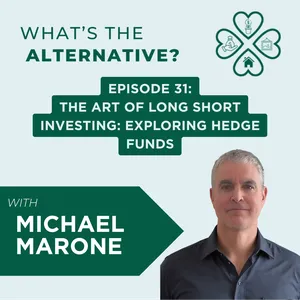
What's the Alternative? | Episode 31 | The Art of Long Short Investing: Exploring Hedge Funds with Michael Marone
In this episode of What's the Alternative? host Shana Orczyk Sissel sits down with Michael Marone, Co-Founder & Co-Chief Investment Officer at Crescent Rock Capital, a global equity long-short hedge fund manager. They dive deep into the realities of running a long-short strategy in today's market—how to think about shorting in a world structurally tilted against short sellers, why "boring" ideas often make the best shorts, and how shifts in market structure, AI, small caps, and deglobalization are reshaping the opportunity set for active managers and allocators. Whether you're an advisor, allocator, or sophisticated individual investor, this conversation offers a practical framework for evaluating hedge funds, understanding risk, and positioning portfolios in a changing world. Key Takeaways: * Why effective shorting often comes from "boring," fundamentally sound companies facing marginal deterioration—not flashy frauds or meme names. * How changes in market structure, including the rise of passive investing, have created both headwinds and unique opportunities for active long-short managers. * Why small caps may be one of the ripest areas for active management, and how to think about quality, liquidity, and selectivity in that space. * How to assess whether "AI is a bubble" by comparing today's leaders to the dot-com era, and what deglobalization really means for global equity opportunities. If you're an advisor or investor looking to better understand hedge funds, long-short equity, and how alternatives fit into modern portfolios, this episode is for you. Like, subscribe, and turn on notifications to stay up to date on future episodes of What's the Alternative? Connect with us! * Michael Marone on LinkedIn [https://www.linkedin.com/in/michael-marone-20b853161/] * Crescent Rock Capital Management [https://crescentrockcapital.com/] * Shana Orczyk Sissel on LinkedIn [https://www.linkedin.com/in/shsissel/] * Banríon Capital Management [https://www.banrioncapital.com/] Investing involves risk of loss. Past performance does not guarantee future results.

64 MIN
FEB 3, 2026
What's the Alternative? | Episode 30| Chasing Liquidity: Cracking the Code of Private Equity with John Lidington
In this episode, host Shana Orczyk Sissel sits down with John Lidington, Portfolio Manager at Man Numeric, to explore the evolving world of liquid private equity—an innovative way that seeks to capture private equity–style returns through public markets. John shares how Man Numeric's liquid private equity strategy bridges the gap between public and private markets, offering investors access to private equity–like exposure without the high fees, illiquidity, or lock-up periods of traditional PE funds. Key Takeaways: * How liquid private equity works—and how public equities can be used to seek exposure to certain private equity characteristics. * The quantitative and fundamental factors that drive Man Numeric's approach to identifying companies with private equity–like characteristics. * Why more companies are choosing to stay private longer, and what that means for public market investors. * How investors can gain private equity exposure without high fees, illiquidity, or long lock-up periods. * Practical insights into building diversified portfolios that capture the benefits of both public and private market dynamics. Watch now to learn how the boundaries between public and private markets are blurring—and what that means for the future of investing. Connect with us! * John Lidington, CFA on LinkedIn [https://www.linkedin.com/in/johnlidington/] * KraneShares Man Buyout Beta Index ETF [https://kraneshares.com/etf/buyo/] * Man Group Alternatives Website [https://www.man.com/capabilities/alternatives] * Shana Orczyk Sissel on LinkedIn [https://www.linkedin.com/in/shsissel/] * Banríon Capital Management [https://www.banrioncapital.com/] Investing involves risk of loss. Past performance does not guarantee future results.
49 MIN