Truth Unveiled with Ralph

Ask Ralph Media, Inc.

Details

Where faith meets clarity in a confusing world Do you ever feel disoriented by a world that seems to be spinning out of control? Do the headlines, cultural shifts, and economic pressures leave your heart unsettled—longing for something solid to stand on? You’re not alone. I’m Ralph Estep Jr., and every week on Truth Unveiled, I help you cut through the noise of our culture and uncover what’s really going on—through the timeless lens of God’s Word. This isn’t about fear or politics; it’s about finding peace and purpose when the world doesn’t make sense. Together, we’ll look at current events, personal struggles, and spiritual questions—and reveal how Scripture brings light, order, and hope to it all. Each episode gives you: ✅ Biblical insight to navigate today’s challenges with wisdom. ✅ Practical application to strengthen both your faith and your finances. ✅ Encouragement and hope to stand firm in Christ, no matter what the headlines say. If you’re ready to stop letting chaos shape your thinking and start living from a place of confidence, truth, and peace— hit follow on Truth Unveiled with Ralph and visit TruthUnveiledWithRalph.com for free devotionals, studies, and community resources. Because when the truth is unveiled, fear loses its power—and faith takes its place.

Recent Episodes

OCT 18, 2026
The Questions God Asks
“How are you?” You’ve answered it ten times today, and I’d bet most of those answers were “busy” or “fine.” I hear it at my desk all year long. Someone gets close to the room they don’t want to show anybody, and they steer me somewhere else. We don’t exactly lie. We relocate. The first question God ever asked is only three words long, and He asked it to a man hiding in the trees. “Where are you?” He wasn’t opening a case. He was opening a door. In Episode 69, I look at three people and the three questions God asked them: Adam, hiding in the garden: “Where are you?” (Genesis 3:9) Moses, stalling at the burning bush: “What is that in your hand?” (Exodus 4:2) A man who had been lying beside a pool for 38 years: “Do you want to be made well?” (John 5:6) I think most of us dodge God’s questions in one of three ways. We hide, we argue, or we explain until the explanation becomes our name. I share what I see from my side of the desk as a licensed public accountant, then we look at what God does with a question when we stop dodging. What you’ll hear Why we answer a different question than the one we were asked The hider, the arguer, and the explainer, and how to figure out which one you are Why the offended party is the one doing the seeking How the same rod went from “a rod” to “God’s rod” What Jesus did with a man whose answer was “I have no one” Three questions to answer this week, and how to ask the people you love the way God asks you The line I keep coming back to God’s questions are doorways, not traps. Scripture in this episode Genesis 3:8-10, 21 | Exodus 4:1-2, 12, 20 | John 5:5-9 | Luke 19:10 | Revelation 3:20 (World English Bible) Your challenge this week Grab one sheet of paper and write three questions across the top: Where am I? What’s in my hand? What do I want? Answer all three honestly. Then ask one person you love a question that sounds like an invitation instead of an accusation. Ready to answer Him? If this episode stirred something in you, reach out at truthunveiledwithralph.com/decision. You can stay anonymous. I just want to pray with you. Next episode Proverbs 3, “First Things First.” What comes first in your life, and does your money show it? Keep seeking the truth, and let it set you free. God bless you, and I’ll see you next time. Ralph #ralphestepjr
46 MIN
OCT 11, 2026
A Bag with Holes In It: When You Work Hard and Never Seem To Get Ahead
You work hard. You make more than you ever have. And by the end of the month, the money is gone. I sit across the desk from people like this almost every day, and in today’s Truth Unveiled I take you to the Book of Haggai, a two-chapter book written to people who were working hard and still coming up empty. God’s answer to “never enough” is not to work harder or find a better budgeting app. He says, “Consider your ways.” I look at this passage through my 30 years as a licensed accountant, from the holes you can find on a bank statement to the ones that never show up on one, like exhaustion, a tired marriage, and a prayer life you keep meaning to get back to. In this episode: Why the people in Haggai lived in paneled houses and still felt cold The two most expensive words in a busy life: “not yet” What “consider your ways” means, and why I see it as an invitation and not a scolding Why Haggai is not a prosperity formula What Jesus says in Matthew 6 about where your heart lives Three kitchen table pictures: the young couple, the business owner, and the retiree Four questions I want you to answer for yourself this week Scripture: Haggai 1:2-9, Haggai 1:13, Haggai 2:4-5, Matthew 6:19-21, Matthew 11:28 Take the next step: If you prayed along with me today, tell me about it at https://truthunveiledwithralph.com/decision. I would love to hear from you and pray with you. This week’s challenge: Take one hour with a pen and paper and look at where your money, time, and energy actually go. Then take one thing off your “not yet” list. Looking for practical money help every day? I host a daily show called Becoming Financially Confident at https://becomingfinanciallyconfident.com. Know someone who keeps saying, “I just don’t know where it all goes”? Send them this episode. Next week, we talk about the two questions God asks: “Where are you?” and “What’s in your hand?” Subscribe so you don’t miss it. #ralphestepjr
38 MIN
OCT 4, 2026
Honor Has a Cost
There’s a woman sitting in her car outside the house she grew up in. The engine is off. The groceries are warming in the back. Her mother can’t be left alone anymore. She’s been parked in that driveway for 11 minutes because the second she walks through the door, she becomes the caregiver again. And underneath the exhaustion is a thought she’s ashamed to admit: “I want this to be over.” Then comes the thought that does even more damage: What kind of Christian thinks that? In Episode 67, I’m saying the quiet part out loud. For more than 30 years, I’ve sat across the desk from families as a licensed public accountant in Middletown, Delaware. I’ve seen what caring for aging parents can do to a family. The squeeze between raising your kids and caring for your parents. The guilt that never seems to balance. The sibling with plenty of opinions but no hands in the work. The grief of watching someone you love disappear while they’re still sitting in front of you. My own family knows some of this firsthand. I share what we’re walking through with my mother-in-law’s dementia, along with a moment I’ll never forget: playing Elvis for my mother after her brain surgery. Then we open Scripture. The fifth commandment has no age limit and no performance clause. But honor isn’t the same as obedience, unlimited access, or silently enduring whatever comes. In Mark 7, Jesus confronts the Corban tradition, where someone could declare resources “given to God” while refusing to provide for their parents. We look at what that same kind of avoidance can sound like today. We also go to the cross, where Jesus made sure His mother would be cared for. That moment gives us an important truth: Honor is required of you. Doing it alone never was. What You’ll Hear Why caregiver guilt can sometimes be exhaustion wearing conviction’s coat The difference between honor, obedience, and endurance What Corban meant and what that kind of avoidance can look like today How to honor a parent who hurt you without giving them access to you or your children How to ask a distant sibling for specific help Why one 60-minute conversation years early can spare your family a hospital-hallway crisis How to love a parent with dementia when they may no longer register that you came Why getting help isn’t failure Practical questions to ask yourself when caregiving feels too heavy to carry alone Scripture Referenced Exodus 20:12 Mark 7:9-13 1 Timothy 5:4, 8 John 19:26-27 Ephesians 6:2-3 Take It With You Honor is required of you. Doing it alone never was. You can love your parent and still be tired. You can honor them and still need boundaries. You can ask for help. And you can grieve what’s being lost while the person you love is still here. Did You Make a Decision for Christ Today? I’d love to hear from you. Let me know at truthunveiledwithralph.com/decision Share This Episode Do you know someone who’s tired? A sibling carrying more than anyone realizes? A friend caring for a parent right now? Send them this episode with four words: “I see you.” Who is the one person you need to send this to today? #ralphestepjr
50 MIN
SEP 27, 2026
Did It Actually Happen?
For more than 30 years, I've worked as a licensed accountant, testing whether the numbers someone hands me actually hold up. In this episode, I bring that same posture to the biggest claim in Christianity, that a man who was dead on Friday was alive on Sunday. Watch the full episode Read the blog post I start at a Thanksgiving table, with a son asking his dad a question the dad doesn't have an answer for, and open the file from there. We look at Paul's letter to the Corinthians, the earliest written record of the resurrection, where he tells you exactly how to prove his own religion false. Then I walk through four lines of historical evidence: how early the claim actually is, how embarrassing the details are, why the empty tomb mattered in that specific city, and why the people closest to it never took the easy way out, even facing death. I also give the leading alternative theories, swoon, wrong tomb, hallucination, and legend, an honest hearing. By the end, the question isn't whether I've proven anything. It's what changes in your life if this is true, how you talk to a doubting kid without panicking, and how you stand at a grave. Scripture referenced: 1 Corinthians 15:3-8, 1 Corinthians 15:14-19, 1 Corinthians 15:20, 1 Corinthians 15:58, 1 Peter 3:15, John 7:5, Acts 26:26, Luke 24:36-43. Ready to make a decision? Go to truthunveiledwithralph.com/decision. Subscribe to YouTube: https://www.youtube.com/@TruthUnveiledwithRalph/videos Listen to our worship songs: https://youtube.com/playlist?list=PL3YkmLWcKD_KxZX0Fp6XQBhCEFEsSxPjh&si=qnvG0Sc4pb9VhaKl Subscribe wherever you're listening so the next episode finds you.
52 MIN
SEP 20, 2026
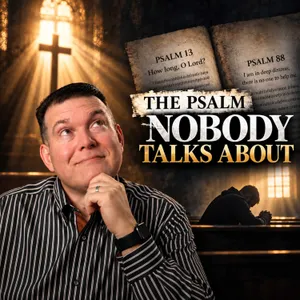
Permission to Complain: What the Psalms Do With Pain
I've learned to notice that little sound people make right before they say "I'm fine." I've sat behind the same kind of desk for 30 years, and I see the folder every time, bills piling up, accounts quietly drained, stress nobody mentioned out loud. We walk into church and do the exact same thing. Somebody taught us that protecting the room matters more than telling the truth. Watch the full episode Read the blog post This week I read straight through Psalm 13 and Psalm 88 to show that God kept the hard songs in his own hymnbook. The Bible is full of hymns that are really just complaints. David does four things in six verses: he speaks straight to God, tells him the truth, asks for something specific, then remembers who God is. Psalm 88 never gets there. It ends in total darkness, and God left it that way on purpose. That means you're allowed to bring your own messy folder to him. Lament isn't weak. It's faith. It means you still believe somebody is listening. I keep the response simple. Say one true sentence out loud. Write it in a notebook. Tell a friend. If you're still in the dark tomorrow, come back and say it again. God wrote these songs himself, so he can handle your anger and your grief. He even kept a psalm that ends in darkness in the hymnal, so no honest sufferer would ever have to fake it. We can stop performing fine. We can tell God the truth and still call it worship. Takeaways: We're taught to say "I'm fine" before we're taught to tell the truth, and it hides real pain. We turn honest prayers into press releases, tidy and technically true, with the blood wiped off. God kept the raw, angry laments in scripture on purpose, so we're allowed to bring the same kind of prayer. We treat complaint as disrespect, but lament is actually an act of faith, since it keeps the conversation with God alive. I use David's four moves when I pray: speak straight to God, tell him the truth, ask for something specific, then remember who he is. Stop trying to fix people so fast. Sit with them, say "that's terrible," and just stay present. I'm a natural fixer, and I've had to learn that silence and steady presence help more than a quick answer ever does. Jesus quoted a lament, Psalm 22, with his own dying words on the cross, so honest pain directed at God is not beneath anyone. Links referenced in this episode: truthunveiledwithralph.com/decision

56 MIN