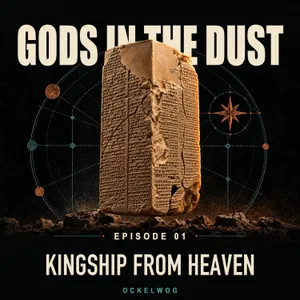
Kingship from Heaven: The Sumerian King List
A four-thousand-year-old clay prism claims kingship descended from heaven, eight rulers governed for 241,200 years, and a flood divided time itself. Mariana Eaker and Tyson Lukowski investigate where the Sumerian King List moves from political history into myth, and why later traditions remembered fish-cloaked sages who delivered civilization. The Weld-Blundell Prism does something modern history is not supposed to do. It begins with impossible kings and divine authority, crosses a flood in a single sentence, then continues toward rulers who may have left evidence in the ground. Mariana and Tyson follow that transition through Mesopotamian number symbolism, the historical shadow of Enmebaragesi, flood deposits at ancient cities, Eridu’s sacred geography, the apkallu sages, and Berossus’s account of Oannes. Then they give the ancient-visitor interpretation a direct evidence test. The result is stranger than a simple debunking. The tablets do describe civilization as received knowledge, but they also reveal a recognizably human conspiracy: rulers using inherited memory, sacred language, and catastrophe to make political power appear older than argument. Full textual, museum, and archaeological sources are linked below. Chapters 00:00 Cold open 01:48 The object in the case 04:53 Eight kings and too much time 07:43 The man at the edge of history 09:57 The line of water 15:04 Why Eridu comes first 17:39 The seven sages 24:08 Testing the visitor theory 27:06 What the list is really protecting Hosts Mariana Eaker is the evidence-first investigative anchor. Tyson Lukowski is the myth researcher and pattern-seeker who follows an alternative reading until it stops predicting evidence. Both are recurring fictional presenters performed with synthetic voices. Produced by Ockelwog. Sources The Sumerian King List, ETCSL translation The Weld-Blundell Prism, Ashmolean Museum The Sumerian Flood Tablet, Penn Museum Enki/Ea and the apkallu, ORACC Fish-cloaked apkallu figurine, British Museum Assyrian and Babylonian scholarly tradition, ORACC Reflections on the Mesopotamian Flood, Penn Museum Editorial note The episode distinguishes ancient textual or material evidence, scholarly interpretation, reasonable inference, and modern speculation. The extraterrestrial reading is examined as a modern hypothesis, not presented as an archaeological conclusion. Read the full transcript, check the sources, and turn the Weld-Blundell Prism in 3D: https://ockelwog.com/episodes/01-kingship-from-heaven/ New episodes every Tuesday. Follow Gods in the Dust so the next case shows up in your library, and if this one made you think, a rating helps other people find the show.