



S5E35: Blackbrush and the Desert's Long Memory
OCT 23, 202637 MIN
Description
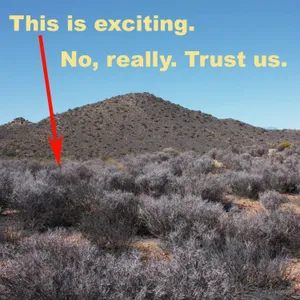
Blackbrush, Coleogyne ramosissima, is easy to overlook. It’s tiny, dark leaves and gray stems can make a stretch of landscape look at best boring, at worst funereal. But this rose family plant’s low, dense canopy helps shape desert plant communities, and gives desert animals an important food source. Nurse plants shelter vulnerable seedlings from heat, drying winds, and hungry animals. Blackbrush may well be the most important nurse plant for Joshua trees.
Long-lived adults, episodic seed production, rodent seed caches, and suppressed young plants help blackbrush stands persist. But blackbrush isn’t well adapted to what North America’s hot deserts have become. Research in the Panamint Mountains shows why rebuilding a mature desert shrub community can take far longer than replacing its individual plants.
Protecting existing blackbrush matters as warming and disturbance make natural recovery harder.
Also, you still have a few days left to apply for our Fellowship for Desert Reporting, viewable at https://thedamn.org/fellowship.
Sources cited, plus extras:
Webb, R. H., Steiger, J. W., & Turner, R. M. (1987). Dynamics of Mojave Desert Shrub Assemblages in the Panamint Mountains, California. Ecology, 68(3), 478–490. The exceptionally slow recovery of blackbrush communities after disturbance, including the climatic and geomorphic stability quotation. Free PDF. pubs.usgs.gov
Hunter, K. L., & McAuliffe, J. R. (1994). Elevational Shifts of Coleogyne ramossissima in the Mojave Desert during the Little Ice Age. Quaternary Research, 42(2), 216–221. Packrat midden evidence for blackbrush expansion at the southern Nevada study site during the Little Ice Age. The extra “s” in ramossissima appears in the published title. Cambridge Core
Meyer, S. E. (2023). Factors Regulating Population Stand Structure in Blackbrush (Coleogyne ramosissima: Rosaceae), a Masting North American Desert Shrub. Diversity, 15(5), 619. Stand structure, episodic seed crops, rodent dispersal, and banks of suppressed young plants within adult crowns. mdpi.com
Pendleton, B. K., & Meyer, S. E. (2004). Habitat-correlated variation in blackbrush (Coleogyne ramosissima: Rosaceae) seed germination response. Journal of Arid Environments, 59(2), 229–243. Differences among populations in seed chilling requirements and germination responses. . ScienceDirect
Jones, L. C., Schwinning, S., & Esque, T. C. (2014). Seedling ecology and restoration of blackbrush (Coleogyne ramosissima) in the Mojave Desert, United States. Restoration Ecology, 22(5), 692–700. Seedling establishment, herbivory, and how nurse-plant effects change with elevation and environmental stress.
Become a desert defender!: https://90milesfromneedles.com/donate
See omnystudio.com/listener for privacy information.