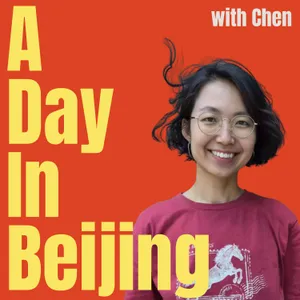
A Day In Beijing with Chen

Chen

Details

This is more than a travel guide to China. We are real people who live here, your eyes on the ground, and we want you to see it from the inside. A Day In Beijing is a weekly podcast about the history, culture, and people in China. China has opened its doors with visa-free travel. But most "China experts" have never lived here or don't speak Chinese. This podcast is none of those things. We're here to break the cultural stereotypes of China. It's 2026, if you want to hear real voices from China, you can now. Instagram: @a_day_in_beijing Email: [email protected]

Recent Episodes

OCT 21, 2026
Hutongs | Beijing's DNA | Season 1 Finale
Eighteen episodes in, and there's only one way to end this season, with the lanes where Beijing actually lives. Hutongs have been the DNA of this city for over 800 years. Not museums. Not tourist stops. But homes. In this episode: where the word comes from, what hutongs are, what they're connecting in between, and how Beijing went from 6,000 hutongs to a few hundred. This is also where I say thank you before I start my trip down south. To rest before the second season, but also to seek more inspiration. The last episode of Season 1.Season 2 is coming. A Day In Beijing is an English-language Beijing podcast inspired by the history, innovations, and people of Beijing, created and hosted by a born-and-raised Beijinger. We exist not only as your virtual travel guide, your dictionary to China, but also to challenge and break the colonial narratives that have been shaping Beijing and China. What this episode covers:🔹 The word 胡同 (hútòng). It's not originally Chinese. The most widely accepted theory traces it to Middle Mongolian, a word meaning "water source." 1271.🔹 The grid. Kublai Khan's architects built a strict road hierarchy. Main streets ran 25 to 36 metres wide. Side streets 18 metres. Hutongs, 6 to 7 metres. Just enough for two carts to pass.🔹 Siheyuan (四合院). Four buildings around an open courtyard. The main building at the north end, facing south, most sunlight, most important. That's where the head of the family lives. Every room tells you who lives there and where they rank.🔹 The width of the lane told you your rank. Wider hutong, higher status. The narrowest hutong in Beijing, 钱市胡同 (Qiánshì Hútòng), is near Qianmen, south of Tiananmen Square. Forty centimetres wide at its narrowest.🔹 What happened to the hutongs? By the 1980s and 90s, many hutong courtyards were overcrowded, one courtyard that once held one family now had three, four, five families squeezed in. When modernisation came, the government moved families into apartment blocks. For many, it was an improvement, running water, private bathrooms, heating. But the scale went further than repair.🔹 Preservation. There are protected zones now, around the Bell Tower, the Drum Tower, Shichahai.🙏 I'm no historian I research every episode the best I can. If anything sounds off, let me know. I'm always learning and this podcast gets better with your help.🌏 Planning a trip to Beijing? I run small, responsible cultural experiences that support independent businesses and local communities. DM me.🎧 Search "A Day In Beijing", it's also available on: Spotify / Apple Podcasts / YouTube Music / Goodpods / 小宇宙 / Substack🌐 adayinbeijing.carrd.co📸 Instagram: @a_day_in_beijing / @chen_backinbeijing✉️ [email protected]

20 MIN
OCT 14, 2026
Beijing Decoded | Why Beijing Is Divided Into 16 Districts and What Each One Means
Tell a Beijinger which district you live in and they already think they know everything about you. A Day In Beijing is an English-language Beijing podcast inspired by the history, innovations, and people of Beijing; created and hosted by a born-and-raised Beijinger. It exists not only as your virtual travel guide, your dictionary to China, but also to challenge and break the colonial narratives that have been shaping Beijing and China. This is Part 3, aka the finale, of the Beijing City Planning series. Part 1 covered Beijing’s name and the 2,000-year-old blueprint. Part 2 walked through the nine inner city gates and the logistics system that kept a million people fed. This episode maps the 16 districts that make up modern Beijing; from the power centre of 西城 to the “sleep city” suburbs of 通州; and the social ladder that connects them. 🙏 I’m no historian I research every episode the best I can. If anything sounds off, let me know. I’m always learning and this podcast gets better with your help. 🌏 Planning a trip to Beijing? I run small, responsible cultural experiences that support independent businesses and local communities. DM me. 🎧 Search “A Day In Beijing”, it’s also available on: Spotify / Apple Podcasts / YouTube Music / Goodpods / 小宇宙 / Substack 🌐 adayinbeijing.carrd.co 📸 Instagram: @a_day_in_beijing / @chen_backinbeijing ✉️ [email protected]
23 MIN
OCT 7, 2026
9 Imperial Gates, 9 Different Jobs | Beijing's City Tales II
This is part 2 of our mini-series on Imperial Beijing City Planning. Beijing's inner city had nine gates, and not one of them was just a door. One was for grain. One was for executions. One was for the emperor's personal drinking water. And one was for manure. This episode breaks down the system that made old Beijing run, gate by gate. A Day In Beijing is an English-language Beijing podcast inspired by the history, innovations, and people of Beijing; created and hosted by a born-and-raised Beijinger. It exists not only as your virtual travel guide, your dictionary to China, but also to challenge and break the colonial narratives that have been shaping Beijing and China. Part 1 covered where Beijing's name came from and the 2,000-year-old planning rulebook that told people exactly how to build a Chinese capital. What this episode covers: 🔹 四九城 — Sì Jiǔ Chéng. "Four-Nine City." Four walls, nine gates. The word old Beijingers use for the real, proper, inside-the-walls Beijing. Not a neighbourhood — a declaration. 🔹 The system. A walled city of roughly one million people during the Qing dynasty. Food, water, coal, building materials — everything had to come through somewhere. Waste and the dead had to go out. Each gate was assigned a function. Formally. 🔹 正阳门 (Zhèngyáng Mén) — the emperor's gate. Dead centre of the south wall, on the central axis. The emperor passed through twice a year — for the winter solstice ceremony and the spring ploughing ritual. That's it. Two days a year. Everyone else used a different door. Both the gate tower and arrow tower still stand — the only gate where that's true. 🔹 崇文门 (Chóngwén Mén) — the tax gate. All alcohol entering the city came through here. Highest tariffs of any gate. The 哈德门 cigarette brand took its name from an older version of this gate's name — the gate is gone, but it's on a packet of cigarettes. 🔹 宣武门 (Xuānwǔ Mén) — the death gate. Every morning, prisoners condemned to execution were marched out through this gate at dawn. They walked south to 菜市口 — a vegetable market that doubled as Beijing's primary execution ground for centuries. Where the gate stood, there's now one of the oldest Catholic churches in Beijing. 🔹 朝阳门 (Cháoyáng Mén) — the grain gate. All grain entered through here. Nine imperial granaries sat behind it. The gate was marked with a wheat ear pattern so there was no confusion about what this door was for. 🔹 东直门 (Dōngzhí Mén) — the building materials gate. Timber, bricks, tiles. Called the poorest gate — no officials, no merchants, just labourers hauling wood on their backs. 🔹 西直门 (Xīzhí Mén) — the water gate. The emperor's drinking water came from Jade Spring Mountain, carried through this gate every day. An entire city gate whose daily function was delivering one person's drinking water. 🔹 阜成门 (Fùchéng Mén) — the coal gate. Coal from the Mentougou mines entered here. This is how Beijing heated itself — coal through 阜成门 into kitchens and 炕 (kàng), the heated brick beds that kept families warm through winter. 🔹 德胜门 (Déshèng Mén) — the Victory Gate. When the army marched to war, they left through here. The arrow tower still stands — nearly 600 years old. 🔹 安定门 (Āndìng Mén) — the Peace Gate. When the army came home, they returned through here. It also handled the city's waste and manure. Triumph and rubbish through the same door. 🙏 I'm no historian; I research every episode the best I can. If anything sounds off, let me know. I'm always learning and this podcast gets better with your help. 🌏 Planning a trip to Beijing? I run small, responsible cultural experiences that support independent businesses and local communities. DM me. 🎧 Search "A Day In Beijing", it's also available on: Spotify / Apple Podcasts / YouTube Music / Goodpods / 小宇宙 / Substack 🌐 adayinbeijing.carrd.co 📸 Instagram: @a_day_in_beijing / @chen_backinbeijing ✉️ [email protected]
20 MIN
SEP 30, 2026
Why Peking? | Beijing City Planning Part 1: The Blueprint
"Peking" isn't a Western mispronunciation. It's actually closer to how people used to say 北京 four hundred years ago. The sound changed. The spelling didn't. The New York Times didn't switch to "Beijing" until 1986. And Peking duck, Peking University, Pekingese; the old name is still everywhere. This episode starts with a name, goes back 3,000 years, and ends with the 2,000-year-old rulebook that told every Chinese dynasty exactly how to build a capital city. A Day In Beijing is an English-language Beijing podcast inspired by the history, innovations, and people of Beijing, created and hosted by a born-and-raised Beijinger. We exist not only as your virtual travel guide, your dictionary to China, but also to challenge and break the colonial narratives that have been shaping Beijing and China. 🌏 Planning a trip to Beijing? I run small, responsible cultural experiences that support independent businesses and local communities. DM me on Instagram.📪 Next Wednesday — Part 2: the gates. Beijing had more then 10 of them. Each one had a different job. Hit Follow so you don't miss it.🎧 Search "A Day In Beijing", it's also available on: Spotify / Apple Podcasts / YouTube Music / Goodpods / 小宇宙 / Substack🌐 adayinbeijing.carrd.co📸 Instagram: @a_day_in_beijing / @chen_backinbeijing✉️ ⁠[email protected]⁠ What this episode covers:🔹 Why "Peking"? 京 used to be pronounced closer to /kiŋ/ — a sound that shifted over centuries to the modern /tɕiŋ/. The spelling stuck in European maps and postal systems.🔹 Seven names, seven lives. 燕 Yān (~7th century BC) — a border state on the military frontier. The beer brand 燕京啤酒 still carries this name. 🔹 南京 Nánjīng (938 AD, Liao Dynasty) — "Southern Capital," one of five Liao capitals, with the supreme capital 上京 in Inner Mongolia. 🔹 中都 Zhōngdū (1153, Jin Dynasty) — "Central Capital." 1215: Genghis Khan burned it to the ground. 大都 Dàdū / Khanbaliq (1267, Yuan) — Kublai Khan's new capital. 🔹 北平 Běipíng (1368, Ming) — "Northern Peace," deliberately demoted when the capital moved to Nanjing. 🔹 北京 Běijīng (1403) — renamed by the Yongle Emperor, the usurper who seized the throne from his own nephew. 🔹 北京 Běijīng (1949) — restored by a vote. Every name was political. 🔹 Beijing as military frontier. For most of Chinese history, this wasn't a capital. It was a border town; a strategic point between the central plains and the northern steppe. The names tell the story: each one reflects who controlled it, what they wanted it to be, and how much power they had. The shift from frontier garrison to imperial capital is the story of China itself. 🔹 The blueprint — 考工记, Kǎogōng Jì. The Book of Diverse Crafts. Over 2,000 years old. One of the oldest urban planning manuals in human history. It prescribed exactly how a capital must be built: 9 li on each side (~4.5 km). Palace at the centre, facing south. 🔹 Ancestral temple on the left — 左祖. Altar of earth and grain on the right — 右社. Court in front — 前朝. Market behind — 后市. Central axis running north to south. 🙏 I'm no historian — I research every episode the best I can. If anything sounds off, let me know. I'm always learning and this podcast gets better with your help.
20 MIN
SEP 23, 2026
Religion and Ethnicity in Beijing | A Mosque and a Temple, Neighbours for 1,000 Years
A 1,000-year-old mosque that looks like a Chinese temple but faces Mecca. A 1,400-year-old Buddhist temple built as a war memorial for soldiers killed in the battles. Two blocks apart in the same Beijing neighbourhood. Both survived the Second World War and the Cultural Revolution. This is the story of religion and ethnicity in Beijing, told through two buildings that have been neighbours for over a millennium. A Day In Beijing is an English-language Beijing podcast inspired by the history, innovations, and people of Beijing; created and hosted by a born-and-raised Beijinger. It exists not only as your virtual travel guide, your dictionary to China, but also to challenge and break the colonial narratives that have been shaping Beijing and China. This is Part 2 of the Niujie series. Last episode covered who the Hui Muslims are, what China's 56 ethnic groups mean, and why I'm telling this story. Who is this podcast for?🌍 Anyone curious about religion in China, religious diversity in Beijing, or ethnic minorities in China.🇨🇳 Anyone who is planning a trip to Beijing📚 History lovers — the Silk Road, the Cultural Revolution, Islam in China and Buddhism.🎙️ Anyone who wants to hear about China from someone who actually lives there.What this episode covers:🔹 Religion in Beijing — what it actually looks like on the ground. Not a policy debate. Two buildings, two blocks apart, both still functioning. A mosque and a Buddhist temple, neighbours for over 1,000 years.🔹 The Niujie Mosque — 牛街礼拜寺. Beijing's oldest and largest mosque. Built 996 AD by an Arab scholar who travelled the Silk Road to China. Curved Chinese rooflines, red doors, courtyard layout — but green glazed tiles (the colour of Islam) and the whole building faces west, toward Mecca. Chinese architecture on the outside, Islamic function on the inside.🔹 The Moon-Watching Tower — 望月楼. Every Ramadan, the imam climbs this hexagonal pavilion to spot the new crescent moon. It looks like a Chinese pagoda. It works like an Islamic observatory.🔹 The Cultural Revolution and religion in China. 220 mosques were destroyed across the country during the Cultural Revolution (文化大革命). The Niujie Mosque survived because Zhou Enlai personally intervened to protect it.🔹 Fayuan Temple — 法源寺. Beijing's oldest Buddhist temple, founded 645 AD by Emperor Taizong of the Tang Dynasty. Empress Wu Zetian named it. Emperor Qianlong wrote the plaque. Today it houses the China Buddhist Academy — a four-year degree programme where Buddhist monks are ordained.🔹 The lilacs of Fayuan Temple. Famous in spring — the poet Xu Zhimo brought Rabindranath Tagore to see them. But this building was also a war memorial, a prison for captured Song Dynasty emperors, and the setting for Li Ao's Nobel-nominated novel. The flowers are the least interesting thing about it.🔹 Ethnicity and religion in China — why they're separate. The Hui are an ethnic group, not a religious group. Islam is a religion practised across multiple Chinese ethnic groups. This distinction shapes everything about how China classifies, governs, and understands its minority communities.🔹 What religious coexistence looks like in Beijing. Not a political argument. Not a government talking point. Two buildings. Two faiths. 1,000+ years. Two blocks. Still open. Visit and see for yourself.🙏 I'm no historian — I research every episode the best I can. If anything sounds off, let me know. I'm always learning and this podcast gets better with your help.🌏 Planning a trip to Beijing? I run small, responsible cultural experiences — including a Muslim Street Food Walking Tour through this exact neighbourhood. DM me on Instagram.🎧 Search "A Day In Beijing", it's also available on: Spotify / Apple Podcasts / YouTube Music / Goodpods / 小宇宙 / Substack 🌐 adayinbeijing.carrd.co📸 Instagram: @a_day_in_beijing / @chen_backinbeijing✉️ [email protected]

22 MIN