



After The Tones Drop
with Cinnamon
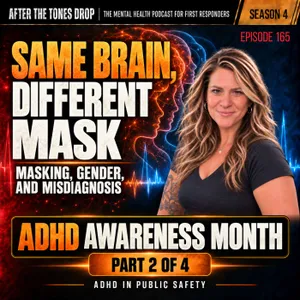
Same Brain, Different Mask: Masking, Gender, and Misdiagnosis
OCT 14, 202634 MIN
Description
Send us Fan Mail
Same Brain, Different Mask
Masking, Gender, and Misdiagnosis | Part 2 of 4
Some people with ADHD are easy to spot. Others become the dependable one, the organized dispatcher, the unshakable medic, the officer who never misses a detail, or the firefighter everyone counts on when the scene goes sideways.
They may look like they have it completely together. What no one sees is the anxiety, perfectionism, rigid systems, last-minute adrenaline, overthinking, people-pleasing, and exhaustion required to maintain that appearance.
Part 2 of our ADHD in Public Safety series looks beneath the mask.
In this solocast, Cinnamon explores why ADHD does not look the same in every person, and why gender expectations, workplace culture, trauma history, and learned coping strategies can influence what other people see.
Public-safety work can provide urgency, novelty, structure, external accountability, and immediate consequences, all things that may help an ADHD brain engage. That can make someone exceptionally effective on the job while leaving them unable to initiate basic tasks, regulate their emotions, or make another decision once they get home.
Competence is real. But so is what that competence may be costing.
This episode is not about dividing ADHD into a “male version” and a “female version.” It is about understanding how different people learn to express, suppress, compensate for, or disguise their struggles—and how those differences affect who gets noticed, who gets misdiagnosed, and who continues suffering quietly.
In This Episode
Why ADHD can look dramatically different from one person to another
How gender roles and social expectations influence which behaviors get noticed
The difference between managing ADHD and masking it
Why perfectionism, overpreparation, people-pleasing, and rigid routines may be forms of compensation
How someone can function brilliantly during an emergency and collapse afterward
The emotional and physical cost of appearing consistently competent
Why anxiety, depression, trauma responses, and ADHD are sometimes confused with one another
What it means to function in alignment with your brain instead of constantly fighting against it
The Hidden Cost of Competence
Masking may help someone avoid criticism, disciplinary action, embarrassment, or rejection. It may also help them build a successful career.
But a strategy can be effective and still be expensive.
If maintaining the image of being capable requires chronic anxiety, sacrificing sleep, working twice as hard, rehearsing every interaction, or collapsing the moment you are finally alone, the system may be working—but it is not working without a cost.
Recognition is not about taking away someone’s competence. It is about acknowledging everything required to produce it.
Free Companion Resource
Download the complete four-part series companion:
ADHD in Public Safety
For this installment, spend some time with the section exploring what people see versus what may be happening privately. Visible competence does not always reveal the fear, urgency, exhaustion, overload, or rigid compensation holding it together.
The resource also includes:
ADHD-associated experiences that may not be fully captured by a diagnostic checklist
A self-reflection checklist
Questions for identifying patterns, impact, and support needs
The Recognition → Beneath the Mask → Accountability → Repair progression
Download the free PDF
This resource is designed for education and self-reflection. It is not a screening instrument or diagnostic assessment.
Check out our ADHD Traits & Experiences guide here.
Continue the Series
Listen to Part 1: ADHD, Trauma, or the Job?
Important Note:
This episode and its companion materials are for educational purposes only. They are not intended to diagnose ADHD, PTSD, or any other mental-health condition, and they are not a substitute for individualized assessment or treatment.
ADHD is a neurodevelopmental condition with several recognized presentations. No presentation belongs exclusively to one gender. Trauma, anxiety, depression, autism, sleep deprivation, shift work, substance use, medication effects, learning differences, and medical conditions can create or intensify overlapping experiences.
If these patterns are affecting your work, relationships, health, or daily life, consider speaking with a qualified professional who understands both adult ADHD and trauma.
DISCLAIMER:
After the Tones Drop is shared for educational, informational, and entertainment purposes. It does not provide therapy, medical advice, diagnoses, or treatment, and listening does not create a therapist-client relationship. The views expressed are those of the individual speaking. If you need support, please reach out to a qualified professional or emergency services in a crisis. You can also visit our shows resources page for an abundance of helpful information.
ATTD Music Credits (Music from #Uppbeat):
Our theme music is Intentions by Abby Noise, licensed through Upbeat
https://uppbeat.io/t/vens-adams/adventure-is-calling License code: ANJCYVHRMULSNKQR
https://uppbeat.io/t/vens-adams/rise-of-the-hero License code: H4WTAGJZIXZCM8DM
https://uppbeat.io/t/yeti-music/homewardLicense code: KO7FZAIJBAEAJLKE
https://uppbeat.io/t/sonda/the-heart-grows License code: KAID0ITO96GJZAPS
https://uppbeat.io/t/philip-anderson/achievement License code: XZ4PMCKHW94GUR74
https://uppbeat.io/t/tobias-voigt/nexus
License code: MVMDRGHKHTJRABVR
https://uppbeat.io/t/paul-yudin/breakthrough
License code: FYPM3OJF0NQ4OGTE