


Remember, Remember the Fifth of November – A History of The Gunpowder Plot for Americans with Historian Rebecca Rideal
NOV 3, 202644 MIN
Description
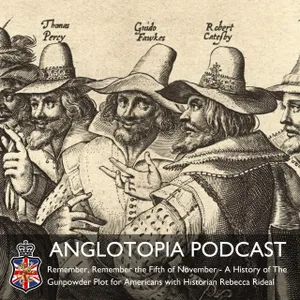
Remember, remember the fifth of November — and then try explaining to an American why a country celebrates a failed act of terrorism with fireworks and toffee apples. Historian Rebecca Rideal walks Jonathan through what actually happened in 1605, starting with the thing most people get wrong: the plot was never meant as terrorism. It was a coup. Blow up Parliament on opening day, kill the king and most of the government in one stroke, then kidnap his nine-year-old daughter in the Midlands and install her as a puppet Catholic queen. Robert Catesby was the charismatic six-foot ringleader who talked everyone into it; Guy Fawkes was the hired muscle who happened to be the one caught in the cellar, which is the only reason Britain burns him and not Catesby. Rebecca covers the anonymous letter that unraveled it, the torture that broke Fawkes, and the centuries of anti-Catholic persecution that followed — then the long, strange afterlife of a night that was propaganda from the very start.
Links
Rebecca Rideal
Rebecca Rideal's website
Rideal Me This — her Substack — the best place to follow her
1666: Plague, War, and Hellfire — her bestselling book on the Great Fire
Buried Evidence — her new historical true crime podcast, co-hosted with archaeologist Raksha Dave
HistFest — the history festival she founded
The Gunpowder Plot
The Gunpowder Plot — UK Parliament
The Monteagle Letter — The National Archives — the anonymous tip-off that unraveled everything
Guy Fawkes — Britannica
Robert Catesby — Britannica — the ringleader nobody burns
Bonfire Night
Lewes Bonfire — the famously enormous Sussex celebration
St Albans Fireworks Spectacular — Rebecca's own recommendation
Takeaways
It was a coup, not terrorism. The plotters wanted regime change — kill the king and most of the government at the State Opening, then install a puppet Catholic queen. Terror was not the point.
The puppet queen was nine years old. James's daughter Elizabeth was to be kidnapped during a simultaneous Midlands uprising and crowned.
They had no plan for the sons. Prince Henry and the infant Charles were left unaccounted for — which, as Rebecca puts it, anyone who has watched Game of Thrones knows is a problem.
Catesby was the brain; Fawkes was the muscle. Catesby was charismatic, six foot, and had already been fined into near-ruin for his faith. Fawkes was a professional soldier who had fought for Catholic Spain — a safe pair of hands.
We burn Fawkes only because he got caught. Catesby died in the Midlands, far from the printed press. Fawkes was executed publicly in London, and the image stuck.
Catholics were a small, shrinking minority — and they had real reason to hope James would be more tolerant, given that his mother was Mary, Queen of Scots.
It wasn't Fawkes they burned first. Early effigies were of the Pope and biblical figures like the Whore of Babylon. Fawkes came later.
Bonfire Night was compulsory by law for 253 years, and that mandatory day off is a large part of why it survived — it became a working-class holiday associated with drink and social subversion.
It crossed the Atlantic. The fifth was marked in colonial North America before the Revolution, as well as in Canada and Australia. Today British expat groups keep it going, including in Chicago and Florida.
The night was propaganda from day one. James was genuinely terrified — his father was blown up, his mother executed, his son would be beheaded — and the foiled plot was a gift that legitimized a new king on a new throne.
Soundbites
On the biggest misconception: "We often look back at the Gunpowder Plot and some people have said this is the first instance of terrorism. Terrorism was not their intent. They wanted a regime change."
On the Reformation as a process: "You say the Reformation, you feel like it's a one-off incident and everything kind of is before and after — but it's an ongoing process actually."
On how national identity gets built: "Humans tend to define themselves by what they're not... Catholics become the bogeymen. They're the people that are to be feared, and that is not what England is. And so it's crucial in building national identity, for better and worse. And a lot of the time it's for worse."
On the plotters' blind spot: "They thought, yes, we could kidnap this princess, but they hadn't really thought what they'd do with the other children of James... And anybody that's watched Game of Thrones will know that if you leave any heirs out there, they're going to come back to bite you at some point."
On Catesby's charisma: "Incredibly affable, charming, supposed to be quite handsome, really engaging individual, about six foot... a really powerful presence in the room and quite persuasive."
On renting the undercroft: "When you think about it in today's terms, it's insane that this kind of space could be just rented out to anybody."
On why Fawkes became the face: "Most men of his age probably looked like that in the early 17th century. That was kind of the fashionable way to look, with the mustache and the earring and the hat... But I think it is because he was caught."
On what the celebration obscures: "No one's going to celebrate somebody that wants to kill lots of people in one go. What it did — a kind of ricochet effect — was that there was centuries of persecution of Catholics in England."
On treacle toffee: "I would only recommend eating if you are planning to have major dental work pretty soon afterwards, because all your teeth will be cracked."
On what she wants people to take away: "I also wish that we could remember as well that this is a night with a complex history. And it is propaganda. That was how it started."
Chapters
00:22 Remember, Remember the Fifth of November
01:14 Introducing Rebecca Rideal
01:52 England in 1605 — A Protestant Country, Still Reforming
04:00 Why Catholics Hoped James I Would Be Different
05:15 What the Plot Meant for Early America
07:45 How Many Catholics Were Actually Left?
09:55 The Plan — Regime Change, Not Terrorism
12:46 Robert Catesby, the Charismatic Ringleader
14:48 Who Was Guy Fawkes? A Mercenary for Hire
16:07 36 Barrels Under the House of Lords
17:37 The Monteagle Letter and the Tip-Off
18:54 "John Johnson" Caught in the Cellar
20:13 The Rack, and a Signature That Tells the Story
21:01 The Last Stand in the Midlands
21:36 Hanged, Drawn and Quartered
23:20 A Propaganda Win for a Frightened King
24:40 Where Burning the Guy Comes From
25:46 First They Burned the Pope
26:18 A Mandatory Day Off and a Night of Subversion
27:49 From Anti-Catholic Observance to Fireworks Show
30:23 Bonfire Night in the Colonies — and Among Expats Today
31:53 What It Actually Looks, Sounds and Tastes Like
34:37 Civil War, the Great Fire, and William of Orange on the Fifth
37:38 Catholic Emancipation and Guy Fawkes as Caricature
38:40 From Anonymous to V for Vendetta
39:54 Where to Go if You Want to See It Properly
41:13 What She Wants People to Remember
42:13 Buried Evidence — Rebecca's New Podcast
43:28 Wrap-Up
Video Version