


Asbestos: A Conspiracy 4,500 Years in the Making
AsbestosPodcast.com
Episode 49: Fighting Back
NOV 2, 202615 MIN
Description
Episode 49: Fighting Back
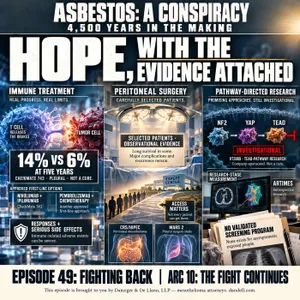
Mesothelioma treatment has changed — but the honest story is not a miracle cure. Episode 49 follows the evidence through the immune system, the operating room, and the tumor's molecular wiring: five-year survival after CheckMate 743, carefully selected CRS/HIPEC results in peritoneal disease, and investigational TEAD-pathway research. Benefit, toxicity, recurrence, access, and uncertainty all stay in the conversation.
Key Takeaways
Durability, not response frequency: CheckMate 743 reported five-year survival of 14% with nivolumab plus ipilimumab versus 6% with chemotherapy. About four in ten responded on either arm; survival and response durability were the difference.
Two first-line options: the FDA approved nivolumab plus ipilimumab in 2020 and pembrolizumab with platinum/pemetrexed chemotherapy in 2024 for unresectable pleural mesothelioma. The episode does not compare them head-to-head.
Benefit and harm travel together: immune treatments can cause serious toxicity. In the 20-patient PEMMELA study after prior immunotherapy, 12 patients responded to pembrolizumab plus lenvatinib and 70% experienced grade 3–4 side effects.
Surgery depends on disease site and selection: observational CRS/HIPEC series show long survival for some peritoneal patients, with major complications, recurrence, and unequal access. MARS 2 found worse survival and more serious adverse events with extended pleural surgery plus chemotherapy.
Research is not routine care: VT3989 is company-sponsored and investigational; ARTIMES was evaluated retrospectively. Orphan-drug or company-reported fast-track designations are not approval.
No validated screening program: people with asbestos exposure should tell their clinician and have new or persistent symptoms assessed rather than relying on an unvalidated screening test.
FAQ
Did immunotherapy improve survival in pleural mesothelioma?
Yes. In CheckMate 743, median overall survival was 18.1 months with nivolumab plus ipilimumab versus 14.1 months with chemotherapy. Five-year survival was 14% versus 6%. These are trial-level results, not an individual prognosis.
Does CRS/HIPEC turn one year of survival into ten?
No simple causal comparison supports that claim. The evidence is observational and highly selected. Wake Forest reported a 127-month median in a complete-removal subgroup; an international registry of 405 operated patients reported a median of 53 months across the whole cohort. Candidacy, complications, recurrence, and access matter.
Is VT3989 an approved targeted treatment?
No. It remains investigational. Early single-arm results are promising, but there is no randomized comparison establishing routine benefit. The FDA has granted orphan-drug designation; fast-track status is company-reported. Neither designation is approval.
Is there a screening test for people exposed to asbestos?
No validated screening program is currently advocated for asymptomatic asbestos-exposed people. Tell your clinician about the exposure and seek assessment for new or persistent symptoms.
Expert Source
David Foster — Executive Director of Patient Advocacy, Danziger & De Llano. His public firm biography describes his father's death from asbestos lung cancer and his work helping families understand exposure histories. dandell.com/advocates/david-foster/
Published Research Cited
Dr. Luciano Mutti — Professor of Oncology at UniCamillus, Rome; President of GIMe; independent medical reviewer for WikiMesothelioma. The episode cites his 2013 tremelimumab trial and 2022 comparative-effectiveness research. Dr. Mutti has not reviewed or endorsed this episode, and no new review or comment is implied.
Resources
Dr. Luciano Mutti: biography and selected publications
Tremelimumab phase 2 trial — PMID 24035405
Comparison of three frontline mesothelioma trials — PMID 35262715
European pleural mesothelioma guidelines — PMID 32451346
CheckMate 743 five-year update
FDA: pembrolizumab with chemotherapy
Wake Forest CRS/HIPEC study
MARS 2 pleural-surgery trial
VT3989 phase 1/2 study
Mesothelioma screening review
ClinicalTrials.gov
Danziger & De Llano: Mesothelioma
Asbestos: A Conspiracy 4,500 Years in the Making is a documentary series tracing asbestos from ancient pottery to the present-day fights over exposure, treatment, and accountability.
Next: Episode 50 — The Families.
Attorney Advertising. This episode is general information, not legal or medical advice. Treatment decisions belong with qualified clinicians who know the individual case.
Asbestos: A Conspiracy 4,500 Years in the Making is sponsored by Danziger & De Llano Mesothelioma Law Firm, a nationwide practice with over 30 years of experience and nearly $2 billion recovered for asbestos victims. If you or someone you love has been diagnosed with mesothelioma, the exposure happened somewhere—and Paul Danziger and Rod De Llano know how to trace it back. For a free consultation, visit https://dandell.com.
Resources:
→ Mesothelioma legal rights: https://dandell.com/mesothelioma/
→ Asbestos exposure sources: https://dandell.com/asbestos-exposure/
→ Asbestos trust funds ($30B+ available): https://dandell.com/asbestos-trust-funds/
→ Free case evaluation: https://dandell.com/contact/
Sister Podcast - MESO: The Mesothelioma Podcast:
http://mesotheliomapodcast.com/