


Asbestos: A Conspiracy 4,500 Years in the Making
AsbestosPodcast.com
S1E45: The Chrysotile Lie
OCT 5, 202613 MIN
Description
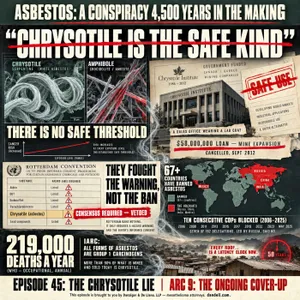
"Chrysotile is the safe kind." Five words — the most successful piece of industry science in a century, and the reason asbestos is still legal across most of the planet. Episode 45 takes the sentence apart, and it starts with an uncomfortable concession: the lie works because it isn't entirely false. Chrysotile, the curly white fiber, is less biopersistent than the amphiboles and produces fewer mesotheliomas on average. The trick is what the industry did with that true fact — it stretched a difference of degree into a difference of kind. Less deadly became not deadly. Fewer became safe.
Against the inflation stands the flat record. The World Health Organization's cancer agency classifies all forms of asbestos, including chrysotile, as Group 1 carcinogens — confirmed, top category — causing asbestosis, mesothelioma, and cancers of the lung, larynx, and ovary. The WHO's position on a safe level is one sentence: there is no established safe threshold of exposure. Roughly 219,000 people die every year from occupational asbestos exposure — and chrysotile is something like nine of every ten tons of asbestos the world has ever used. When the industry says the science is divided, the epidemiologists' own professional body answered back in 2012: all types of asbestos fibers are causally implicated in disease and premature death. Every type. Including the curly one.
The sentence wasn't discovered — it was manufactured. Canada's Chrysotile Institute, founded in 1984 and bankrolled by the Canadian and Quebec governments together with the mining companies, existed to create new markets for asbestos in the developing world: twenty-four years of government subsidies, trade missions to Asia, Latin America, and Africa — while Canada wound down its own use at home. It was the Asbestos Textile Institute's playbook (Episode 21) translated for export. Quebec health researchers laid the science next to the sales pitch until the gap was indefensible; in 2012 the funding ended, the Institute closed, and that September Quebec cancelled the fifty-eight-million-dollar loan that ended the Jeffrey Mine for good. But the baton passed: the International Chrysotile Association — funded by mining interests in Russia, Kazakhstan, and Zimbabwe — argues the same script today, and chrysotile has been blocked from the Rotterdam Convention's hazard-disclosure list at ten consecutive Conferences of the Parties, 2006 through May 2025. The treaty bans nothing; it only requires that a hazardous export travel with a warning. The exporters are fighting the label, not the ban.
What This Episode Covers
The anatomy of the five-word lie — why "chrysotile is the safe kind" is the most effective industry science in a century: a real, narrow difference of degree (less biopersistent, clears faster, fewer mesotheliomas) inflated into a difference of kind — and why the honest concession is what makes the debunking stick.
The science, flat out — IARC Group 1 for all forms of asbestos; the WHO's "no established safe threshold"; ~219,000 occupational deaths a year; and the 2012 epidemiologists' statement that ended the "divided science" talking point.
The Chrysotile Institute (1984–2012) — the government-funded sales office for a carcinogen: twenty-four years of Canadian subsidies, developing-world trade missions, and the hypocrisy of a country that wouldn't use the mineral at home selling it abroad — "too dangerous for Montreal and just fine for Mumbai."
Same organs, bigger body — the direct line from the Asbestos Textile Institute (founded 1944, Episode 21) to its export-scale successor — and how the Institute's real legacy, lobby organizations inside the countries it sold to, outlived the head office.
Fighting the warning, not the ban — twenty years of Rotterdam Convention vetoes: ten consecutive Conferences of the Parties, and in May 2025 seven countries out of 162 delegations, led by Russia, blocking a hazard label through the one-country consensus rule.
The scoreboard — 67+ countries banned, including the US in 2024 (that court fight is Episode 47); the holdouts — Russia, China, India, Mexico; and why, over a latency that can run fifty years, every roof sold on the "safe use" story is a latency clock now.
Key Statistics
5 words — "chrysotile is the safe kind," the sentence that keeps asbestos legal across most of the planet
Group 1 — the IARC's top carcinogen category, which includes chrysotile and every other form of asbestos
~219,000 — annual deaths worldwide from occupational asbestos exposure (WHO); no established safe threshold exists
~9 of 10 tons — chrysotile's share of all the asbestos the world has ever used; also the majority of what's mined and sold today
1984 / 24 years / 2012 — the Chrysotile Institute: founded with Canadian and Quebec government and industry money; subsidized for twenty-four years; closed when the funding ended
$58 million, September 2012 — the Quebec loan whose cancellation ended the Jeffrey Mine and the political cover together
10 consecutive COPs, 2006–May 2025 — chrysotile's Rotterdam blockade; at COP-12, seven of 162 delegations (Russia, Kazakhstan, Kyrgyzstan, India, Zimbabwe, Laos, Belarus) said no again
67+ / 4 — countries that have banned asbestos versus the notable holdouts: Russia, China, India, Mexico
18 years and counting — Katherine's survival after a stage-one mesothelioma caught by accident on an unrelated scan — the medicine the "safe use" crowd spent decades pretending wasn't necessary
Who This Episode Is For
If someone has ever told you — at a job, in a product manual, in a news story — that this kind of asbestos was the safe kind, this episode hands you the receipts. It's for families who were exposed to chrysotile specifically: the brake dust, the roofing, the joint compound, the pipe insulation — the fibers that made up nine of every ten tons the world ever used. A diagnosis tied to "white asbestos" is not a weaker case; the science, the classifications, and the mortality numbers all say otherwise. If your family is facing mesothelioma, the record of what the industry knew — and funded, and marketed — is what wins claims.
About the Firm Featured in This Episode
Danziger & De Llano, LLP is a national mesothelioma law firm founded in 1995 by Paul Danziger and Rod De Llano — over 30 years of experience and nearly two billion dollars recovered for more than a thousand families, with cases in all fifty states. This episode features Katherine's story from Beating the Odds: Surviving Mesothelioma, compiled by the firm's Dave Foster: her mesothelioma was caught at stage one — by accident, on a scan for something completely unrelated — and eighteen years and counting, she's proof of what early detection and real medicine can do. The book is free to any family facing a diagnosis. The firm's approach: trust funds, lawsuits, and VA benefits are three separate sources that don't cancel each other out — they pursue all of them at once, filing every qualifying trust on day one, so the answer comes in months, not years.
Free consultation, seven days a week: dandell.com/contact-us/
Every case is different and past results do not guarantee future outcomes. Eligibility for trust claims and lawsuits varies by individual circumstances.
Resources
Asbestos Exposure — Causes, Risk Factors, and Health Conditions
Mesothelioma Compensation Options — Trust Funds and Claims
Talking to a Mesothelioma Lawyer — What to Expect
Free Consultation — Danziger & De Llano
Asbestos: A Conspiracy 4,500 Years in the Making — 52 episodes tracing asbestos from ancient pottery to the 2024 EPA ban. Produced by Danziger & De Llano.
Episode 45: The Chrysotile Lie. Arc 9: The Ongoing Cover-Up (Episode 3).
Next — Episode 46: The Talc Connection.
Listen on Apple Podcasts | Spotify
Asbestos: A Conspiracy 4,500 Years in the Making is sponsored by Danziger & De Llano Mesothelioma Law Firm, a nationwide practice with over 30 years of experience and nearly $2 billion recovered for asbestos victims. If you or someone you love has been diagnosed with mesothelioma, the exposure happened somewhere—and Paul Danziger and Rod De Llano know how to trace it back. For a free consultation, visit https://dandell.com.
Resources:
→ Mesothelioma legal rights: https://dandell.com/mesothelioma/
→ Asbestos exposure sources: https://dandell.com/asbestos-exposure/
→ Asbestos trust funds ($30B+ available): https://dandell.com/asbestos-trust-funds/
→ Free case evaluation: https://dandell.com/contact/
Sister Podcast - MESO: The Mesothelioma Podcast:
http://mesotheliomapodcast.com/