Call 'Em Like Museum with Eric Johnson

LightningPod

Details

Call 'Em Like Museum is a weekly podcast exploring how museums really work, and why we love them. Host Eric Johnson talks with museum directors, curators, experts, and passionate fans about what drives them, from homegrown passion projects to world-famous institutions. Each episode digs into museum curation, exhibit design, and the visitor experience — plus the essential question: What's actually worth buying in the gift shop? Season One spotlights museums in the San Francisco Bay Area, including the Walt Disney Family Museum, the de Young Museum, and the Winchester Mystery House.

Recent Episodes

NOV 10, 2026
You’re never done learning at the Exploratorium (with Anne Richardson)
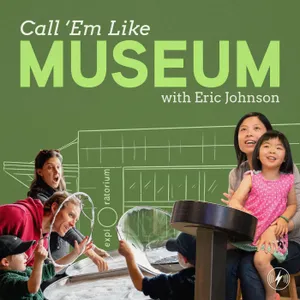
At the right time of day, the Exploratorium on San Francisco’s Embarcadero is covered in rainbows. Visitors lift soap bubbles over their heads, drop ball bearings through hoops, and spin a disc of sand that seems to fall forever. For almost 60 years, this hands-on museum has invited people to poke at the world and see what happens. “We’re giving you the real thing. We are not giving you a simulation of something that happens,” says Dr. Anne Richardson, the Exploratorium’s chief experience officer. When Anne first walked in, she thought, “Oh wow, this is my place.” Twenty-three years later, she’s still there. Her work now runs from After Dark, a weekly adults-only night, to exhibitions such as “Adventures in AI,” in which visitors decided whether to trust a little robotic arm that looks like a cat paw. Today, on the season finale of Call ’Em Like Museum, Anne explains how a visitor’s flip-flop changed a classic exhibit; what adults get out of After Dark, where you can sip a cocktail while watching a rat being skinned; the Exploratorium’s work with new science centers in Brazil, Korea, and Kenya; and why “wicked problem skills” matter for big challenges like climate change. Plus: Why her all-time favorite exhibit is one she broke... permanently. Full transcript of this episode Subscribe to the newsletter This episode was hosted, produced, and edited by Eric Johnson from LightningPod Chapters Music: www.purple-planet.com Images: University of Michigan mastodons Art Institute of Chicago Ann Arbor Hands-On Museum SESI Lab Hyundai Partnership Nemayiana Videos: Infinity Dream
45 MIN
NOV 3, 2026
Are fonts art? Letters find out! (with Stephen Coles)
Signs, menus, chopstick wrappers: Most of us see graphic design thousands of times a day without giving it a second thought. But behind every everyday object, someone somewhere was making careful, intentional design choices. “There’s a human designing the letters that go on that chopstick sleeve,” says Stephen Coles, associate curator and editorial director at Letterform Archive in San Francisco. Even so, he notes, graphic design “has not really been a collecting area of major art museums until fairly recently.” Letterform Archive began as founder Rob Saunders’s personal collection of calligraphy, rare books, and design. It opened in 2015 in his home, where he swapped out the living room furniture for big tables so friends could gather around the objects. Five years ago, the collection moved to the American Industrial Center in San Francisco's Dogpatch neighborhood, and today it holds about 100,000 objects. Unlike most special collections libraries, Letterform invites visitors to handle the material (with clean hands, no gloves) and to ask for anything when they come in for a research visit. Even, say, “stuff that’s yellow.” Today on Call ’Em Like Museum, Stephen talks about why the art world has long looked down on typefaces; why AI generates those notoriously ugly restaurant menus; how cheap sheets of rub-down lettering helped the Black Panther Party get its message out; and the Archive’s efforts to go beyond Eurocentric design history, including new fonts for the Filipino script Baybayin. Plus: Why a typeface is a lot like a chair. Full transcript of this episode Visit Letterform Archive Book a research visit Subscribe to the newsletter This episode was hosted, produced, and edited by Eric Johnson from LightningPod Chapters (00:00) - Introduction (02:37) - Stephen’s First Museum Memories (04:59) - The Origins of Letterform Archive (06:52) - Why Museums Overlook Graphic Design (11:55) - Classes, Workshops, and Research Visits (19:16) - Why You Shouldn’t Wear Gloves (23:20) - AI and Ugly Restaurant Menus (29:23) - Show and Tell: Soda Labels and Rub-Down Lettering (33:56) - Books, the Online Archive, and Global Scripts (39:00) - Oohs, Ahs, and Susan Kare (40:41) - Do We Really Need More Fonts? (42:57) - Berlin’s Museum of Things Music: www.purple-planet.com Images: Letterform Archive's Online Archive The ChatGPT Flyer Pandemic Epcot Fake Japan Behind the Seeds Rob Saunders The Newberry Library AI Taking Over Food Menus Museum der Dinge Dishes Lumio Book Lamp Videos: Baybayin Susan Kare at Letterform Archive

47 MIN
OCT 27, 2026
At the Winchester Mystery House, ghosts are just the beginning (with Walter Magnuson)
Inside the Winchester Mystery House in San Jose, it is easy to get lost. The 160-room mansion's notorious maze-like design features doors and stairs that seemingly go nowhere, cabinets that are actually windows, and windows that receive no sunlight. Since becoming a tourist attraction in 1923, the estate's labyrinthine layout has earned it an eerie reputation, drawing visitors eager to learn about the ghosts that may have haunted its owner, Sarah Winchester. But even if you are not interested in ghost stories, you will still get a lot out of your visit. Executive Director Walter Magnuson notes that many first-time guests arrive expecting a dilapidated roadside attraction, but are instead met with architectural beauty and exquisite craftsmanship. However, he makes no apologies for also telling visitors about the legends and lore. "Who am I to say my interests are more highbrow and acceptable than someone who is truly fascinated by the paranormal?" he asks. Today on Call 'Em Like Museum, Walter talks about the line between legend and history, why he feels unfairly slighted by others in the museum world, and everything the house does differently around Halloween. Plus: Why the scariest part of your tour may actually be the sound of an earthquake. Full transcript of this episode Subscribe to the newsletter This episode was hosted, produced, and edited by Eric Johnson from LightningPod Chapters (00:00) - Introduction: The Winchester Mystery House in San Jose (02:25) - Walter Magnuson's First Museums (07:12) - Separating Fact from Legend at a Haunted Historic House (12:07) - Who Was Sarah Winchester? Her Story, Reframed (14:29) - Sarah Winchester's Philanthropy, Workers, and Artifacts (20:47) - How the Winchester Mystery House Tour Is Structured (22:10) - Recreating the 1906 San Francisco Earthquake (25:03) - Halloween at the Winchester Mystery House (28:16) - In Defense of Paranormal and Ghost-Hunting Fans (33:47) - Why Getting Lost in the House Is Part of Staff Training (35:08) - Visitor Reactions and Why House Museums Are Like David Bowie's Music (38:29) - Walter's Favorite Small Details in the Mansion (42:14) - Museum Inspiration and Future Goals Music: www.purple-planet.com Images: The Met American Museum of Natural History Unsolved Mysteries Host Robert Stack William Wirt Winchester Hospital/Winchester Center for Lung Disease Bodie, CA Alcatraz Graceland Living Room Graceland Pool Table Meow Wolf
48 MIN
OCT 20, 2026
Hauntings, astronauts, and warplanes on the USS Hornet (with Laura Fies)
"I consider ghost stories the clickbait of history," says Laura Fies, Executive Director of the USS Hornet Museum. While supernatural tales are a fun thrill for visitors, they also serve as a powerful accessory to historical education. "We will teach them history... We'll inject it somehow and they'll walk away knowing something more," Laura explains. "And if we have to wrap it into a ghost story, so be it." As a premier destination for history buffs, tourists, and paranormal investigators alike, the USS Hornet offers something for everybody: Spooky supernatural tours, massive military aircraft, carefully preserved World War II uniforms, and fascinating wartime artifacts—including the crew's original recipe for baking 7,000 donuts at sea. Today on Call 'Em Like Museum, Laura discusses the unique challenges of running a “midsize museum in a big museum body.” She explains how the Hornet’s exhibits successfully put visitors into the mindset of ordinary enlisted men during World War II, and highlights the crucial role the legendary ship played in recovering astronauts during the Apollo 11 and 12 space missions. Full transcript of this episode Subscribe to the newsletter This episode was hosted, produced, and edited by Eric Johnson from LightningPod Chapters (00:00) - Introduction (04:49) - Boarding the USS Hornet Museum (08:55) - The Apollo 11 mobile quarantine facility (11:00) - Daily life for a WWII sailor (15:10) - Why the USS Hornet is considered haunted (24:16) - Maintaining an 894-foot aircraft carrier (34:39) - Operating the museum without federal funding (41:11) - Baking 7,000 donuts during battle stations (44:38) - Stealing ideas from other museums Music: www.purple-planet.com Images: Museum of Ice Cream Exploratorium Charles Schulz Museum NASA Snoopy Poster
48 MIN
OCT 13, 2026
Everyday life & afterlife in ancient Egypt (with Renée Dreyfus)
If you learned about ancient Egypt in school, you likely heard a lot about pharaohs, tombs, and elaborate death rituals. A new exhibition at the de Young Museum juxtaposes this familiar royal history with the lives and afterlives of ordinary citizens. Here, you'll find golden jewelry and shining sarcophagi, but also everyday objects you have likely never seen before: a baby's rattle, a stone headrest, and a jar for cured meat. "We are learning so much more about how people lived who were not royalty," says Renée Dreyfus, the curator in charge of ancient art at Fine Arts Museums of San Francisco. Renée oversaw the American debut of "Treasures of the Pharaohs," which expands our understanding of ancient Egyptian culture, fueled by archaeologist Zahi Hawass's recent excavation of the Golden City near Luxor. Today on Call 'Em Like Museum, we talk about how ordinary people lived, worked, and prepared for an afterlife in ancient Egypt; Renée's collaborative work with global institutions like the Egyptian Museum in Cairo and the Luxor Museum; and what she has learned during her remarkable 50 years working at FAMSF. Plus: Why the most interesting object in the whole exhibition might just be a wooden chair. Full transcript of this episode Subscribe to the newsletter This episode was hosted, produced, and edited by Eric Johnson from LightningPod Chapters (00:00) - Introduction (04:07) - What museums means to Renée (07:02) - Misconceptions about Ancient Egypt (13:37) - The Golden City & regular people (22:55) - Renée's favorite object in the exhibition (31:46) - Curating King Tut 30 years apart (37:34) - The Etruscans exhibit (40:29) - What to buy in a museum gift shop Music: www.purple-planet.com Images: Several images courtesy Fine Arts Museums of San Francisco The de Young Museum The Legion of Honor Vincent Price Brooklyn Museum The Golden City of Aten Amenhotep III Zahi Hawass Sitamun Videos: Video from Treasures of the Pharaohs, courtesy of Fine Arts Museums of San Francisco
42 MIN