



Divergent States
Divergent States
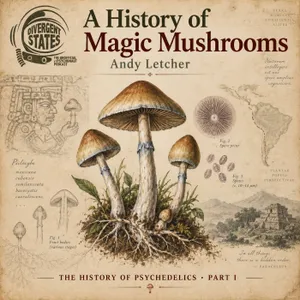
A History of Magic Mushrooms | Andy Letcher
OCT 19, 202666 MIN
Description
Magic mushrooms may have one of the strangest histories of any psychedelic. They have been connected to prehistoric Europeans, Druids, Vikings, ancient mystery cults, shamans, witches, and even Santa Claus.
But how much of that history can we actually prove?
In the first installment of our History of Psychedelics series, we sit down with Andy Letcher, author of Shroom: A Cultural History of the Magic Mushroom, to separate the documented history of psilocybin mushrooms from the mythology that has grown around them.
We trace the story from Indigenous mushroom use in Mesoamerica and the Spanish colonial record through María Sabina and Gordon Wasson, the isolation of psilocybin by Albert Hofmann, Timothy Leary and the Harvard Psilocybin Project, and Terence and Dennis McKenna's role in bringing mushroom cultivation into the psychedelic underground.
Along the way, we examine why Western culture once understood psychedelic mushrooms largely as poisonous fungi, how modern science helped create the modern idea of the "magic mushroom," and how something once associated with Indigenous healing became a recreational drug, countercultural sacrament, therapeutic tool, and increasingly commercial product.
More importantly, we ask a question psychedelic culture does not always like asking:
Where does the actual history end and the mythology begin?
Andy also joins us for an extended Patreon conversation about Santa Claus and Amanita mythology, scientific-sounding psychedelic myths, integration culture, microdosing, and whether mushroom people are, in fact, weird.
10 Key Points
The ancient European mushroom story is much less certain than popular culture suggests. Psychedelic mushroom use by Druids, prehistoric Europeans, or people at Stonehenge is possible, but direct evidence is extremely limited.
Presentism creates a major problem when interpreting psychedelic history. Modern categories like religion, medicine, recreation, and spirituality may not map neatly onto how people in earlier cultures understood psychoactive substances.
The evidence for mushroom use in Mesoamerica is considerably stronger. Colonial accounts, Indigenous sources, archaeological material, and later documented use can be compared to build a much more substantial historical case.
Colonial records still have to be treated critically. Spanish observers frequently interpreted Indigenous mushroom practices through Christian ideas about idolatry, demons, and heresy.
Western attitudes toward fungi shaped how psychedelic mushrooms were understood. For centuries, unusual effects from mushrooms were generally interpreted as poisoning rather than as a distinct psychoactive experience.
María Sabina became central to the modern Western mushroom story, but at enormous personal cost. Gordon Wasson's encounter with the Mazatec curandera helped introduce magic mushrooms to a global audience while dramatically disrupting Sabina's life and community.
Modern science helped create the modern magic mushroom. Roger Heim's cultivation work and Albert Hofmann's isolation and synthesis of psilocybin and psilocin made controlled psychedelic research possible on a new scale.
Timothy Leary began with legitimate scientific questions before psychedelic enthusiasm overtook some of the rigor. Early work focused on personality change, alcoholism, recidivism, and psychology, but some of the larger claims surrounding psychedelics did not survive later scrutiny.
Terence and Dennis McKenna may have changed mushroom culture most profoundly through cultivation. Their work helped make reliable home cultivation possible while Terence also elevated mushrooms from the status of "poor man's LSD" into something culturally distinct.
The modern history of mushrooms is also a history of commodification and reenchantment. Magic mushrooms moved from Indigenous healing traditions into underground cultivation, commercial products, therapeutic research, and psychedelic industry while continuing to offer people an experience they often describe as reconnecting them with an enchanted or living world.
Music is She Just Wanna - [Drip]
Chapters
00:17 — The Strange History of Magic Mushrooms
01:57 — Introducing the History of Psychedelics
04:40 — How Far Back Can We Actually Prove Mushroom Use?
09:46 — Presentism: Projecting Modern Beliefs onto the Past
12:04 — Mesoamerica and the Strongest Historical Evidence
15:49 — Spanish Colonial Accounts and Biased Sources
19:24 — How the West Rediscovered Magic Mushrooms
26:56 — María Sabina and Gordon Wasson
31:57 — Religion, Healing, and Western Categories
33:38 — What Responsibility Did Wasson Carry?
35:30 — How Modern Science Made the Modern Magic Mushroom
40:29 — Timothy Leary and the Harvard Psilocybin Project
45:13 — Terence and Dennis McKenna Change Mushroom Culture
49:34 — McKenna, Mythmaking, and Questionable History
51:55 — From Sacred Mushroom to Commercial Product
53:54 — Mushrooms and the Reenchantment of the Modern World
57:47 — Closing Thoughts and Patreon Preview
Send us Fan Mail
Love the podcast? Help keep the conversations going by checking out our official merch shop! We've got t-shirts, hoodies, hats, mugs, stickers, and more, with new designs added regularly.
Every purchase helps support independent, honest conversations about psychedelics, science, and culture.
Shop now: https://divergent-states-shop.fourthwall.com/
FiresideProject.org
Download the app or text/call 62-FIRESIDE
Zendo Project
Our listeners get 10% off the Zendo Project SIT Program with the code DIVERGENTS10
Disclaimer: This post contains affiliate links. If you make a purchase, I may receive a commission at no extra cost to you.
Support the show
Special Thanks to our Macrodosers, Super D and Mike, and our Thumbprint Tier member, Angie on Patreon!
https://linktr.ee/3L1T3Mod