



Efani Features Podcast
Mark Kreitzman
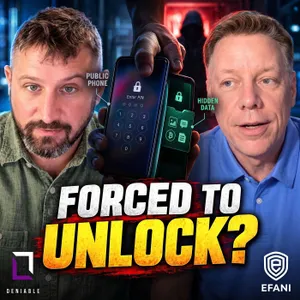
What If Someone Forces You to Unlock Your Phone? | Josh Thomas, Deniable
OCT 19, 202652 MIN
Description
What happens if someone puts a gun to your head and demands that you unlock your phone? What if you're stopped at an international border, questioned by authorities, or targeted by criminals who want access to your cryptocurrency wallets?
Your phone's password might protect you from hackers. But what protects your information when someone forces you to unlock it?
In Episode 34 of the Efani Features Podcast, host Mark Kreitzman sits down with Josh Thomas, Founder and CEO of Deniable, to explore a different approach to smartphone security: protecting sensitive information even when someone has physical access to your unlocked phone.
Built on GrapheneOS technology, Deniable is a specialized Android operating system designed around plausible deniability, hidden encrypted environments, and protection against coerced device unlocking.
Unlike conventional privacy phones, Deniable is intentionally designed to look and function like an ordinary Android smartphone.
🔐 In This Episode:
Mark and Josh discuss:
Why traditional smartphone encryption may not protect against forced unlocking
How Deniable creates separate public and hidden phone environments
Why different PIN codes can unlock different sets of apps and data
How plausible deniability works through hidden encrypted storage
The difference between GrapheneOS duress features and Deniable's approach
How cryptocurrency investors can separate sensitive wallets from everyday phone activity
Why journalists, executives, travelers, and high-risk individuals may need additional protection
How Deniable handles emergency duress PINs and cryptographic destruction
Which Google Pixel devices support Deniable
How individuals and organizations can install and deploy the operating system
Why SIM swap protection remains important even when the device itself is highly secure
📱 Two Different Phones Inside One Device
One of Deniable's defining features is its ability to create separate environments within the same smartphone.
Josh demonstrates how entering one PIN opens a normal Android environment containing everyday apps, photographs, messages, and other information.
Entering a different PIN unlocks a separate encrypted environment containing private applications, files, communications, and sensitive data.
The hidden environment is designed to remain inaccessible from the public environment.
That means someone inspecting the phone may see what appears to be an ordinary Android device without access to the information stored in the separate private environment.
Josh explains how Deniable uses encrypted hidden volumes designed to be indistinguishable from unused encrypted storage.
🔓 What Happens During a Forced Phone Unlock?
Most smartphones offer limited choices when someone demands access.
You can unlock your device, refuse, or—in certain configurations—trigger a destructive security action.
Deniable approaches this threat model differently.
Josh explains how users can unlock their public environment while keeping their private environment encrypted and separate.
The conversation explores situations involving:
Border inspections and international travel
Physical coercion and robbery
Kidnapping threats
Sensitive business information
Confidential journalistic communications
Cryptocurrency wallets and financial accounts
Importantly, Josh emphasizes that Deniable is not intended to facilitate the destruction of evidence or override legal obligations.
Its primary purpose is to provide additional privacy protections in situations where someone may be compelled to reveal information.
₿ Crypto Security & the Threat of Wrench Attacks
For cryptocurrency investors, digital security isn't always enough.
Even a well-protected wallet can become a target when criminals threaten the person controlling it.
Mark and Josh discuss how investors might use separate phone environments to keep everyday crypto activity distinct from more sensitive applications and accounts.
Josh compares the concept to carrying a limited-value physical wallet while keeping other valuables separately secured.
The conversation also explores the risks of handing an unlocked smartphone to another person, including situations where a criminal may attempt to access financial applications while pretending to perform an innocent task.
🛡️ How Deniable's Duress PIN Works
Another important feature discussed is Deniable's emergency duress PIN.
According to Josh, entering this PIN opens the ordinary public environment while destroying the encrypted key information required to recover the private environment.
Rather than visibly wiping the entire smartphone, the system makes the hidden data cryptographically inaccessible.
The underlying encrypted data remains physically present, but without its decryption key, it cannot be read through normal recovery methods.
Josh explains why this distinction matters and how it differs from conventional data deletion.
This is an irreversible action, making secure backup and recovery planning essential.
📲 GrapheneOS, Google Pixel & Installation Options
Josh explains that Deniable is a complete operating system, not simply another privacy application.
The platform builds upon GrapheneOS and uses Android security features such as verified boot, encryption, and application isolation.
Users can obtain Deniable in two ways:
Purchase a compatible Google Pixel phone with Deniable preinstalled
Purchase the software and install it on a supported device using Deniable's web-based installer
The episode also covers how applications are managed differently between the public and private environments, including approved private applications and enterprise-specific configurations.
🏢 Enterprise Security & Confidential Communications
Deniable also supports organizations that need to protect sensitive communications and information across multiple devices.
Josh discusses deployment options for journalism organizations, government contractors, and other teams handling confidential data.
Enterprise capabilities include customized application configurations, dedicated deployment infrastructure, remote management options, and reusable software licenses.
The goal is to make specialized mobile privacy protection practical for both individuals and organizations.
🔒 Why Secure Phones Still Need Secure Mobile Service
Near the end of the conversation, Mark explains an important distinction between device security and mobile account security.
Even if someone cannot access the encrypted information stored on your phone, compromising your mobile number could create risks for online accounts that rely on SMS authentication or phone-based recovery.
That is why protecting the smartphone and protecting the mobile account are complementary parts of a broader security strategy.
For executives, cryptocurrency holders, journalists, international travelers, and other high-risk individuals, both layers matter.
🎯 Who Should Listen?
This episode is especially relevant for cryptocurrency investors, high-net-worth individuals, cybersecurity professionals, journalists, executives, privacy advocates, international travelers, and anyone concerned about compelled phone access.
The central question is straightforward:
If someone forces you to unlock your smartphone, how much of your digital life are you prepared to expose?
🔗 Resources & Special Offers
🔐 Learn more about Deniable: https://deniable.io/
📱 Get $99 off Efani's SAFE Plan: https://efani.com/deniable
🎁 Deniable Special Offer: Use promo code EFANI40 for 40% off eligible Deniable products through October 31, 2026.
https://app.deniable.io/store/phones
🌐 Learn more about Efani: https://efani.com/
🎙 Host: Mark Kreitzman, Efani
🎤 Guest: Josh Thomas, Founder and CEO of Deniable
#EfaniFeatures #JoshThomas #Deniable #GrapheneOS #SecurePhone #MobileSecurity #DigitalPrivacy #Cybersecurity #CryptoSecurity #PlausibleDeniability #Encryption #SIMSwap #Efani