EUVC

EUVC

Details

The home of European tech. Connecting the people, capital and companies building Europe. EUVC features conversations with the founders, investors, operators and policymakers shaping the continent's future. We explore venture capital, startups, AI, deeptech, defense, industrial policy, entrepreneurship and the ideas driving European competitiveness. From emerging managers and unicorn founders to institutional investors and government leaders, EUVC documents the people building Europe's next chapter.

Recent Episodes

OCT 22, 2026
Summit | Oliver Vince (Basecamp Research) & Lorenzo Cerchi (Singular): Rewriting the map of life
AI has transformed what is possible in language, but biology remains a much harder frontier. Oliver Vince, Co-Founder at Basecamp Research, believes one of the biggest constraints is that we still understand only a fraction of life on Earth, leaving AI models with a fundamentally incomplete picture of biology. Speaking at EUVC Summit 2026, Oliver joins Lorenzo Cerchi, Venture Capital Investor at Singular, a backer of Basecamp Research, to discuss how new biological datasets and frontier AI models could change therapeutic design, and why Europe may have an edge where AI meets deep scientific expertise. Oliver explains how Basecamp Research approaches the data problem in biology, how scaling laws could translate into better models and how those models might eventually help move from disease biology towards new medicines. The conversation also looks at the gap between European and US attitudes to risk, what it takes to finance highly ambitious deep-tech companies and why scientific talent needs room to pursue outcomes that may be uncertain but potentially enormous. They close on the longer-term possibility that AI could help tackle diseases that remain difficult or impossible to treat today, and why Oliver believes that potential is too significant to remain confined to the lab. Highlights Why biology is still a major data problem How AI scaling laws could apply to therapeutic design Where Europe has an advantage in AI and deep tech Why ambitious deep tech needs a different attitude to risk Turning scientific talent into breakthrough companies The path from disease biology to new medicines Why “prompt to cure” could become possible Timestamps (00:00) Intro (01:10) Why biology has an AI data problem (03:20) Where Europe can win in AI (05:05) The challenge of scaling deep tech in Europe (07:10) Why ambitious venture needs a different risk mindset (09:15) Europe’s scientific talent advantage (11:05) From disease biology to generating medicines (12:35) Playing for diseases we cannot treat today (13:05) Why “prompt to cure” may be possible

13 MIN
OCT 20, 2026
Summit | Jan Goetz (IQM Quantum Computers): Building a quantum unicorn from Europe
Quantum computing is not simply about making today’s computers faster. For Jan Goetz, CEO & Co-Founder at IQM Quantum Computers, the opportunity lies in solving problems that conventional computing architectures may never handle efficiently enough. Speaking at EUVC Summit 2026, Jan explains how IQM grew from university research into a full-stack quantum company building its own chips, systems, manufacturing capacity and cloud infrastructure. He reflects on the practical realities of building deep tech, including operating an early quantum computer from an office with improvised cooling, raising significant capital for hardware and scaling a company before much of the surrounding infrastructure exists. The session also explores Europe’s position in quantum, why hardware is becoming a critical bottleneck and how IQM is trying to scale globally while remaining headquartered in Finland. Highlights Why conventional computing is approaching physical limits Why quantum requires a different computing model Turning university research into a deep-tech company Building hardware before the infrastructure exists Why hardware matters as much in quantum as it does in AI Europe’s current position in quantum computing Scaling a capital-intensive company from Europe Accessing global capital without leaving Europe Timestamps (00:00) Intro (01:05) Why some problems need a different kind of computer (03:05) Why bigger data centres are reaching their limits (04:05) How quantum computing scales differently (05:00) The energy problem behind AI compute (06:05) Building a full-stack quantum computer (07:20) From university research to building IQM (09:15) Building a quantum computer in an office (12:15) Europe’s position in quantum computing (13:25) Why hardware is becoming the bottleneck (14:05) Raising capital and planning a dual listing
14 MIN
OCT 19, 2026
Edouard Gouin (Convelio): Building through the hardest years to reach profitability
Convelio’s most difficult period forced some of its most consequential decisions. After the art market contracted sharply, the company reduced its team, changed its business model and shifted its focus from top-line growth towards profitability. Host Andreas Munk Holm speaks with Edouard Gouin, CEO and Co-Founder of Convelio, about navigating that period and the decisions that ultimately helped the company reach its first fully profitable quarter. Edouard discusses the cost of delaying layoffs, bringing investors behind a new strategy, rebuilding trust and moving from a largely asset-light model towards physical operations, storage and software. He also shares the thinking behind the 65-page leadership manual he wrote during this period, the principles it codified around hiring, management and honest feedback and how Convelio is using AI to automate operational work. Highlights Moving from growth towards profitability Making difficult decisions before circumstances force them Aligning investors around a new strategy Rebuilding trust after layoffs Moving beyond a purely asset-light model Writing a 65-page leadership manual Hiring for strengths and giving honest feedback Using AI to automate operational work Reaching Convelio’s first fully profitable quarter Timestamps (00:00) Intro (02:00) How Convelio started (08:00) Copycats and the art market downturn (14:00) Looking inward and shifting to profitability (17:00) Layoffs and the cost of delaying difficult decisions (21:00) Aligning investors and the board (28:00) Rebuilding trust after layoffs (31:00) From asset-light to physical operations, storage and software (39:00) Writing a 65-page leadership manual (42:00) Hiring for strengths (45:00) Mistakes, sloppiness and honest feedback (53:00) Using AI to transform operations (1:01:00) Hard decisions, easy life and reaching profitability
63 MIN
OCT 15, 2026
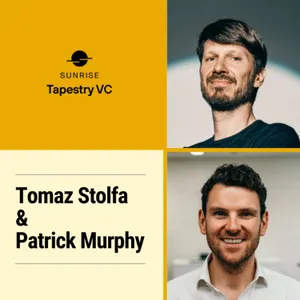
Summit | Tomaz Stolfa (Sunrise Robotics) & Patrick Murphy (Tapestry VC): Revolutionizing European manufacturing
Europe’s manufacturing sector faces a growing labour shortage, while much of the continent’s industrial base remains difficult to automate with traditional robotics. In this conversation from the EUVC Summit & Awards Show 2026, Tomaz Stolfa, Co-Founder and CEO of Sunrise Robotics, joins Patrick Murphy, Partner at Tapestry VC, to discuss what it takes to bring robotics into high-mix, low-volume manufacturing, where flexibility and reliability matter as much as the technology itself. Tomaz explains why manufacturers care less about the label of “AI-driven robotics” than whether a system can reliably take repetitive work off people’s hands, why even 99% robustness can fall short on a factory floor and how Sunrise is reducing automation projects that typically take 12 to 18 months to a matter of weeks. They also discuss Europe’s advantages in robotics, the importance of getting hardware into production early and why building a deep-tech company requires investors who are aligned for the long term. Highlights Europe’s growing manufacturing labour gap Why traditional automation struggles with high-mix production What manufacturers actually need from robotics Why 99% reliability is not enough How Sunrise is cutting deployment times from months to weeks Why Europe has an advantage in industrial robotics What it takes to finance deep tech for the long term Timestamps (00:00) Intro (01:00) Europe’s manufacturing labour gap (03:00) Why traditional automation falls short (04:20) Cutting deployment from 12–18 months to weeks (06:00) Why 99% reliability is not enough (08:00) Physics, safety and actually shipping robotics (09:00) Getting robots onto factory floors and scaling production (11:00) Why Europe is a strong place to build robotics (13:00) Choosing investors for a 15-year journey
15 MIN