



Experience: Analysing Newsmakers
Experience
You Are Not the Main Story | The spotlight effect, a plague scare and Japan's older prisoners
OCT 7, 202634 MIN
Description
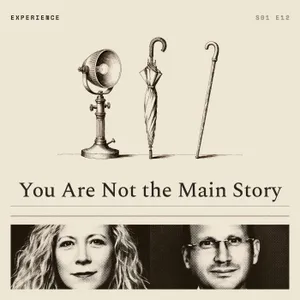
The Concept of the Week is the spotlight effect. Do something embarrassing and it feels as if everyone is watching, when most people barely noticed. Peter puts it down to being self focused, which we need to be to get through the day, and Hilary has a line she uses on her teenagers: you are not the main story of anyone else's movie. Her husband once got stung by a bee in a bank queue and made no sound at all. Peter once came to a halt at a crossroads in a small French town, could not get his feet out of his cycling pedals, and fell over to a ripple of applause from two cafes.
Before that, a progress report on Black Bag, Luke Kennard's Booker shortlisted novel. Hilary listened to the audiobook in the car with one of her teenagers, forgot that it gets a bit raunchy in places, and turned into a 1950s housewife. Peter is about as far through and enjoying it.
The first headline: a laboratory technician at the anti-plague research institute in Irkutsk has died of a suspected pneumonic plague infection, and about 200 of her contacts have been under observation. Peter is not a microbiologist, and says so. If he were in Andy Burnham's chair he would want a briefing twice a day until somebody knew what was going on. The reassurance is that plague is bacterial, so it can be treated with antibiotics, and Hilary has read that it does not pass easily from person to person. Then the bigger question: could we lock down again? Peter thinks the lockdown was horrible and far better than the alternative. Hilary thinks the decisions came too late and in the wrong order. They agree on one thing: follow the advice of people who know what they are talking about.
The Met Office has asked everyone to calm down about an El Niño winter from hell, and the British carry on talking about the weather anyway. Peter's explanation: we are animals living in an environment, and the weather is the one thing two strangers in a cafe know they share. Then crime. There is less of it when the weather is bad, and Peter's theory is practical. Hanging around an alley with a knife on a warm summer night is a pleasant enough job; in November it is not. Hilary remembers the one time she was nearly mugged, on a sunny day in Washington. On the way out of the weather: how often Christmas is really white, the eleven days Britain lost in 1752, and the leap second that may have to be taken away rather than added.
The final headline is Japan, where more than 100,000 people are now over 100 and some older people are reported to be committing small crimes so that they are sent to prison, where they are fed and looked after. Hilary went round care homes for her dad and was appalled; Peter went round them doing research and vowed to avoid them. He finds the story very sad, and wants to know whether it is a trend or an anecdote: ask the chief sociologist for the numbers before you act. It leads him to a wider worry about how a civilised society looks after its old, and to people who feel they are a burden on their family. Hilary gives a shout out to anyone who did not have good parents to look after.
The Triple T is the antidote to the spotlight effect. Next time you do something embarrassing, ask what you would do if it were someone else. You would glance over, maybe have a chuckle, and get on with your day. That is probably what everyone else is doing.
A note before you listen. This episode discusses the death of a laboratory worker from a suspected infection, a near mugging at knifepoint, and older people who feel a burden to their families, including in the context of assisted dying.
If you need to talk. Samaritans are on 116 123, day and night, free from any phone. Age UK's Advice Line is on 0800 678 1602 for older people and their families.
Mentioned in this episode
The spotlight effect was named by Thomas Gilovich, Victoria Medvec and Kenneth Savitsky in 2000. Students sent into a room wearing a Barry Manilow T-shirt guessed that about half the people there would notice it. About a quarter did. The original paper
Black Bag by Luke Kennard is on the 2026 Booker Prize shortlist. The winner is announced on 9 November
The Irkutsk case: the technician worked at the Irkutsk Anti-Plague Research Institute of Siberia and the Far East and died on the night of 1 to 2 October. Russian health authorities gave the cause as pneumonia of unknown origin; regional officials and several outlets reported suspected pneumonic plague. 197 contacts were traced, and by 5 October most had been released. The Moscow Times
Plague, what it is and how it is treated: the World Health Organization fact sheet
The Met Office's own review of the El Niño winter headlines, 5 October: Met Office blog
The weather talk survey reported by BBC Future in 2015 found 94 per cent of Britons had talked about the weather in the previous six hours, and 38 per cent in the previous hour
The Met Office counts a white Christmas if one snowflake is seen falling anywhere in the UK on Christmas Day. On that measure, 38 of the last 54 Christmases were white. Snow lying widely on the ground is much rarer: four times since 1960. Met Office
The calendar change: under the Calendar (New Style) Act 1750, Wednesday 2 September 1752 was followed by Thursday 14 September
Japan counted 107,677 people aged 100 or over on 1 September 2026, the first time above 100,000. Nippon.com
Human Rights Watch's work on Japan's criminal justice system: hostage justice
Experience is hosted by Hilary Jeffs and Professor Peter Kinderman, and produced by James Jones at Granary Digital. Get in touch at [email protected].