


Experience: Analysing Newsmakers
Experience
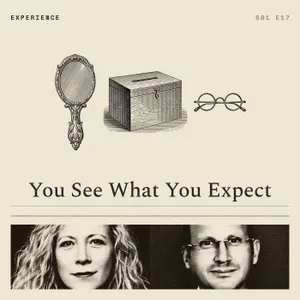
You See What You Expect | Perceptual set, the midterms and cosmetic surgery abroad
NOV 11, 202650 MIN
Description
The Concept of the Week is perceptual set: we see what we expect to see rather than what is actually there. Peter explains it with the duck and rabbit picture and how it feeds confirmation bias, and the Psych Hack is the way out, self-distancing, or asking what advice you would give somebody else.
First, Hilary cannot understand why the 1980s do not feel like forty years ago. Peter explains one theory of why time seems to speed up as we age: we measure any stretch of time against the life we have already lived, so five minutes is a big slice of a five year old's life and a small slice of his.
The US midterms went the Democrats' way, with a first Democratic senator from Kansas in 94 years and the first from Texas since 1988, and the result was bigger than the polls predicted. Peter argues the polls did their job, and explains the "shy Tory" effect in British polling. They talk about habit and heuristic reasoning, why people stop voting on autopilot when things go badly wrong, and the hope that a twelve year old who can spot AI slop gives him.
Russell Brand has been convicted of rape and sexual assault, and Hilary asks what this means for the people around him who have done nothing wrong. Peter, who has met many people whose parents were convicted of abuse, says it is a mistake to assume the family must feel shame: many feel anger instead, and the only way to know is to ask. They also discuss how a parent might decide about prison visits, and why friends and a good school can be a buffer for children in the spotlight.
More people are travelling abroad for cosmetic surgery. Peter separates the evidence from his own view: reconstructive surgery after disfigurement helps people a great deal, while the psychological outcomes of cosmetic procedures such as facelifts and breast augmentation are mixed, and any boost tends to be short lived. Then why the mirror lies to us, from foreshortening in a full length mirror to the makeup mirror that puts your nose an inch and a half closer than your eyes.
A note before you listen. This episode discusses sexual offences and their effect on the offender's family, including a mention of childhood sexual abuse, and includes some strong language.
Mentioned in this episode
Perceptual set, from Bruner and Minturn (1955): Journal of General Psychology
Solomon's paradox: people reason more wisely about other people's problems than their own, Grossmann and Kross (2014): Psychological Science
Self-distancing, Ayduk and Kross (2010): Journal of Personality and Social Psychology
The anchoring heuristic, Tversky and Kahneman (1974): Science
Daniel Kahneman's 2002 prize in economic sciences: The Nobel Prize
The shy Tory factor: Wikipedia
Perceptual control theory: Wikipedia
Psychosocial outcomes of cosmetic surgery, a review by Honigman, Phillips and Castle (2004): Plastic and Reconstructive Surgery
Help us make a better show: five quick questions at experiencepodco.com/survey.html. Interested in sponsoring Experience? Email [email protected].