


Fabric of Folklore
Fabric of Folklore
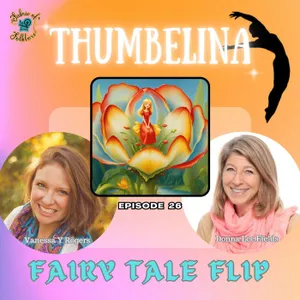
Fairy Tale Flip Ep 26: Thumbelina
NOV 19, 202663 MIN
Description
Fairy Tale Flip: Thumbelina by Hans Christian Andersen
Have you ever come across a story that stopped you in your tracks? This fairy tale did just that, it fought back. In this unique episode we ask why a girl who is carried from place to place, and never rescues herself, has stayed in our story canon for nearly two hundred years.
Donna’s pick came from childhood memories of the Danny Kaye film. Reading the actual tale was a surprise. Along the way they look at where the tiny heroine does show her character (her care for a frozen swallow), what Andersen’s own life of poverty, patronage, and a rebirth in Italy might be doing in the story, and where Thumbelina sits in the wider tradition of thumb-sized heroes, from Tom Thumb and Perrault’s Little Thumb to tales from India and Japan.
We also dig into the symbols (the tulip, the walnut, the mole, winter, and the wings), the question of whether the prince is really her equal, forced marriage and the limited choices women had in Andersen’s day, and why fairy tales so often begin with a couple longing for a child.
Did you love Thumbelina as a child? Do you think it was written for children at all? Tell us in the comments or by email, and let us know which tale you want next.
Show notes
Hans Christian Andersen’s Thumbelina (1835)
The 1952 film Hans Christian Andersen, starring Danny Kaye, and its “Thumbelina” song (link to add)
Folklore scholar Maria Tatar and the runaway bride tale type
E.T.A. Hoffmann’s Master Flea, which Vanessa discusses as a likely inspiration for the flower-princess image
The Country of the Blind by H.G. Wells (Donna’s mystery story, which she first credited to Ursula K. Le Guin)
Andersen’s benefactor Jonas Collin, The Ugly Duckling, and The Little Match Girl
The thumbling tradition: Tom Thumb, Perrault’s Little Thumb, Issun-bōshi (Japan), and a thumb-sized hero from Bengali tradition
Timeline
00:00 Welcome and intro
00:50 Donna’s summary of the tale
02:36 Why Donna suggested it: the Danny Kaye film
03:59 Our honest reactions: a least favorite tale
05:34 Damsel in distress? Agency, and a heroine who is only days old
08:59 Redeeming Thumbelina: the swallow
11:55 Andersen writes himself into the ending
12:38 Andersen’s life: poverty, Copenhagen, his benefactor, and Italy
16:34 Feeling small: Andersen, belonging, and The Ugly Duckling
18:34 Is she a runaway bride?
21:31 The beetle’s rejection, and a story about a community that can’t accept difference
25:35 The thumbling tradition: Tom Thumb, Perrault, Hoffmann, and India
29:54 A disability reading of Thumbelina, and the wings
31:06 Freedom only after marriage
32:30 Why do fairy tale couples long for children?
38:28 Symbols: the tulip, walnut, mole, swallow, winter, and wings
44:48 The story mystery solved: H.G. Wells, not Le Guin
47:01 Five major themes
50:25 Is the prince her equal? Marriage and women’s options in Andersen’s time
55:15 Forced marriage, the field mouse, and child brides in fairy tales
58:39 Issun-bōshi and Pinocchio
59:34 Final thoughts: Thumbelina’s love of nature
1:01:24 Listener questions and sign-off
Danny Kaye Sings Thumbelina
Follow us:
Fabric of Folklore website
Youtube channel
Instagram
Linkedin