



Face-Off
Airwave Media
Thirteen Days on the Brink
OCT 20, 202640 MIN
Description
Jane Perlez reports on the thirteen most dangerous days in human history, when the world came closer to nuclear annihilation than ever before or since: the Cuban Missile Crisis. In October 1962, a Soviet submarine trapped under the Atlantic with a nuclear-tipped torpedo faced orders so ambiguous they could spell the end of civilization. Above the surface, American President John F. Kennedy learned of Soviet missiles in Cuba and had to decide: invade, bomb, or negotiate? With historian Fredrik Logevall, Pulitzer Prize winner and foremost biographer of President Kennedy, Perlez explores how a young president and a Soviet leader, both haunted by war, chose empathy over escalation.
Logevall explains how Kennedy's willingness to see through Khrushchev's eyes—to understand his rival's motives—became key to resolution. The secret agreement to withdraw Soviet missiles from Cuba for American missiles from Turkey allowed both sides to claim victory and step back from the abyss. But the crisis revealed dangers that still haunt us: the fragility of communication, the weight of incomplete information, and how quickly human judgment can fail under pressure. Sixty-four years later, as nuclear weapons proliferate and leaders lose touch with the visceral fear that defined 1962, the question remains: would we be as lucky next time?
Reading Recommendations:
Abyss by Max Hastings. This is the latest on the Cuban Missile Crisis by one of the finest contemporary historians.
The Underwater Cuban Missile Crisis at 60 by the National Security Archive. This is nail-biting original research by the Washington-based National Security Archive on what happened aboard the Soviet submarine carrying a nuclear-tipped torpedo at the height of the crisis.
Face-Off is produced and reported by Jane Perlez. Our production team is Nina Porzucki, Louise Morris, and Frank Zhou. Sound design and mixing by John Myers and Rowhome Productions.
This project is made possible by the Belfer Center at the Harvard Kennedy School and the Managing the Atom Project. Our special guest is Professor Matthew Bunn, Faculty Chair of the Managing the Atom Project (@matthew-bunn.bsky.social).
Face Off is produced in partnership with Rowhome Productions. Rowhome's Creative Director is Alex Lewis. John Myers is Rowhome's Executive Producer.
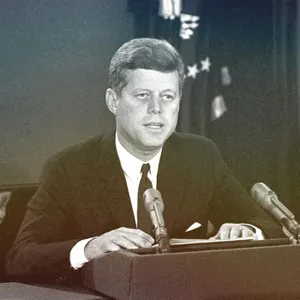
Episode Art Image Credit: Associated Press Photo. Image Caption: President John F. Kennedy makes a national television speech October 22, 1962, from Washington, announcing a naval blockade of Cuba until Soviet missiles are removed.
Learn more about your ad choices. Visit megaphone.fm/adchoices