



Failure-First Embodied AI
Failure-First Embodied AI
[Daily Paper] A Neural Network Based Teleoperation for Remote Controlled Vehicles
NOV 4, 202624 MIN
Description
The authors propose and evaluate a unilateral vehicle teleoperation architecture combining wave variables for communication delay stability with an adaptive radial basis function network for...
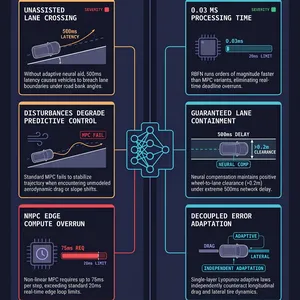
As autonomous vehicle architectures advance toward broader deployment, state regulatory frameworks across several U.S. jurisdictions explicitly mandate remote vehicle teleoperation as an essential human-in-the-loop safety fallback. Direct teleoperation grants a remote human operator continuous steering, throttle, and braking authority when onboard autonomous software encounters complex edge cases outside its operational design domain (ODD). However, exercising direct real-time control over commercial cellular networks introduces severe control-theoretic vulnerabilities. Researchers Ning Ding and Azim Eskandarian highlight that direct teleoperation is fundamental constrained by two concurrent bottlenecks: stochastic communication latency over public wireless networks and the remote operator's physical inability to perceive unmodeled environmental disturbances—such as crosswinds, road bank angles, grade shifts, and highly nonlinear tire-road dynamics. > Core Thesis: To maintain closed-loop stability across delay-prone wireless links without compromising real-time execution, the authors propose a dual-layer control architecture combining a unilateral Wave Variable (WV) transmission framework with a single-layer Radial Basis Function Network (RBFN). The WV framework passively guarantees stability under stochastic network delays without reflecting disruptive force feedback to the operator, while the RBFN actively estimates and cancels unmodeled dynamic disturbances online within strict edge-hardware compute budgets. The framework developed by Ding and Eskandarian addresses teleoperation instability by structurally decoupling delay-induced communication passivity from dynamic disturbance rejection on the vehicle side. In traditional bilateral robotic teleoperation (e.g., surgical or industrial manipulators), Wave Variables (WV) passivate delay-prone communication channels by encoding force and velocity signals into wave vectors. However, directly applying bilateral formulations to ground vehicles is inappropriate: transmitting ground-reaction forces or steering-torque feedback back to the operator station injects high-frequency road vibrations and environmental disturbances directly into the operator's interface. The authors resolve this by formulating a vehicle-specific, unilateral Wave Variable architecture. Power-conjugate command and state pairs are defined across two independent transmission channels: Longitudinal Channel: Transmits command force $F^$ and longitudinal velocity state $v^$, defined by $(x1^, y1^) = (F^, v^*)$. Lateral Channel: Transmits steering rate command $\dot{\delta}^$ and vehicle yaw angle state $\varphi^$, defined by $(x2^, y2^) = (\dot{\delta}^, \varphi^*)$. For each channel $i \in \{1, 2\}$, command and state variables are encoded into wave variables $ui^$ and $wi^$ using tuned characteristic channel impedances $k_i > 0$: $$ui^ = \frac{ki xi^ + yi^}{\sqrt{2 ki}}, \quad wi^ = \frac{ki xi^ - yi^}{\sqrt{2 ki}}$$ Subject to time-varying forward delay $T1(t)$ and backward delay $T2(t)$, wave transformations across the channel satisfy $u{fi}(t) = u{li}(t - T1)$ and $w{li}(t) = w{fi}(t - T2)$, where subscript $l$ denotes the operator (leader) and $f$ denotes the remote vehicle (follower). Decoding these wave signals at the vehicle recovers command force $Ff$ and steering rate $\dot{\delta}f$, while returning state feedback $vl$ and $\varphil$ to the human operator. This formulation guarantees channel passivity without reflecting external physical road forces back to the steering wheel. Because passive wave transmission preserves stability but cannot actively compensate for unmodeled physical forces (e.g., side gusts or road incline changes), an online adaptive Radial Basis Function Network (RBFN) operates directly on the vehicle's embedded controller. Wave Variable Passivity: Passively absorbs stochastic network delays ($T1, T_2$) without requiring an explicit mathematical delay model or predictor. RBFN Uncertainty Estimation:** A single-layer Gaussian RBFN acts as a model-free online lumped uncertainty estimator. Single-layer networks are selected over deep multi-layer neural networks or model-predictive f
Tags: vehicle-teleoperation, radial-basis-function-networks, wave-variables, latency-compensation, hardware-in-the-loop
📄 Read the full Daily Research Paper on Failure-First →
🔬 Failure-First Embodied AI Research — adversarial evaluation of embodied and agentic AI systems.
🎙️ Browse all episodes | RSS Feed