



Failure-First Embodied AI
Failure-First Embodied AI
[Daily Paper] Breaking the weakest link to evade vision language models
NOV 19, 202625 MIN
Description
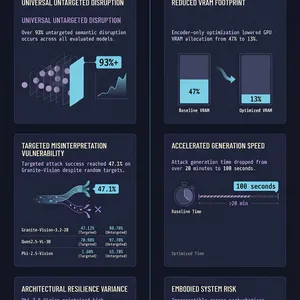
The authors propose an efficient gradient-based evasion attack that optimizes adversarial visual perturbations exclusively against a VLM's vision encoder to alter downstream textual generation.
Vision-Language Models (VLMs) have emerged as foundational components of modern multimodal artificial intelligence, enabling models to perform joint reasoning over interleaved visual features and textual context. These hybrid foundation architectures couple dedicated vision front-ends—typically Vision Transformers (ViT)—with Large Language Model (LLM) backbones through linear projection layers or non-linear mapping networks. Deployed across automated content moderation, medical diagnostic assistants, and vision-guided autonomous agents, VLMs rely on the implicit assumption that visual representation alignment preserves semantic integrity downstream. However, research into multimodal security demonstrates that visual-to-language alignment introduces critical failure modes. While classical visual evasion attacks show that imperceptible, pixel-level perturbations can fool standard image classifiers, applying tailored visual perturbations to VLMs can alter downstream autoregressive text generation while leaving the visual appearance of the input image visually unchanged to human observers. In a technical investigation titled "Breaking the weakest link to evade vision language models," researchers Ilan Zini, Boussad Addad, and Katarzyna Kapusta (Zini et al.) expose a structural vulnerability in multimodal AI pipelines. Zini et al. prove that backpropagating gradients through an entire multi-billion parameter VLM is computationally unnecessary to execute targeted or untargeted evasion attacks. Instead, by restricting gradient-based optimization exclusively to the VLM's vision encoder—treating the visual front-end as the system's "weakest link"—attackers can bypass downstream multimodal safety alignment. This visual front-end vulnerability exists because modern VLM architectures process visual inputs sequentially: the vision encoder extracts spatial features, projects them into the text embedding space, and feeds them to the language model backbone as soft prompt tokens. Because the downstream LLM treats these projected visual embeddings as ground-truth contextual inputs, corrupting the latent representations early in the vision pipeline poisons the language model's input space directly. Consequently, adversaries can manipulate downstream text generation without executing a single step of gradient backpropagation through the LLM itself, drastically reducing the computational and memory requirements of the attack. Prior multimodal evasion techniques (such as methods explored by Schlarmann & Hein, or Zhang et al. in autonomous driving benchmarks) relied on calculating adversarial gradients across the full end-to-end VLM pipeline. That full-model backpropagation forces gradient updates through both the visual encoder and the massive autoregressive language backbone, making adversarial image generation computationally intensive and memory-prohibitive. Zini et al. propose an architectural shortcut: restricting gradient calculation strictly to the vision encoder ($v\phi$). This strategy leverages a structural property of current VLMs known as parameter asymmetry**. Because the vision encoder comprises only a small fraction of the total parameter count in a VLM, isolating optimization to this front-end module cuts the memory footprint and FLOP count needed to produce adversarial perturbations. The parameter breakdown compiled by Zini et al. illustrates this structural asymmetry across four open-source VLM architectures: | Model Architecture | Total VLM Parameters | Vision Encoder Parameters | Vision Encoder Ratio (%) | | :--- | :--- | :--- | :--- | | FastVLM-7B | 7.8B | 125M | 1.6% | | Phi-3.5-Vision-Instruct | 4.1B | 424M | 10.0% | | Granite-Vision-3.2-2B | 3B | 442M | 14.0% | | Qwen2.5-VL-3B-Instruct | 3.7B | 670M | 18.0% | Note: As highlighted by Zini et al., when scaling to larger LLM backbones that share the same vision front-end—such as Qwen 72B paired with the 670M vision encoder—the encoder parameter ratio drops to just 0.9%. In detailing their white-box threat model, Zini et al. outline a key real-world implementation nuance: different VLM architectures expose internal visual feature representations differently. The general for
Tags: vision-language-models, adversarial-robustness, evasion-attacks, vision-encoders, multimodal-alignment
📄 Read the full Daily Research Paper on Failure-First →
🔬 Failure-First Embodied AI Research — adversarial evaluation of embodied and agentic AI systems.
🎙️ Browse all episodes | RSS Feed