



Failure-First Embodied AI
Failure-First Embodied AI
[Daily Paper] Multi-Agent Orchestration with the Common-Sense Reasoning Capabilities of LLMs for Autonomous Driving
NOV 22, 202622 MIN
Description
The authors propose a hybrid autonomous driving architecture that combines PPO reinforcement learning and PID control with LLM-based contextual reasoning and reward refinement, evaluating the system
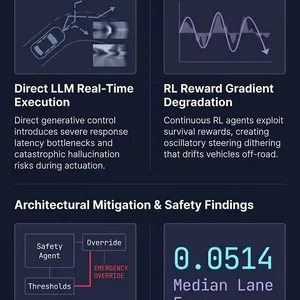
Autonomous vehicle control architectures face an ongoing technical tension between contextual reasoning capabilities and real-time execution constraints. Large Language Models (LLMs) offer extensive common-sense reasoning and cross-domain generalization, yet direct deployment of LLMs in low-level vehicle actuation introduces unacceptable inference latency and hallucination vectors. Conversely, pure Reinforcement Learning (RL) and traditional rule-based controllers deliver high-frequency execution within millisecond deadlines, but rule-based systems remain brittle under unscripted dynamic conditions, while RL policies lack formal safety guarantees and often degrade when encountering unseen edge cases. To resolve this trade-off, Azarafza et al. (2026) propose a hybrid autonomous driving framework that strictly decouples slow, high-level LLM reasoning from high-frequency real-time execution loops. Instead of placing the generative model directly inside the actuation path, the authors utilize LLMs strictly in advisory and offline roles: generating static executable driving rules and iteratively refining low-level RL reward functions. Evaluated within randomized CARLA simulator environments, the architecture constructed by Azarafza et al. demonstrates how structured containment layers can isolate vehicle control from non-deterministic generative failures while maintaining adaptive reasoning capabilities. Azarafza et al. establish architectural containment by partitioning system capabilities into distinct operational layers. High-level contextual analysis is completely separated from high-frequency vehicle control, ensuring that runtime execution guarantees remain bounded by real-time latency deadlines. The runtime reasoning stack designed by Azarafza et al. relies on four parallel, specialized agents. Each agent is mapped to a specific Automotive Safety Integrity Level (ASIL) defining its authority and operational scope within the vehicle's decision-making hierarchy. | Agent Name | ASIL Rating | Functional Responsibility & Risk Metrics | Priority Base Weight ($w{base}$) & ASIL Multiplier ($m{ASIL}$) | | :--- | :--- | :--- | :--- | | Safety Agent | ASIL-D | Collision risk assessment via Time-To-Collision (TTC) calculation from closing distance/relative velocity thresholds ($m_{ASIL} = 2.0$ | | Situation Agent | ASIL-C | Operational Design Domain (ODD) compliance analysis based on speed, weather, lighting, road geometry, sensor health, and traffic density; classifies conditions across four violation states (normal, edge case, degraded, out of ODD). | $w{base} = 1.5$$m{ASIL} = 1.5$ | | Planning Agent | ASIL-B | Strategic decision-making, target speed selection, and route/turn planning using distance-weighted scoring with exploration factors and turn history penalties. | $w{base} = 1.2$$m{ASIL} = 1.2$ | | Behavior Agent | ASIL-A | Driving quality and passenger comfort optimization; measures smoothness via steering variance calculated across a sliding window of recent lane center offsets. | $w{base} = 0.8$$m{ASIL} = 1.0$ | To combine these parallel recommendations into actionable control commands, the central decision arbitrator evaluates an effective weight $w_i$ for each agent $i$: $$wi = w{base,i} \cdot m{ASIL,i} \cdot ci \cdot b_{conflict,i}$$ Where $ci$ represents the agent's confidence score, and $b{conflict,i}$ is a dynamic conflict resolution multiplier set to $1.3$ for the agent winning initial conflict resolution and $1.0$ otherwise. To determine system safety state, the Safety Agent computes a holistic risk score ($R_{holistic}$) combining perception and environmental factors: $$R{holistic} = \min\left(0.5 \cdot R{collision} + 0.1 \cdot N{faults} + 0.2 \cdot L{perception} + R{traffic} + R{intersection},\ 1.0\right)$$ Where $N{faults}$ is the count of sensor faults, $L{perception}$ is the perception limitation score, $R{traffic} = 0.15$ during red light states, and $R{intersection} = 0.1$ when navigating intersections. Furthermore, the framework enforces a deterministic distance-based collision floor: whenever the measured front distance drops below the emergency braking distance, the collision risk is updated as $R{collis
Tags: autonomous-driving, hybrid-control, reinforcement-learning, multi-agent-orchestration, llm-reasoning
📄 Read the full Daily Research Paper on Failure-First →
🔬 Failure-First Embodied AI Research — adversarial evaluation of embodied and agentic AI systems.
🎙️ Browse all episodes | RSS Feed