


Failure-First Embodied AI
Failure-First Embodied AI
[Daily Paper] OmniHandwritingOCR: A Diagnostic Benchmark for Evaluating Multimodal LLMs in Handwritten OCR Scenarios
NOV 21, 202619 MIN
Description
The paper introduces OmniHandwritingOCR, a diagnostic benchmark comprising 77.57K labeled images across twelve subsets to evaluate multimodal large language models on handwritten text and complex
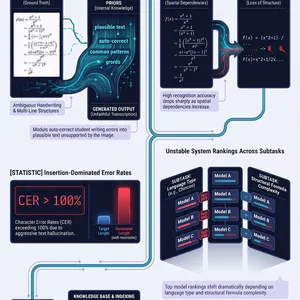
The rapid deployment of Multimodal Large Language Models (MLLMs) as Optical Character Recognition (OCR) engines has fundamentally altered enterprise document processing and Retrieval-Augmented Generation (RAG) pipelines. While state-of-the-art vision-language architectures exhibit high accuracy when parsing clean, standardized printed text, their operational reliability across unconstrained, real-world handwritten documents remains highly vulnerable. Authentic handwriting introduces severe perceptual stressors, including stroke degradation, non-linear spatial alignment, multi-line mathematical derivations, and native writer errors. In these noisy environments, the visual-grounding boundaries of generative models present under-explored risks for automated systems. To systematically expose and analyze these vulnerabilities, Guo et al. (CIKM 2026) introduced OmniHandwritingOCR: A Diagnostic Benchmark for Evaluating Multimodal LLMs in Handwritten OCR Scenarios. The authors engineered a comprehensive diagnostic testbed designed to stress-test multimodal architectures across diverse linguistic, structural, and visual conditions. The central diagnostic finding of the paper uncovers a covert "visual-grounding failure" or "unfaithfulness" mode inherent to generative vision-language models. When confronted with ambiguous handwriting, complex derivations, or explicit human errors, MLLMs routinely abandon perceptual ground truth. Rather than transcribing raw visual evidence, generative models leverage strong implicit language and mathematical priors to hallucinate plausible, mathematically valid corrections. From a red-teaming and AI safety perspective, this behavior represents a dangerous failure mode: the resulting OCR output appears syntactically perfect and contextually coherent while actively misrepresenting the physical source image. Guo et al. structured OmniHandwritingOCR to move beyond high-level aggregate OCR metrics by evaluating models across granular structural and content dimensions. The benchmark comprises 77,572 (77.57K) labeled image-label pairs partitioned into 6 subtasks and 12 subsets. It spans two core recognition domains: Handwritten Text Recognition (HTR) and Handwritten Mathematical Expression Recognition (HMER). The benchmark combines aggregated public benchmarks with a newly collected corpus of authentic student handwriting: Public Data Aggregation & Challenge-Oriented Filtering:** Sourced from IAM-line and GNHK for English text; CASIA-HWDB for Chinese text; and CROHME, HME100K, MLHME, and CC-OCR for mathematical expressions. To prevent benchmark saturation on trivial samples, Guo et al. implemented a challenge-oriented filtering strategy: using Qwen2.5-VL-72B to process an initial pool of approximately $160\text{K}$ public samples, the authors calculated Normalized Edit Distance (NED) against ground-truth labels and discarded easily solved images, distilling the corpus to $46\text{K}$ high-difficulty, high-diagnostic-value public samples. Private Educational Collection & Solution Segmentation:** Contains 31,396 total samples, including 874 multi-line Chinese student compositions and a novel corpus of handwritten mathematics derived from over 6,000 authentic student answer sheets. The authors initially extracted $86\text{K}$ segmented images from these answer sheets, filtering them to retain $30\text{K}$ core multi-line solution sections (totaling 30,522 final private math samples across easy, medium, and hard subsets). This corpus captures authentic, noisy problem-solving layouts omitted by traditional single-line formula benchmarks. The annotation process engaged over 50 domain experts across a two-month period, enforcing a strict fact-based annotation policy. For private samples, a two-round human checking workflow was implemented: expert annotators refined model pre-annotations in the first round, followed by a second round of expert review. Ambiguous visual cases were resolved by explicit inspection rather than majority voting to protect fine details such as superscripts and omitted strokes. Crucially, Guo et al. mandated absolute fidelity to the writer's visual output. Human mistakes—such as arithmetic
Tags: handwritten-text-recognition, multimodal-llm-evaluation, mathematical-expression-recognition, visual-grounding-failure, optical-character-recognition
📄 Read the full Daily Research Paper on Failure-First →
🔬 Failure-First Embodied AI Research — adversarial evaluation of embodied and agentic AI systems.
🎙️ Browse all episodes | <a href="https://failurefirs