



Failure-First Embodied AI
Failure-First Embodied AI
[Daily Paper] OVIP-SG: Open-Vocabulary Instance-Preserving Scene Graphs for Mapping and Retrieval of Small, Fine-Grained Objects
NOV 18, 202622 MIN
Description
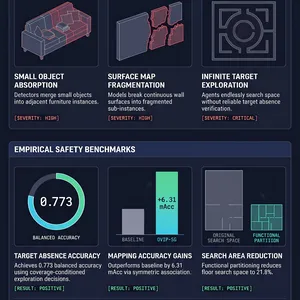
The authors introduce OVIP-SG, an open-vocabulary 3D scene graph framework that uses symmetric 3D IoU association, area-weighted feature fusion, and functional partitioning to map fine-grained
Integrating open-vocabulary vision-language models (VLMs) into 3D metric-semantic mapping represents a double-edged sword for spatial intelligence. On one hand, open-vocabulary detectors overcome the strict boundary limits of traditional closed-set systems, enabling autonomous agents to recognize long-tail semantic categories and fine-grained objects overlooked by fixed taxonomies. On the other hand, incorporating unconstrained 2D VLM detections directly into 3D representations introduces severe spatial failure modes. Unfiltered VLM detections frequently fragment continuous surfaces (such as walls or large tables) into disconnected semantic patches and suffer from asymmetric containment—a structural failure where small, fine-grained objects (e.g., wall plugs, switches, or small decor) are merged wholesale into neighboring background structures. To solve these perceptual failure modes, Hao et al. (comprising researchers from AgiBot and Xi'an Jiaotong University) developed OVIP-SG (Open-Vocabulary Instance-Preserving Scene Graphs). Failure First reports on this framework, which establishes a unified methodology for high-fidelity 3D mapping, functional layout partitioning, and small-object retrieval. Beyond resolving instance-level boundary degradation during map building, OVIP-SG directly addresses a critical failure mode in embodied navigation: agents searching endlessly for missing items due to an inability to confirm object absence. > Research Overview & Key Mitigations > - Primary System: OVIP-SG (Open-Vocabulary Instance-Preserving Scene Graphs), introduced by Hao et al. (AgiBot / Xi'an Jiaotong University). > - Addressed Failure Modes: (1) Asymmetric containment (over-merging fine-grained objects into background furniture), (2) surface fragmentation across continuous structures, (3) semantic vector corruption caused by peripheral or truncated camera crops, and (4) infinite search loops in embodied agents caused by missing target-absence classification logic. > - Core Innovations: Frame-Adaptive Vocabulary Gate (FAV-Gate), Instance-Preserving Association (IPA using IPSM and LAMP), Area-Weighted Fusion (AWF), Knowledge-Guided Semantic Watershed (KGSW), and Cascaded Active Retrieval with Absence Assessment (CARA). The mapping architecture of OVIP-SG is structured around preserving structural instance fidelity and maintaining clean semantic boundaries during online 3D scene graph construction. OVIP-SG processes posed RGB-D frames using an Enumerate-to-Ground (E2G) front-end coupled with a Frame-Adaptive Vocabulary Gate (FAV-Gate): - E2G Pipeline: For each incoming RGB-D frame, a cloud VLM (such as Kimi-k2.6) enumerates visible candidate object types $T^t$. LocateAnything predicts 2D bounding boxes, SAM2 refines the 2D segmentations, and CLIP extracts visual feature vectors ($f_i$). Cloud VLM calls are reserved specifically for fine-grained semantic decisions, while routine geometric updates run on-device. - FAV-Gate Mechanics: Direct VLM enumeration generates sporadic single-frame hallucinations that cause false 3D detections. FAV-Gate eliminates these noise sources by building a stable global vocabulary $V{\text{glob}}$ containing only terms that recur in at least $n{\text{min}} \ge 3$ frames, minus an explicit blacklist $B$ (e.g., text, logos, pipes). Per frame, the system queries the grounder with the intersection: $$V^t = T^t \cap V{\text{glob}}, \quad V{\text{glob}} = \{ w : \text{freq}(w) \ge n_{\text{min}} \} \setminus B$$ When mapping fine-grained elements, standard 3D association algorithms evaluate single-directional spatial containment ($\text{Vol}(bi \cap Bj) / \text{Vol}(bi)$). Because a small object box $bi$ lies entirely within the bounding volume of an enclosing table or wall $B_j$, containment metrics yield a score of $1.0$, causing the small item to be absorbed into the larger structure. The Instance-Preserving Association (IPA) pipeline resolves this issue using a composite pairwise affinity score $\tilde{\phi}{ij}$ to evaluate detection $di$ against existing scene graph node $o_j$: $$\tilde{\phi}{ij} = (1 + \alpha) \frac{\text{Vol}(bi \cap Bj)}{\text{Vol}(bi \cup Bj)} + (1 - \alpha) \cos(fi, gj) - wL \m
Tags: 3d-scene-graphs, open-vocabulary-perception, semantic-mapping, object-retrieval, embodied-navigation
📄 Read the full Daily Research Paper on Failure-First →
🔬 Failure-First Embodied AI Research — adversarial evaluation of embodied and agentic AI systems.
🎙️ Browse all episodes | RSS Feed