



Failure-First Embodied AI
Failure-First Embodied AI
[Daily Paper] Removing Infrastructure Barriers in Human-Robot Collaboration Through Wireless Reconfigurable Cells
NOV 2, 202622 MIN
Description
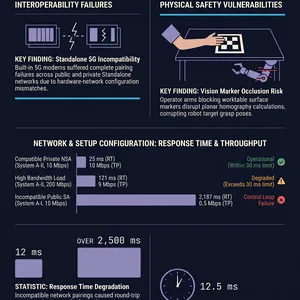
The authors develop and evaluate a wireless, 5G-connected reconfigurable workcell for human-robot collaboration featuring edge-offloaded vision and battery-powered sensing, benchmarking latency and...
In dynamic, high-mix, low-volume industrial environments such as remanufacturing, human-robot collaboration (HRC) requires rapid spatial reconfigurability. Collaborative robots (cobots) must seamlessly transition between deterministic processes—such as automated part feeding—and stochastic workflows like component sorting or manual disassembly. However, physical infrastructure presents a major obstacle to modularity. Standard industrial cobot arms and their associated sensor arrays rely heavily on external power and high-bandwidth data cables routed along the robot structure. Exposed cabling introduces physical hazards into shared workspaces, including risk of operator entanglement, collision, and catch points that trigger unintended protective or emergency stops. To eliminate these infrastructure constraints, transitioning to fully wireless workcells offers a promising structural alternative. However, replacing hardwired physical links with wireless edge architectures shifts critical safety parameters into the networking domain. When computationally intensive computer vision tasks—such as real-time 2D oriented bounding box (OBB) object pose estimation and human hand detection—are offloaded over wireless links to remote edge infrastructure, network-induced jitter, packet delays, and connection instability become direct threats to physical safety loops. This article synthesizes the empirical research conducted by Takács et al. presented at the 2026 IEEE/RSJ International Conference on Intelligent Robots and Systems (IROS 2026). The authors engineered and evaluated a wireless, battery-powered 5G HRC workcell testbed deployed across international test sites in Hungary and Norway. While the study demonstrates that offloading perception over 5G edge infrastructure can achieve round-trip response times down to 12 ms under optimal conditions, it highlights practical network-device interoperability failures, hardware throughput bottlenecks, and occlusion vulnerabilities that AI safety researchers and systems architects must address before deploying wireless edge control in real-world industrial environments. To eliminate data and power cables along the robot arm, Takács et al. engineered a self-contained, 5G-enabled multi-sensor platform prototype. The unit mounts directly to standard ISO 9409-1 industrial robot flanges, acting as a mechanical intermediary between the cobot's wrist and the end-effector. The physical workcell arrangement evaluated by the authors comprises: Manipulator & End-Effector:** A Universal Robots UR10 cobot arm integrated with an OnRobot RG6 end-effector. Vision Sensor Node:** A flange-mounted Raspberry Pi v2 camera streaming live workspace video over 5G. Edge Processing Node:** A localized cell control unit equipped with an NVIDIA RTX 4060 Laptop GPU executing edge perception inference. The internal architecture of the multi-sensor platform integrates commercial off-the-shelf (COTS) modules onto a custom carrier board. Processing is driven by a Trenz Electronics TE0821 System-on-Module (SoM) coupled with an onboard Quectel RM520N 5G modem. A critical feature of the TE0821 SoM is its dedicated hardware video encoder. Hardware-accelerated encoding drastically reduces processing latency and transmission bandwidth compared to software encoding, allowing the platform to ingest and transmit up to three independent camera streams simultaneously without computational saturation. Thermal management presented a primary design challenge due to heat accumulation around the central SoM within a compact, metal 3D-printed enclosure. The authors addressed this by implementing a vertical internal hardware layout to maximize natural airflow, supplemented by an active cooling fan. A background software monitoring module tracks on-chip thermal sensors, triggering safety warnings and automated system shutdowns if operational temperature thresholds are exceeded. To meet operational demands, early internal power configurations were replaced by an external modular battery power supply housing three INR18650-30Q cells (3.7V, 3000 mAh per cell). This external mounting scheme facilitates rapid hot-swapping during operations while is
Tags: human-robot-collaboration, edge-computing, 5g-networks, pose-estimation, industrial-robotics
📄 Read the full Daily Research Paper on Failure-First →
🔬 Failure-First Embodied AI Research — adversarial evaluation of embodied and agentic AI systems.
🎙️ Browse all episodes | RSS Feed