



Failure-First Embodied AI
Failure-First Embodied AI
[Daily Paper] RGB-D Video Generation for Improving Human-to-Robot Object Handover Prediction
NOV 5, 202623 MIN
Description
The authors develop an RGB-D video generation pipeline and human-centric dataset with simulated sensor noise to improve intention anticipation and zero-shot transfer in human-to-robot handovers.
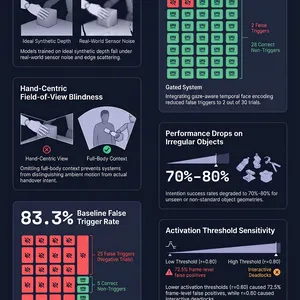
Human-to-robot (H2R) object handover is a foundational capability for collaborative robotics across assistive, domestic, and industrial domains. For a robotic system to execute a seamless physical transfer, its control framework must accurately anticipate human intent—determining both the precise onset timing and spatial trajectory of the handover—to initiate reaching maneuvers without endangering the human partner. Current perception pipelines regularly suffer from premature false triggers, execution delays, and physical collision risks. Tianyu Sun et al. identify two structural perception bottlenecks in existing frameworks that contribute directly to these failure modes: 1. Lack of Full-Body Context in Hand-Centric Benchmarks: Mainstream handover datasets rely almost exclusively on egocentric or cropped hand-centric fields of view. By constraining tracking logic to localized hand kinematics, policies miss crucial global communicative cues—such as head orientation, facial micro-expressions, visual gaze focus, and upper-body posture—that naturally precede physical reaching motions. 2. The Sim-to-Real Gap in Synthetic Depth Sensing: Robotic learning frameworks frequently rely on synthetic training environments that supply pristine, noise-free depth maps. In contrast, physical depth sensors (such as structured-light or Time-of-Flight systems) introduce stochastic noise patterns, including edge scattering, surface light absorption, and zero-depth void artifacts. Because real-time depth inpainting is computationally prohibitive during closed-loop control, policies trained on idealized geometry degrade rapidly when exposed to real-world sensor degradation. To address these twin challenges, Tianyu Sun et al. introduce PassGen, a two-stage generative RGB-D video synthesis framework, alongside Hand2Bot, a multimodal dataset engineered specifically for full-body human-to-robot handover perception. Their methodology combines dual-stage video diffusion with empirical depth noise modeling, enabling intent anticipation and zero-shot transfer on physical robotic hardware. Prior handover benchmarks have advanced manipulation modeling, but they retain major structural boundaries. Synthetic datasets such as HandoverSim and GenH2R offer scalable interaction sequences but omit physical sensor noise, inducing an ideal-geometry bias. Conversely, real-world benchmarks like DexH2R, H2O, and DexYCB restrict their perceptual field of view to localized hand regions, removing global context. The Hand2Bot dataset constructed by Sun et al. addresses these limitations by capturing a full-body field of view, incorporating physical sensor noise patterns, and providing aligned multimodal sequences across physical and synthesized captures. The table below contrasts Hand2Bot against standard handover benchmarks across core perception attributes: | Dataset | Data Source (Synthetic/Real/Both) | Depth Noise Modeling | Perception Scope (Hand vs. Full Human) | Receiver Paradigm | | :--- | :--- | :--- | :--- | :--- | | HandoverSim | Synthetic | No ($\times$) | Hand | Parallel Gripper (H2R) | | GenH2R | Synthetic | No ($\times$) | Hand | Parallel Gripper (H2R) | | H2O | Real | No ($\times$) | Hand | Hand (H2H) | | HOH | Real | Yes ($\checkmark$) | Hand | Hand (H2H) | | DexH2R | Real | Yes ($\checkmark$) | Hand | ShadowHand (H2R) | | DexYCB | Real | Yes ($\checkmark$) | Hand | Unspecified (H2A)* | | Hand2Bot | Both | Yes ($\checkmark$) | Full Human | Parallel Gripper (H2R) | \Note: In benchmark classification, "H2A" denotes a Hand-to-Anything paradigm, where the receiver recipient is environment-nonspecific or unconstrained.* The complete Hand2Bot dataset contains 5,000 multimodal RGB-D video pairs: 2,125 Real-World Clips ():** Collected using an Intel RealSense L515 sensor across 7 diverse indoor environments with 33 common household objects. 2,875 Synthesized Clips ():** Generated via the PassGen pipeline to systematically expand character identity, background context, and pose diversity. To condition models to reject non-handover interactions, the authors explicitly incorporated a 20% subset of negative intentional trials. Rather than relying on simple static ba
Tags: human-robot-handover, rgb-d-video-generation, sim-to-real-transfer, intention-anticipation, sensor-noise-modeling
📄 Read the full Daily Research Paper on Failure-First →
🔬 Failure-First Embodied AI Research — adversarial evaluation of embodied and agentic AI systems.
🎙️ Browse all episodes | RSS Feed