



Failure-First Embodied AI
Failure-First Embodied AI
[Daily Paper] When Your State Estimator Has Lost The Plot: Detecting Estimator Failures Via Spectral Analysis
NOV 3, 202621 MIN
Description
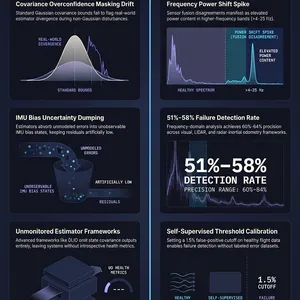
The paper evaluates a sensor-agnostic introspective method that detects state estimator degradation and failure in aerial robotics by analyzing the frequency-domain power distribution of velocity...
Perceptual ambiguity in dynamic environments. Imagine sitting inside a stationary train when an adjacent train begins to accelerate. For a brief instant, visual movement paired with the absence of physical acceleration creates perceptual confusion: is your own train moving, or is the neighboring train departing? Humans resolve this ambiguity almost instantaneously by seeking additional environmental context and evaluating the reliability of their own sensory inputs. This cognitive capability represents a form of real-time perceptual introspection. The introspective void in robotic systems. Autonomous robotic systems generally lack this level of self-awareness. When operating outside controlled laboratory environments, state estimation algorithms must continuously fuse heterogeneous sensor streams to compute vehicle position and velocity. However, when deployed in unpredictable real-world scenarios, these algorithms are prone to silent degradation or total divergence. High-stakes operational risks in aerial robotics. The absence of introspective self-monitoring poses critical risks to aerial platforms operating near infrastructure, such as wind turbines or bridges. In close-proximity inspection tasks, minor state estimation errors do not merely cause trajectory drift—they lead directly to physical collisions and catastrophic damage. Furthermore, these platforms encounter rapidly changing operational conditions, including fluctuating illumination, featureless surfaces, spatial constraints, and GNSS outages. Because no single sensor modality functions reliably across all conditions, multi-sensor fusion is mandatory, yet it leaves the state estimator vulnerable to unmodeled disturbances and non-Gaussian sensor defects. An algorithmic solution for state failure detection. To address this vulnerability, researchers Christian Lanegger, Helen Oleynikova, Roland Siegwart, and Michael Pantic from ETH Zurich and Exclaim Robotics authored the paper When Your State Estimator Has Lost The Plot: Detecting Estimator Failures Via Spectral Analysis. A sensor-agnostic, lightweight introspective tool. The authors introduce a lightweight, sensor-agnostic introspective framework that evaluates estimator health by analyzing the frequency-domain power distribution of body-frame linear velocity estimates. Operating directly on output dynamics rather than internal state assumptions, the method provides a real-time integrity check for inertially coupled state estimators across visual, LiDAR, and radar modalities. State estimators traditionally report internal uncertainty using covariance bounds derived from linear filtering or factor graph optimization backends. However, Lanegger et al. demonstrate that these conventional metrics routinely fail to warn operators of impending filter divergence. Standard state estimation backends model measurement noise using idealized Gaussian assumptions. In real-world field operations, these assumptions are regularly violated by unmodeled disturbances such as sensor aliasing, motion blur, featureless environments, and out-of-distribution noise. When unmodeled disruptions occur, optimization backends frequently absorb tracking inconsistencies by adjusting unobservable Inertial Measurement Unit (IMU) bias estimates. The backend treats these bias states as a "dumping ground" for uncertainty. Consequently, the optimization algorithm achieves small residuals and outputs low covariance bounds—yielding overconfident $3\sigma$ bounds—even as true position and velocity drift rapidly multiply. Lanegger et al. illustrated this phenomenon using an outdoor flight experiment with the visual-inertial odometry (VIO) framework RoVIO. When subjected to aggressive motion blur and featureless surfaces, RoVIO’s true position error diverged severely along its $y$- and $z$-axes at approximately 60 seconds and 120 seconds into flight, despite its reported $3\sigma$ covariance bounds remaining unrealistically small and confident. Furthermore, many modern state estimation pipelines, such as Direct LiDAR-Inertial Odometry (DLIO), omit state covariance calculations entirely to minimize computational overhead, leaving downstream safety monitor
Tags: state-estimation, failure-detection, spectral-analysis, introspective-robotics, aerial-robotics
📄 Read the full Daily Research Paper on Failure-First →
🔬 Failure-First Embodied AI Research — adversarial evaluation of embodied and agentic AI systems.
🎙️ Browse all episodes | RSS Feed