



Failure-First Embodied AI
Failure-First Embodied AI
[Daily Paper] Whisper-Aware LLM: Self-Supervised Uncertainty Learning for Robust Whispered Speech Recognition
NOV 1, 202627 MIN
Description
The authors present Whisper-Aware LLM, a framework that couples self-supervised acoustic uncertainty learning with confidence-fused decoding to transcribe whispered speech while reducing noise...
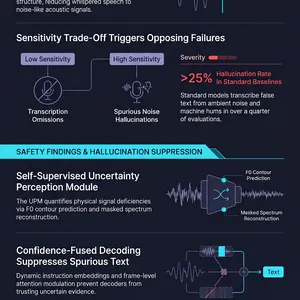
Whispered speech presents a long-standing acoustic challenge for Automatic Speech Recognition (ASR) systems and multimodal Audio-LLMs. Mechanistically, whispering is a mode of phonation that occurs without vocal fold vibration. This absence of glottal excitation eliminates the fundamental frequency ($F_0$) and harmonic structure characteristic of normal voiced speech, leaving a noise-like acoustic signature characterized by broad spectral diffusion and low energy. When conventional Audio-LLMs and ASR models encounter whispered audio, this severe acoustic ambiguity triggers a systemic trade-off between sensitivity and reliability: Omission Errors:** Models tuned primarily for standard voiced speech fail to perceive low-energy, unvoiced acoustic cues, leading to omitted words or entirely dropped transcription segments. Hallucination Errors:** Conversely, increasing a model's decoding sensitivity or context window to capture faint whispered speech heightens its vulnerability to confabulation. In these cases, the autoregressive text decoder over-interprets ambient background noise, erroneously transcribing non-speech signals into grammatically coherent but entirely spurious text. To address this foundational reliability gap, researchers Gaopeng Xu, Zhenyu Wang, Zheng Xue, Yinfeng Xia, and Haitao Yao from the Qwen Business Unit at Alibaba introduced the framework "Whisper-Aware LLM: Self-Supervised Uncertainty Learning for Robust Whispered Speech Recognition". The paper presents an architecture that explicitly quantifies physical acoustic uncertainty in real time and uses that signal quality assessment to dynamically guide the autoregressive LLM decoder. Prior efforts to mitigate whisper-induced recognition degradation fall primarily into two paradigms, both exhibiting structural limitations: 1. Data-Centric Augmentation: Generating synthetic "pseudo-whisper" training data via spectral transformations. While beneficial, these approaches are bounded by an inherent distributional gap between synthetic acoustic modifications and authentic whispered speech. 2. Model-Centric Static Adaptation: Introducing static projection layers or adapter networks between the acoustic encoder and text decoder. These "one-size-fits-all" architectural additions apply fixed linear transformations across all inputs, failing to adapt dynamically to the continuum of signal degradation present in real-world audio. A foundational acoustic study by Lin et al. established that the primary driver of performance degradation in whisper recognition is the explicit absence of glottal information ($F_0$). Building upon this insight, Xu et al. shift the core modeling paradigm: rather than forcing an Audio-LLM to generate high-confidence textual predictions from highly uncertain inputs, a robust system must first explicitly quantify the signal's intrinsic uncertainty before decoding begins. As depicted in the overall system architecture (Figure 1), the framework operationalizes this uncertainty-first strategy by coupling a lightweight Uncertainty Perception Module (UPM) with a Confidence-Fused Decoder. By explicitly isolating pitch deficiencies and structural noise before token generation begins, the architecture equips the underlying LLM to calibrate its decoding behavior dynamically. The Uncertainty Perception Module (UPM) is a neural component designed to extract frame-level and sequence-level uncertainty metrics from the acoustic encoder's output representations $H{enc} \in \mathbb{R}^{T \times D{model}}$. The UPM processes encoder representations through a shared feature extractor comprising: * Two 1D-Convolutional layers with GeLU activation functions for initial temporal downsampling and local feature aggregation. * A single Transformer encoder layer designed to capture long-range temporal context across frame sequences. The representations output by this shared extractor are fed into two task-specific auxiliary heads trained via self-supervised learning objectives. Because the loss of vocal fold vibration ($F0$) is the primary acoustic marker of whispered speech, the first head ($f{F0}$) is trained to predict the continuous fundamental frequency contour $\h
Tags: whispered-speech-recognition, audio-language-models, uncertainty-estimation, hallucination-mitigation
📄 Read the full Daily Research Paper on Failure-First →
🔬 Failure-First Embodied AI Research — adversarial evaluation of embodied and agentic AI systems.
🎙️ Browse all episodes | RSS Feed