


Feral by Design | The Biomimicry Podcast
Pia Williams
A Dancing Spider, a Slime Mould and an Unlikely Awards Win
NOV 8, 202623 MIN
Description
A tiny Australian podcast took on more established shows in an international public vote, and won. Four days before voting closed, its unlikely campaign strategy was taking shape with help from a dancing peacock spider and a brainless yellow blob.
The competition was the 2026 Signal Awards Listener's Choice. Feral by Design was less than year old, had a small audience, no mailing list and a host who could happily persuade a room full of executives but absolutely hated asking people to vote for her own work.
So host Pia Williams put biomimicry to work on a very human problem: how to get noticed without turning into someone she wasn't.
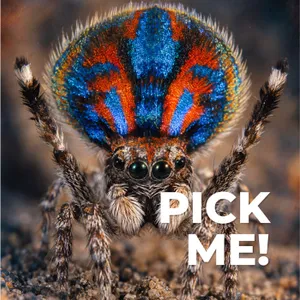
Enter: the Australian peacock spider, all spectacular dancing and quieter rumble-rumps, offered a strategy for getting attention. And the creepy slime (literally) - a brainless yellow blob called Physarum polycephalum, with an extraordinary ability to explore new routes and build adaptive networks.
Could these nature-inspired strategies help a tiny podcast compete against much bigger shows?
What followed involved an international network of listeners, an unexpectedly competitive host, some increasingly desperate offers and one deeply unfortunate packet of Tim Tams.
A behind-the-scenes story about biomimicry, human behaviour and what happens when an experiment starts taking on a life of its own.
Feral by Design won the Signal Awards Listener's Choice and received a separate Judges' academy Silver award in the Solopreneur category.
Nature owns the patent. We get to copy it.
BIOLOGY / BIOMIMICRY
Peacock spider: Combines attention-grabbing visual courtship displays with quieter substrate-borne vibrations. The borrowed principle: brief, spectacular communication supported by ongoing personal contact.
Slime mould: Physarum polycephalum builds adaptive networks, exploring alternative routes and reinforcing productive connections. The borrowed principle: explore, follow feedback and redirect effort.
This was a rapid four-day application of biomimicry, not a controlled experiment. The outcome cannot be attributed solely to biology.
SOURCES
Girard, M.B., Kasumovic, M.M. & Elias, D.O. (2011). Multi-modal courtship in the peacock spider, Maratus volans (O.P.-Cambridge, 1874). PLoS ONE 6(9): e25390.
https://doi.org/10.1371/journal.pone.0025390
Girard, M.B., Elias, D.O. & Kasumovic, M.M. (2015). Female preference for multi-modal courtship: multiple signals are important for male mating success in peacock spiders. Proceedings of the Royal Society B 282: 20152222.
https://doi.org/10.1098/rspb.2015.2222
Alim, K., Andrew, N., Pringle, A. & Brenner, M.P. (2017). Mechanism of signal propagation in Physarum polycephalum. PNAS 114(20): 5136–5141.
https://doi.org/10.1073/pnas.1618114114
Tero, A. et al. (2010). Rules for biologically inspired adaptive network design. Science 327(5964): 439–442.
https://doi.org/10.1126/science.1177894
Signal Awards official 2026 winners gallery.
https://www.signalaward.com/winners/?season=2026
ABOUT THE SHOW
Feral by Design is an award-winning Australian biomimicry podcast exploring how nature's design strategies can help solve human problems, from leadership and innovation to creative problem-solving and everyday life. Created and hosted by Pia Williams.
Send Pia a note
S3E09
Send Pia a note
Follow Feral for new episodes every fortnight.
Instagram / Facebook / YouTube : @feralbydesignpod
feralbydesign.com
Created and hosted by Pia Williams
Clever by Nature. Feral by Design.