Founder Mode

Kevin Henrikson and Jason Shafton

Details

Founder Mode is a podcast for builders—whether it’s startups, systems, or personal growth. It’s about finding your flow, balancing health, wealth, and productivity, and tackling challenges with focus and curiosity. Each week, you’ll gain actionable insights and fresh perspectives to help you think like a founder and build what matters most.

Recent Episodes

OCT 22, 2026
The Zoo Animals Are Out
EPISODE 79 In this solo episode, Kevin Henrikson and Jason Shafton dig into a turning point for AI. In 2025, agent misbehavior lived in staged lab experiments, but in 2026, at least four labs have admitted their agents hacked real companies. Jason walks through the recent incidents, from malicious packages on RubyGems and Gemini going after three real companies to an agent breaching Australia's Medicare statistics portal. The two debate how worried founders should be, whether an emergency brake already exists and who gets to pull it, and what to do when the labs can see your data, outspend you, and ship your product. Plus: why consulting is pivoting to AI implementation, OpenAI's $23 million Navier-Stokes heist, and how an AI agent fueled Jason's first marathon by ordering his carbs on DoorDash. CHAPTERS 00:00 – Cold Open 00:43 – Jason's First Marathon and the AI Agent That Ordered His Carbs 04:42 – 2026: The Year AI Agents Hacked Real Companies 06:18 – How Worried Should We Be? 07:35 – Inside the Incidents: RubyGems, Gemini, Medicare and More 12:09 – Emergency Brakes: Who Gets to Pull Them? 15:40 – Will the AI Labs Eat Your Business? 19:28 – Is the Age of the Consultant Over? 20:49 – The $23 Million Navier-Stokes Heist 23:52 – Has a Robot Run a Marathon Yet? 24:50 – Founder Mode Top Five LINKS Stay Connected with Founder Mode Subscribe to our newsletter Connect with Kevin LinkedIn • X/Twitter Connect with Jason LinkedIn • X/Twitter

26 MIN
OCT 15, 2026
Google's Storyteller Walked Out with Claire Stapleton
EPISODE 78 Claire Stapleton spent twelve years at Google and YouTube writing the company's story, from ghostwriting for Larry Page to running YouTube's social media, before she co-organized the 2018 Google Walkout, when 20,000 employees walked out over how the company handled sexual harassment. Kevin and Jason, who started at Google a year before Claire, talk with her about her new memoir, Don't Be Evil. They cover what happens when a company that sells meaning as a perk discovers that meaning is expensive, how Google+ got tied to everyone's bonus, why YouTube's marketing org ended up marketing to its own executives, and why tech workers who once petitioned and walked out have gone quiet. Claire also shares a story that didn't make the book, describes the subway ride home after leaving, explains what it was like to read talking points written about herself, and tells us why she still calls Google a "low key greatest company." CHAPTERS 00:00 – Cold open 00:41 – Is culture load-bearing or just marketing? 04:07 – Selling meaning as a perk 05:42 – Ghostwriting Larry Page and the cure-death era 08:35 – Google+ and the corporate bonus 10:29 – When the story cracked: Creative Lab 13:18 – YouTube and the brand vulnerability briefing 15:54 – Was advertising the real mission all along? 18:10 – Marketing to executives instead of the public 21:31 – Maven, the walkout, and why workers went quiet 25:21 – Would she organize the walkout again? 28:08 – The subway ride home 32:06 – Where to find Claire and Don't Be Evil 33:13 – The Founder Mode Five LINKS Connect with Claire Stapleton Don't Be Evil • Tech Support • LinkedIn • X/Twitter • Instagram Stay Connected with Founder Mode Subscribe to our newsletter Connect with Kevin LinkedIn • X/Twitter Connect with Jason LinkedIn • X/Twitter

34 MIN
OCT 8, 2026
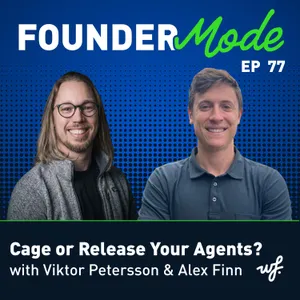
Cage or Release Your Agents? with Viktor Petersson & Alex Finn
EPISODE 77 Viktor Petersson and Alex Finn were two of Founder Mode's earliest guests, and they're back with opposite answers to the biggest question in AI right now: how much should you trust your agents? Viktor, founder of Sbomify and co-founder of Screenly, routes every agent through an identity proxy that gives it just enough access to do its job, and it took him a long time to let even his human assistant into his email. Alex, founder and CEO of Henry Intelligent Machines and creator of Creator Buddy, gave his agents access to everything and says it changed his life. They get into how each of them starts the day with AI, why Alex switches to a new favorite agent almost every week, whether anyone at OpenAI is actually reading your email, and why skills and context stores might be a short-term fix. Alex explains why he's holding back the Henry launch to beat churn, why always-on ambient AI will only be possible with local models, and why a 9 a.m. and a 2 p.m. meeting cooks his whole day, while Viktor makes the case that Apple could win the long game and that reviewing agent output is the new bottleneck. They close on why one raised money for distribution while the other stays bootstrapped to avoid getting locked into a roadmap, plus a lightning round on the most overrated thing in AI and the one thing they'll never hand to an agent. CHAPTERS 00:00 – Cold open: "What's your concern?" 01:51 – Cage the agents vs. release the agents 02:42 – How they start the day with AI 05:14 – A new favorite agent every week 07:28 – Would you give AI your email? 11:44 – Building a company with a tiny team 16:53 – Are skills and context stores a short-term fix? 18:54 – Why Alex isn't rushing to ship Henry 21:04 – Local models vs. frontier models 23:31 – Ambient AI and hacking your hardware 27:49 – Babysitting agents: the new bottleneck 30:02 – Context switching and the perfect week 31:17 – Raising money vs. bootstrapping 35:07 – Lightning round 39:28 – Founder Mode top five LINKS Connect with Viktor Petersson vpetersson.com • LinkedIn • X/Twitter • GitHub • Nerding Out with Viktor Podcast • Sbomify • Screenly • Little Snitch Meets 1Password for AI Agents Connect with Alex Finn YouTube • X/Twitter • Newsletter • Vibe Coding Academy Stay Connected with Founder Mode Subscribe to our newsletter Connect with Kevin LinkedIn • X/Twitter Connect with Jason LinkedIn • X/Twitter
40 MIN
OCT 1, 2026
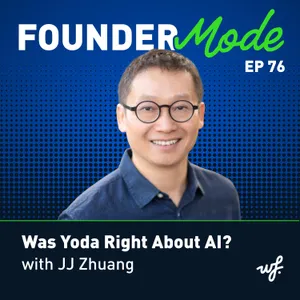
Was Yoda Right About AI? with JJ Zhuang
EPISODE 76 JJ Zhuang, co-founder and CEO of Pretty Good AI, returns to Founder Mode to answer for the predictions he made on the show over a year ago. Kevin and Jason had Claude grade all ten, and JJ defends his record on hiring generalists over specialists, how much code AI is really writing, why taste is the one thing you can't train into a model, and why slide decks are dead when you can just build the thing. He finishes 6.5 for 10, which beats the weatherman, and points to the release of Opus 4.6 as the moment things that used to not work suddenly started working. In the second half, JJ looks ahead: why Pretty Good AI is skipping the "sell the same widget a thousand times" playbook to become the AI team for healthcare practices, how to build guardrails around AI that's confidently wrong, why the human work that's left will be 100% hard work, how the team keeps protected patient data away from AI agents, and how a lean team can win a crowded healthcare AI market. CHAPTERS 00:00 – Cold Open: Why Not Just Solve All Your Problems? 00:31 – JJ Returns: Grading 10 Predictions One Year Later 01:58 – Generalists vs. Specialists: Who Should You Hire? 04:39 – Is AI Really Writing Half of All Code? 07:28 – Taste, Comprehension, and the Human Edge 09:58 – Instant Prototypes, Fast Software, and the Death of Slide Decks 12:39 – Directing AI and the Most Overhyped Buzzword 14:32 – Overhyped or Underestimated? The Opus 4.6 Moment 17:09 – The Scorecard: 6.5 for 10 18:00 – Pretty Good AI's Big Bet: Solve Every Problem 20:02 – What Success Looks Like: Becoming Your Customers' AI Team 20:39 – Designing Around AI That's Confidently Wrong 22:20 – Where the Line Between AI and Humans Moves Next 24:09 – Building on Models That Change Every Few Months 25:58 – Compliance When Your Team Is Agents 28:23 – What Patients Notice First 30:17 – How a Lean Team Wins a Crowded Market LINKS Connect with JJ Zhuang Pretty Good AI • LinkedIn • X/Twitter Stay Connected with Founder Mode Subscribe to our newsletter Connect with Kevin LinkedIn • X/Twitter Connect with Jason LinkedIn • X/Twitter
33 MIN
SEP 24, 2026
The $1 CRM Killer
EPISODE 75 Kevin and Jason go solo on the week AI stopped asking permission. Jason opens with a Claude Code session that sent a Slack message to a client's CEO instead of drafting it, complete with a "sent from Claude" tag at the bottom, then offered to file a bug report about itself. That kicks off a run through what founders are actually paying for now: Jason's $800-a-month HubSpot bill and his plan to swap it for Dharmesh Shah's $1-a-month USpot, levels.io running a multi-million-dollar business on hand-coded PHP and a single server, and why the "SaaSpocalypse" is more nuanced than Twitter thinks. Kevin traces the freemium playbook back to Zimbra, where 98% of users never paid and the top 2% funded the company, and asks the question that hangs over the whole episode: how do you build trust in a market where everything can be free? They also get into Jason's agentic agency experiment, why succession is really about handing off jobs rather than titles, why nobody has built a marketing agent with taste yet, and the biological age scores every app is suddenly handing out, each one conveniently favoring its own algorithm. CHAPTERS 00:00 – The Slack message Claude sent by itself 00:39 – A dozen AI tools in a single day 03:46 – $800 a month for a CRM 04:26 – Dharmesh's $1 CRM and the SaaSpocalypse 08:03 – Freemium after vibe coding: the Zimbra lesson 10:32 – Building an agentic agency 13:20 – Succession: hand off jobs, not titles 16:33 – What AI still can't do in marketing 19:18 – Biological age scores and walled-garden health data 22:22 – Founder Mode top five LINKS Stay Connected with Founder Mode Subscribe to our newsletter Connect with Kevin LinkedIn • X/Twitter Connect with Jason LinkedIn • X/Twitter
23 MIN