



Fun Facts Daily
Kyle Wood
Fun Facts About Toast
NOV 10, 202615 MIN
Description
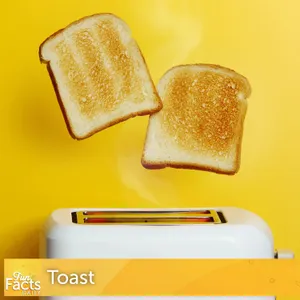
Toasting bread transforms ordinary slices through a complex chemical process known as the Maillard reaction, which occurs when amino acids and simple sugars are exposed to heat between 280 and 330 degrees Fahrenheit. Discovered by French physician Louis-Camille Maillard in 1912, this reaction creates distinct aromas, browning, and flavor compounds by rearranging molecular structures into Amadori compounds and chain-like polymers. Beyond culinary enhancement, historical techniques for toasting bread originated as practical preservation methods in ancient Egypt and Rome to remove excess moisture, prevent mold growth, and salvage stale loaves during long journeys. Over centuries, this culinary staple evolved significantly, transitioning from open-fire cooking and spiced wine additions in medieval Europe to the invention of the automatic pop-up toaster by Charles Strite in 1919 and Otto Rohwedder's bread-slicing innovations in 1928.
The physics behind the common observation that dropped toast frequently lands butter-side down has even captured scientific attention, famously studied by physicist Robert Matthews, who demonstrated that standard table heights and rotational torque give a falling slice just enough time for a half-rotation. While heat drives off roughly 15 to 20 percent of a slice's moisture, toasting does not eliminate calories or carbohydrates; instead, it alters starch structures to lower the glycemic index compared to fresh bread. Whether exploring the etymological roots shared with coffee roasting and mineral torrefaction or choosing the ideal slice thickness and toaster settings to achieve a crispy exterior while preserving a soft interior, understanding the science and history of toast reveals a fascinating intersection of chemistry, physics, and culinary tradition.
Listen Ad-Free on Patreon.
For just $3 per month, you can get ad-free versions of Fun Facts Daily, Who ARTed and Art Smart. Head over to https://www.patreon.com/cw/FunFactsDailyPod if you are interested.
Want to learn more? Head over to my website www.funfactsdailypod.com and be sure to listen to my other podcasts Who ARTed: Weekly Art History for All Ages or Art Smart. For family fun, check out my son's podcast Rainbow Puppy Science Lab
The image used in the episode cover art came from Adobe's stock assets.
Fun Facts Daily is an Airwave Media Podcast. If you are interested in advertising on this or any other Airwave Media show, email: [email protected]
Learn more about your ad choices. Visit megaphone.fm/adchoices