Funnel Reboot

Glenn Schmelzle

Details

A show giving you better insight into your funnel, so your marketing can be even better. New content biweekly, geared to help data-based marketers solve common problems that businesses have with the strategy, implementation and measurement of their digital marketing. Podcast hosted by Glenn Schmelzle.

Recent Episodes

OCT 18, 2026
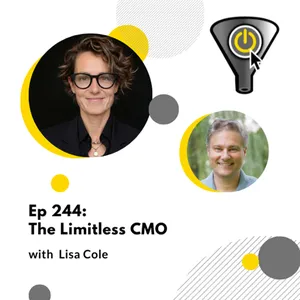
The Limitless CMO, with Lisa Cole
I want to share three experiences I've had and I want you to see if there's anything off about them: A while ago I sat with a RevOps leader, while they scrolled through a CRM where every single lead was tagged as an MQL. "Marketing sets them all to that," they said matter-of-factly. Sales knew, marketing knew, and everyone went along because the company was venture-backed and under executive demands to produce. Marketing simply bent the metric so the dashboard would look healthy. A Director of Marketing I knew understood that he could put a large budget bump in his annual plan. His boss, the VP of Sales, had encouraged him to think big. So he did, and it was approved. Long after budget season had ended, the purchases were denied and the money went to sales expenses. He understood what had happened and didn't push back, because his job depended on the VP of Sales. The budget had looked real until the moment it turned out not to be. A marketing leader once walked me through her martech budget. The marketing automation system, with its data-append module and a long list of add-ons, cost far more than I thought was reasonable. I asked if it was worth it. "It's everything to us," she said. I asked if they could drop the data-append module and use an intern, which would cost much less. "Finance would never approve us asking for more headcount." The software subscription flew with no problem, and even though hiring a person was cheaper, they didn't want to rock the boat with finance. The same pattern runs through all of these situations: marketers contorting themselves under pressure from some outside force. Our guest argues that force is structural. Marketing is saddled with baggage that keeps it from meeting what today's organizations expect, and the only way to keep up is to restructure. My guest is the Chief Marketing Officer and Head of the AI Center of Excellence at 2X, where she helps enterprises use strategic outsourcing, AI and marketing performance management. Before that, she spent two decades with agencies, then went brand-side in C-level roles at several large brands. There she worked alongside major consulting firms, which changed how she thought about the way marketing should be organized. She has written three books for growth leaders: Brand Gravity; The Revenue RAMP, which has been spun off into the Revenue Accelerator course; and The Limitless CMO, published in 2026. Join me as we head to Detroit Michigan to talk with Lisa Cole. Links to everything mentioned in the show are on the Funnel Reboot site's page for this episode.

33 MIN
SEP 28, 2026
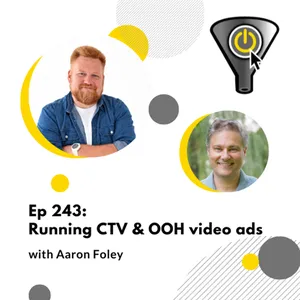
Running CTV & OOH Video Ads, with Aaron Foley
Up to the end of the twentieth century, the only ads that appeared on a screen were the ones arranged by a handful of TV networks. They were the only ones who could sell commercials, and only the biggest companies could afford what they charged for 30 seconds of airtime. Then, about 25 years ago, some digital marketing innovations started to make a new ad model possible. In 2000, Google launched a self-serve ad platform, and it was later joined by display ad exchanges like Right Media and DoubleClick. For a while, they displayed image ads, but faster broadband internet eventually meant they could serve video, and by the end of the decade an ad-serving standard was set. Thanks to internet protocol, new screens provided information back to bidders. Now, instead of buying by the time slot, advertisers pre-set what they'd bid to show an ad to viewers, based on what is being watched and possibly the viewer's demographics. The marriage of all these has enabled ads to be shown to consumers streaming on their smart TV, Apple TV, Roku or Fire Stick at home. It also opened up a whole new inventory — almost anywhere there's a screen: at the grocery store, in the elevator at the office, at the gas pump. Maybe you don't buy these ads. But it's almost certain that your customers face these screens daily. The question is whether you should put your ads on them. My guest is a graduate of Bishop's University who has spent twenty years inside that marketplace, including time at Samsung. He runs the consultancy Marcus & Muse and founded the Ottawa Ad Club. Let's bring in Aaron Foley. Links to everything mentioned in the show are on the Funnel Reboot site's page for this episode.

31 MIN
AUG 31, 2026
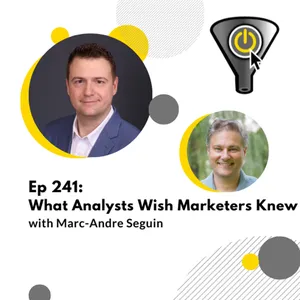
What Analysts wish marketers knew, with Marc-Andre Seguin
Some of us are lucky enough to work in a place with analysts who can help us make sense of our data. But there are added challenges in making this collaboration work. Analysts may struggle with the questions marketers ask, finding them too vague for analyzing. Marketers may get data back that they find irrrelevant; they may assume the analyst misunderstood their request. I'll grant that we can speak the same language, but that isn't enough. An Analyst cannot look at all the data, they cannot do analysis that will answer all your questions. The outcome you get will match the old movie Cool Hand Luke, which put it this way, WHAT WE'VE GOT HERE IS A FAILURE TO COMMUNICATE. The solution is for both sides to learn just enough of how the other's world to have meaningful dialogues all the way from problem scoping to decision-making. My guest today has been on the analyst's side of that table. He knows what practices determine whether this partnership works or fails. Graduating with a B.Sc. in Statistics, he has served as a Business Intelligence (BI) professional at various Government agencies and school boards. He is at home using tools like GA4, IBM Cognos to Microsoft PowerBI and writing in languages like SQL, DAX and Python. He's also previously been a professional jazz musician, which led 17 years ago to him founding JazzGuitarLessons.net, a site selling online guitar courses to budding musicians. running the ecommerce and email aspects of that site using his knowledge of analytics proves how well he knows what information we need on the marketing side of the business. Let's go to Gatineau Quebec to learn what analysts need from marketers to do their best work, with Marc-Andre Seguin. Chapter Timestamps 00:00 Intro 03:07 Meet Marc-Andre 05:58 Bias And Ground Rules 07:10 Data Quality And Signal 08:51 Cost Of Analytics Stack 11:35 What Makes Analysts Great 13:35 SME Habits That Help 17:29 Communication And Personalities 19:32 Chatbot Announcement 19:59 Stats And Tools For Marketers 23:53 Using LLMs With Guardrails 26:20 Wrap Up And Where To Find Links to everything mentioned in the show are on the Funnel Reboot site's page for this episode.
27 MIN
AUG 17, 2026
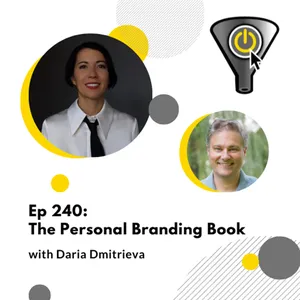
The Personal Branding Book, with Daria Dmitrieva
When I ask how someone forms their perception of a brand, what comes to mind? It might be they hear about it by word of mouth, or on an email thread or private message. In a nutshell, what's said about our company when we're not in the room, when we're not in control of the message. Now try the same experiment with our personal brand. Is our immediate thought how to look as good as possible? Is it how to curate the results that pop up when they search our name? Truth is, our personal brand has already been formed, we just weren't in on those conversations. Being active on our social media accounts can help, but we can also send the wrong brand message, shooting ourselves in the foot. When I first got onto Facebook and X, I feared that posting too much content would make me look distracted. When I did post, I felt a certain portion of them should be about my company or at least something generic. If I did have an opinion, it had to be watered down.My thinking was I should talk how my employer wanted me to talk. Turns out that is the complete opposite of how I should have been branding myself. It wasn't until I hung out my own shingle, that I realized being a generic-sounding consultant made me a commodity. That meant my rates were set by the market - I had to be a price-taker. But employees who act generically are also treated as commodities who must take whatever salary is offered. So regardless of where you sit, you're better off with a good personal brand. Am I saying employees should kiss ass on social, posting about how much they love their work? No. They can post thoughtful criticisms about the industry, they can post solutions to problems they and their peers face. Content like this boosts a person's brand without offending employers. They know you won't always be working for them; they'll bask in your halo while they can get it. But before you put out content you have to get introspective on what your brand stands for. It's hard for us to stare at a sheet of paper and figure this out, we get better results using a framework. And this is where our guest can help. Since getting her MBA from Moscow International Higher Business School, she has managed some of Europe's largest brands, from Stollwerck, to Nestlé and Shell. She is also a visual artist, marketing consultant and coach. Her 2026 book deals with this very issue. Let's go now to the French seaside resort town of Cannes to speak with the author of "The Personal Branding Book", Daria Dmitrieva. Chapter Timestamps 00:00 Intro 02:27 Meet Daria Dmitrieva 03:12 Brand As A Compass 05:55 Premium Brand Parallels 08:56 Authenticity Over Packaging 13:33 Fear And The Shadow Gift 19:04 Become A Magnet 22:26 CEO Dreamer Critic Roles 26:33 Body Cues And Intuition 28:39 Celebrate Progress 32:02 Daria Origin Story 35:35 Where To Find The Book Links to everything mentioned in the show are on the Funnel Reboot site's page for this episode.
36 MIN