


Future of Threat Intelligence
Team Cymru
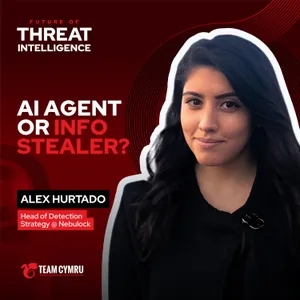
Nebulock’s Alex Hurtado on why current logs fail to distinguish AI agents from info stealers
OCT 8, 202641 MIN
Description
Over 60% of false positives trace back to vendor-provided detection rules. That finding, from a first-of-its-kind SANS report Alex Hurtado helped produce, captured why detection engineering has become its own discipline, one that treats rule management like a CI/CD pipeline.
Alex, Head of Detection Strategy at Nebulock, breaks down how AI is reshaping the detection lifecycle, from query generation to self-healing alert tuning, and flags a critical blind spot where current logs cannot distinguish a legitimate AI agent action from a malicious one.
Topics discussed:
Treating detection rule management as a CI/CD pipeline
Vendor rules as the leading source of false positives
Applying AI to query generation and alert tuning
Distinguishing AI slop from actionable threat research
Chaining atomic detections across data sources for coverage
Closing the visibility gap on AI agent telemetry
Open source tools for monitoring AI agent activity
Key Takeaways:
Treat detection rule management like a CI/CD pipeline to keep pace with evolving environments and shifting attack surfaces.
Audit vendor-provided detection rules first when investigating false positive volume, since they account for over 60% of false positives according to the SANS report.
Apply AI to query generation and alert tuning so detection engineers spend less time writing SPL, SQL, or AQL and more time on coverage strategy.
Chain atomic detections across multiple data sources and TTPs to build behavior-based alert narratives instead of relying on single-event rules.
Curate threat intelligence sources manually before feeding them into AI workflows to filter out AI-generated slop masquerading as research.
Evaluate open source AI agent telemetry projects like Perplexity's Numbat and Huntress contributor Anton Uvrotsky's A10 to start building visibility into agent activity.
Map your detection backlog against both internal environment changes and external threat landscape shifts to prioritize what to build next.
Listen to More Episodes: YouTube • Apple • Spotify • Website