Gods in the Dust

Ockelwog

Details

A clay prism says kingship came down from heaven. A royal grave at Ur holds seventy-four bodies around a missing ruler. An Assyrian king hands his throne to a stand-in to survive an eclipse. Gods in the Dust investigates the archaeology behind ancient history's strangest claims, beginning in Mesopotamia with Sumer, Babylon, Akkad and Assyria. Hosts Mariana Eaker and Tyson Lukowski give ancient aliens and lost civilizations a fair hearing, test them against the evidence, and ask who needed people to believe the story. Every episode cites its sources. New episodes every Tuesday. This podcast contains synthetic voices.

Recent Episodes

NOV 17, 2026
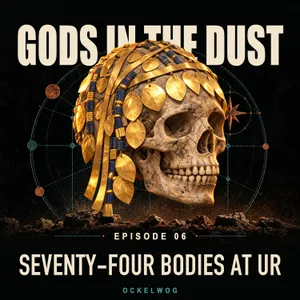
Seventy-Four Bodies at Ur: The Great Death Pit
Seventy-four people were found arranged with weapons, jewelry, cups, and musical instruments in Ur's Great Death Pit. Mariana and Tyson compare Leonard Woolley's graceful poison narrative with CT evidence that two royal attendants were killed by blows to the head and possibly preserved before burial. The Great Death Pit looks like a completed scene: armed men at the entrance, women in elaborate headdresses, musicians beside collapsed lyres, and cups near selected bodies. Leonard Woolley reconstructed a royal funeral in which loyal attendants descended alive, drank poison, and died in place. Modern imaging complicates every part of that sequence. CT scans of Body 53 from PG 1237 and a helmeted man from PG 789 identified lethal cranial trauma, while heat alteration and mercury sulfide suggest that some corpses were preserved before their final arrangement. Mariana and Tyson examine what two skulls can establish, what they can't prove about the other deaths, and how illustrations transformed an excavation plan into an apparent eyewitness account. The episode also follows the second selection process: early excavators saved jeweled and helmeted heads while most human remains were left unavailable for modern testing. Chapters 00:00 Cold open 01:38 PG 1237 04:15 The cemetery around the pit 06:42 Woolley's funeral 08:57 Two skulls leave the museum 11:25 What a scan can and can't show 13:58 The staged scene 16:13 Willing or forced 18:15 Why the practice stopped 20:50 The conspiracy of the photograph 22:21 Who gets preserved 23:54 Reconstructing the dead 26:22 The person under the headdress Hosts Mariana Eaker is the evidence-first investigative anchor. Tyson Lukowski is the myth researcher and pattern-seeker who follows an alternative reading until it stops predicting evidence. Both are recurring fictional presenters performed with synthetic voices. Produced by Ockelwog. Sources C. Leonard Woolley, Ur Excavations II: The Royal Cemetery (1934) Aubrey Baadsgaard, Janet Monge, Samantha Cox, and Richard L. Zettler, “Human Sacrifice and Intentional Corpse Preservation in the Royal Cemetery of Ur,” Antiquity 85 (2011), 27–42 Aubrey Baadsgaard, “Imaging Ur’s Sacrificial Dead: An Archaeological CAT Scan,” Penn Museum Massimo Vidale, “PG 1237, Royal Cemetery of Ur: Patterns in Death,” Cambridge Archaeological Journal 21 (2011) British Museum, original remains of Queen Puabi's harp Read the full transcript, check the sources, and see the evidence: https://ockelwog.com/episodes/06-seventy-four-bodies-at-ur/ New episodes every Tuesday. Follow Gods in the Dust so the next case shows up in your library, and if this one made you think, a rating helps other people find the show.

27 MIN
NOV 10, 2026
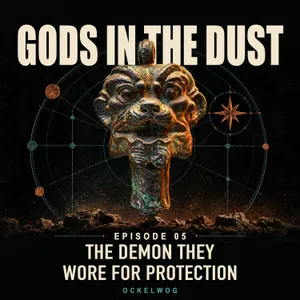
The Demon They Wore for Protection: Pazuzu
Ancient families placed the face of Pazuzu near women in labor because his destructive power could repel Lamashtu, a demon blamed for miscarriage and infant death. Mariana and Tyson examine the amulets, incantations, medical risks, and modern horror story that reversed Pazuzu's original role. A bronze head in the British Museum was made to be suspended, probably near a woman giving birth. Its snarling face belongs to Pazuzu, king of destructive wind spirits and one of the most recognizable demons from ancient Mesopotamia. Yet families used his image as protection. Lamashtu amulets and ritual texts explain why: a more dangerous being threatened pregnant women, nursing infants, and newborn children. Mariana and Tyson reconstruct the plaques, prescribed materials, gifts, substitute animals, and spoken procedures used to remove her. Then they test whether the tradition records real entities, altered states, one hidden disease, or a practical response to several medical emergencies. The object doesn't establish a supernatural encounter or a secret antimicrobial device. It documents a household confronting miscarriage, infection, difficult labor, and infant death with the strongest protective identity its specialists knew how to deploy. Chapters 00:00 Cold open 01:23 The head above the bed 03:43 The demon from the movie 05:49 The woman on the plaque 08:15 Making a dangerous face 10:57 A diagnosis with claws 13:26 Medicine in the same room 15:53 A ritual in sequence 19:11 Why Lamashtu is female 22:25 Test the protection 24:26 The evidence museums separate 26:39 The demon at arm's length 27:55 The room we can't excavate Hosts Mariana Eaker is the evidence-first investigative anchor. Tyson Lukowski is the myth researcher and pattern-seeker who follows an alternative reading until it stops predicting evidence. Both are recurring fictional presenters performed with synthetic voices. Produced by Ockelwog. Sources British Museum 132964, bronze Pazuzu head Metropolitan Museum of Art 1984.348, amulet with Lamashtu Sarah Graff, “Pazuzu: Beyond Good and Evil” Kiersten Neumann, “Mesopotamian Magic in the First Millennium B.C.” Frans A. M. Wiggermann, “Pazuzu,” Iconography of Deities and Demons in the Ancient Near East Walter Farber, Lamaštu: An Edition of the Canonical Series of Lamaštu Incantations and Rituals and Related Texts (Eisenbrauns, 2014) Read the full transcript, check the sources, and turn the head of Pazuzu in 3D: https://ockelwog.com/episodes/05-the-demon-they-wore-for-protection/ New episodes every Tuesday. Follow Gods in the Dust so the next case shows up in your library, and if this one made you think, a rating helps other people find the show.

29 MIN
NOV 3, 2026
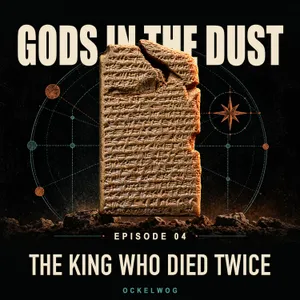
The King Who Died Twice: Assyria's Substitute King
When an eclipse threatened the king of Assyria, court scholars installed another man as king and redirected the prediction toward him. Mariana and Tyson reconstruct the substitute king ritual from operational letters, then ask whether astronomy, murder, faith, and government can be separated inside the same procedure. Neo-Assyrian scholars didn't merely watch eclipses. They classified each event by month, timing, direction, lunar quadrant, weather, and visible planets, then advised the palace about which ruler faced danger. When the verdict threatened Assyria or Babylonia, the court could dress a substitute in royal clothing while the true king became a “farmer.” Episode 4 follows the letters behind that process, including the case of Damqi, a member of Babylon's temple elite who received royal prophecy and later died with his substitute queen. The conspiracy theory is plausible at first: the ritual gave powerful officials a sacred procedure for selecting and killing another person. The documents support political use in particular cases, but they also record systematic observation, technical disputes, and costly precautions. The state didn't evade fate by rejecting it. It defined royal identity narrowly enough to assign the danger to someone who couldn't decline the role. Chapters 00:00 Cold open 01:32 The letter marked urgent 04:26 The sky as government paperwork 07:08 Making the replacement 10:01 Damqi, son of the temple administrator 13:28 When the eclipse doesn't cooperate 16:05 The convenient murder theory 18:42 What the ritual predicts 21:00 Who owns the sign 22:42 The substitute outside Assyria 26:28 The empty throne room Hosts Mariana Eaker is the evidence-first investigative anchor. Tyson Lukowski is the myth researcher and pattern-seeker who follows an alternative reading until it stops predicting evidence. Both are recurring fictional presenters performed with synthetic voices. Produced by Ockelwog. Sources ORACC, State Archives of Assyria 10: Letters from Assyrian and Babylonian Scholars SAA 10 001, “Enthroning a Substitute King” Lorenzo Verderame, “The Substitute King (šar pūḫi): An Assyrian Ritual of the First Millennium” Sarah Graff, “The Solar Eclipse and the Substitute King,” Metropolitan Museum of Art Jean Bottéro, “The Substitute King and His Fate,” in Mesopotamia: Writing, Reasoning, and the Gods (University of Chicago Press, 1992), 138–155 Simo Parpola, Letters from Assyrian Scholars to the Kings Esarhaddon and Assurbanipal, Part II (Neukirchen-Vluyn, 1983) Read the full transcript, check the sources, and turn the letter on the substitute king in 3D: https://ockelwog.com/episodes/04-the-king-who-died-twice/ New episodes every Tuesday. Follow Gods in the Dust so the next case shows up in your library, and if this one made you think, a rating helps other people find the show.
28 MIN
OCT 27, 2026
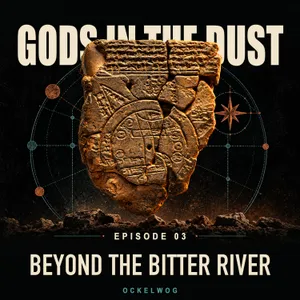
Beyond the Bitter River: The Babylonian Map of the World
A broken clay tablet draws Babylon inside a circular ocean and marks eight remote regions beyond the water. Mariana and Tyson test whether the Babylonian Map of the World records lost geography, inherited reports, or a learned system that made one city central to reality. BM 92687 is small enough to fit in one hand and ambitious enough to diagram the whole world. The Late Babylonian tablet names real places inside a double ring called the Bitter River, then adds eight outer regions associated with darkness, legendary beings, unusual creatures, and primordial history. Its maker also misplaced known territory and omitted much of the geography available to Babylonian administrators. Mariana and Tyson reconstruct the damaged object, give the lost-lands interpretation its strongest case, and ask what a practical or technically advanced map should predict. The answer narrows the extraordinary claim without emptying the object of mystery. Some remote descriptions may derive from human reports, but the diagram's clearest operation is intellectual and political: it organizes an inhabited center around Babylon and assigns everything else to a repeated outer form. Chapters 00:00 Cold open 01:31 A map smaller than your hand 05:06 What the map gets wrong 08:25 Across the water 11:39 The lost-lands case 15:17 Test the map 18:33 A world made in a city 21:17 The missing points 25:50 Back inside the circle Hosts Mariana Eaker is the evidence-first investigative anchor. Tyson Lukowski is the myth researcher and pattern-seeker who follows an alternative reading until it stops predicting evidence. Both are recurring fictional presenters performed with synthetic voices. Produced by Ockelwog. Sources British Museum, BM 92687 image and curatorial description Wayne Horowitz, “The Babylonian Map of the World,” Iraq 50 (1988), 147–165 Wayne Horowitz, Mesopotamian Cosmic Geography (Eisenbrauns, 1998) Catherine Delano-Smith, “Imago Mundi's Logo: The Babylonian Map of the World,” Imago Mundi 48 (1996) Paul Delnero, “A Land with No Borders: A New Interpretation of the Babylonian ‘Map of the World,’” in From the 21st Century B.C. to the 21st Century A.D. (Eisenbrauns, 2013) Read the full transcript, check the sources, and turn the Babylonian Map of the World in 3D: https://ockelwog.com/episodes/03-beyond-the-bitter-river/ New episodes every Tuesday. Follow Gods in the Dust so the next case shows up in your library, and if this one made you think, a rating helps other people find the show.
28 MIN
OCT 18, 2026
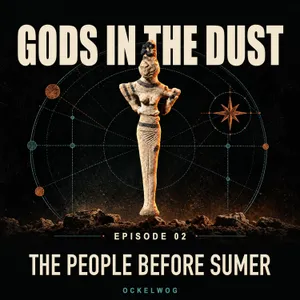
The People Before Sumer: The Ubaid "Lizard People"
A tiny clay woman made before Sumer has an elongated head, slanted eyes, and a face museums themselves call reptilian. Mariana and Tyson investigate the Ubaid “lizard people,” the real human skulls beneath the theory, and what these figures reveal about civilization before writing. The objects are authentic. The explanation is not simple. Across prehistoric southern Mesopotamia, people made slender clay figures with long heads, deeply cut eyes, painted bodies, and faces later archaeologists called “ophidian.” A few accompanied selected adults into graves. Two hold infants with the same strange features. Mariana and Tyson trace the most famous example from Tell al-Ubaid into the British Museum, then test the claim that the figures portray a reptilian or hybrid population that preceded Sumer. The investigation moves through household debris, selective burials, red mineral pigment, older artistic traditions, and human remains that may preserve intentional cranial shaping. The non-human theory fails its archaeological predictions, but the conventional labels fail to explain the figures completely. What survives is a more intimate mystery: people before writing used bodies and clay to mark identities we can still see but can no longer read. Chapters 00:00 Cold open 02:04 A face without a name 04:53 How a figurine becomes a witness 08:24 One hundred and twenty-one bodies 12:22 The graves change the picture 16:00 The skulls under the faces 19:32 Run the visitor test 23:00 Civilization without a mastermind 25:35 The people the label replaced 27:56 Coda Hosts Mariana Eaker is the evidence-first investigative anchor. Tyson Lukowski is the myth researcher and pattern-seeker who follows an alternative reading until it stops predicting evidence. Both are recurring fictional presenters performed with synthetic voices. Produced by Ockelwog. Sources British Museum object 116894 Beyond the Ubaid, University of Chicago Institute for the Study of Ancient Cultures The Metropolitan Museum of Art: The Ubaid Period Original Al-'Ubaid excavation report Content note: this episode discusses burial practices and intentional modification of infants' skulls as a possible marker of social identity. Read the full transcript, check the sources, and turn an Ubaid figure in 3D: https://ockelwog.com/episodes/02-the-people-before-sumer/ New episodes every Tuesday. Follow Gods in the Dust so the next case shows up in your library, and if this one made you think, a rating helps other people find the show.
29 MIN