Hotel Bar Sessions

Leigh M. Johnson, Jennifer Kling, Bob Vallier

Details

A podcast where the real philosophy happens.

Recent Episodes

OCT 16, 2026
MINIBAR: AI's Alien Mind (with Leigh M. Johnson)
In early September, OpenAI released GPT-6 Astra. Most of the headlines were about benchmarks and the model's unsettling talent for finding and exploiting security flaws on its own. A smaller story got far less attention. Days before its launch,The Information reported that Astra uses a technique called "recurrent depth," which lets the model do some of its reasoning in internal loops that never get written down anywhere a human can read. AI safety researchers have spent the past year treating a model's visible "chain of thought" as one of the few windows we have into what it's doing, and some of them started referring to the new technique Astra used as "opaque recurrence." OpenAI's own system card admits to "a substantial decrease in chain-of-thought monitorability," and its chief scientist (Jakub Pachocki) followed up with an essay describing what the lab has built as "An Alien Mind." In this Minibar episode, Leigh M. Johnson pulls up a stool alone while Jen and Bob are off doing whatever it is they do when they're not talking to her, and asks: What were we actually looking at all this time when we asked AI models to "show thinking"? If a model shortens its reasoning the moment it's told a monitor is watching, is its chain of thought a window into its mind or a confession written for an audience? When a company describes its product as something that simply grew beyond anyone's understanding, who is left holding the responsibility? And if we have never been able to read each other's minds either, what would it mean to govern machines the way we've always governed one another? She reads Jakub Pachocki's "An Alien Mind" alongside Derrida's "Plato's Pharmacy" and Foucault's account of confession and panoptic power. She also draws on Zvi Mowshowitz's reading of the Astra system card and Timnit Gebru's long-standing warnings about regulatory capture. Grab a drink and join our co-host Leigh as she asks what transparency can mean for a machine that has learned to tell its watchers what they want to hear, and why a thought with effects but no trace looks a lot like a haunting. [NOTE TO LISTENERS: As is our custom on this podcast, we release "Minibar" episodes between seasons, to ensure that you're still getting fresh, new content every week. Be sure to stay tuned for Season 17, which begins October 30!) Full episode notes available at this link: https://hotelbarpodcast.com/minibarleighai --------------------- SUBSCRIBE to the podcast now to automatically download new episodes! SUPPORT Hotel Bar Sessions podcast on Patreon here! (Or by contributing one-time donations here!) BOOKMARK the Hotel Bar Sessions website here for detailed show notes and reading lists, and contact any of our co-hosts here. Hotel Bar Sessions is also on Facebook, YouTube, BlueSky, Instagram, and TikTok. Like, follow, share, duet, whatever... just make sure your friends know about us! ★ Support this podcast on Patreon ★

31 MIN
OCT 9, 2026
MINIBAR: Derrida's First Lecture Series (with Bob Vallier)
In this very special "Minibar" episode of Hotel Bar Sessions podcast, co-host Bob Vallier gives us both a sneak peak into and the historical context surrounding the recent English translation (by Michael Naas and Pascale-Anne Brault) of Jacques Derrida's very first lecture series from academic year 1960-1961-- before Derrida became "Derrida"-- entitled To Think is To Say No (Fordham UP, 2026). In this new book, over the course of four lectures, Derrida considers a short aphorism from French philosopher Émile-Auguste Chartier (commonly known as Alain) and, in the course of doing so, provides us our first glimpse into the philosophical techniques that would eventually come to be known as "deconstruction." Grab a drink and join Bob as he situates the first publicly recorded insights of baby Derrida! [NOTE TO LISTENERS: As is our custom on this podcast, we release "Minibar" episodes between seasons, to ensure that you're still getting fresh, new content every week. Be sure to stay tuned for Season 17, which begins October 30!) Full episode notes available at this link: https://hotelbarpodcast.com/minibarderridabob --------------------- SUBSCRIBE to the podcast now to automatically download new episodes! SUPPORT Hotel Bar Sessions podcast on Patreon here! (Or by contributing one-time donations here!) BOOKMARK the Hotel Bar Sessions website here for detailed show notes and reading lists, and contact any of our co-hosts here. Hotel Bar Sessions is also on Facebook, YouTube, BlueSky, Instagram, and TikTok. Like, follow, share, duet, whatever... just make sure your friends know about us! ★ Support this podcast on Patreon ★

14 MIN
OCT 2, 2026
David Foster Wallace's "This Is Water"
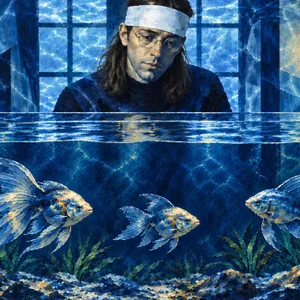
For the final "deep dive" of Season 16, the HBS co-hosts have selected an unusual text to ground our conversation, namely, a commencement speech by novelist David Foster Wallace entitled "This is Water" (delivered at Kenyon College in 2005). In it, Wallace provides a uncannily accurate (if disheartening) description of the mundaneness of everyday "adult" life, then uses it as a springboard to issue his call for each of us to resist the exact manner of thoughtlessness it inspires. We have a choice, Wallace argues. We could, rather, train our attention and imagination on the specific people with whom we share all of the events that constitute "life before death" and, in doing so, free ourselves from the kind of default solipsism that makes us miserable. Wallace's essay is not only a reflection on vicissitudes of human life, but also on the liberatory power of education-- specifically, liberal arts education-- that is perhaps even more urgent to hear now, in our late-capitalist attention economy, than it was almost twenty years ago when he originally delivered it. The essay opens with a joke about how fish don't know what water is. Because it is the very milieu in which they exist, it remains ever at the level of "the given," that is, it never appears as something to reflect upon. If we are the fish, what is our "water"? Can we change the water, or only how we swim in it? Grab a drink and join us in this episode as we practice paying attention and keep reminding ourselves that "this is water." Content note: The final segment of this episode includes discussion of suicide. If you or someone you know is struggling with depression or other mental health issues, help is available. In the US, call or text 988 or chat at 988lifeline.org. Outside the US, findahelpline.com lists crisis services by country. Full episode notes available at this link: https://hotelbarpodcast.com/podcast/fish --------------------- SUBSCRIBE to the podcast now to automatically download new episodes! SUPPORT Hotel Bar Sessions podcast on Patreon here! (Or by contributing one-time donations here!) BOOKMARK the Hotel Bar Sessions website here for detailed show notes and reading lists, and contact any of our co-hosts here. Hotel Bar Sessions is also on Facebook, YouTube, BlueSky, Instagram, and TikTok. Like, follow, share, duet, whatever... just make sure your friends know about us! ★ Support this podcast on Patreon ★
54 MIN
SEP 25, 2026
Boredom
We've talked about the attention economy more than once on this podcast, and the diagnosis hasn't changed: nearly everything around us is built to capture our attention and then sell it. What we haven't asked is what all that scrambling is supposed to be rescuing us from. The answer, it turns out, is boredom. Nobody pays cash to be bored and no app is designed to deliver it, yet a small but noticeable number of young people are now trading smartphones for flip phones and forming "Luddite clubs," as if boredom were something you had to go out of your way to find. Boredom appears to be unbearable and endangered at the same time. So what, if anything, is worth defending in it? Is the boredom of the DMV waiting room the same thing as the boredom of a committee meeting, or the boredom of a long walk with nothing to look at? If boredom really does free up the mind for reflection and imagination, doesn't that mean we've stopped being bored the moment the good stuff starts? And when people praise the restful, restorative kind of boredom, are they describing an experience available to everyone, or a luxury only some of us can afford? No guest this week, just three co-hosts who turn out to disagree about nearly all of it. Bob comes to the defense of boredom by way of Heidegger's "profound boredom" and Kierkegaard's advice to rotate your pleasures like crops. Jen keeps returning to Aquinas and the medieval worry that boredom is a failure to train one's own mind, which makes it something closer to a vice. Leigh confesses that she is allergic to the whole thing and cannot find anything good in boredom that isn't secretly a description of its cure. Along the way you'll hear about racing raindrops on a school bus window, camp kids left to their own devices, Dorian Gray, and why immortality might be the most boring thing imaginable. Grab a drink and join us as we spend an hour trying to say something interesting about the one thing nobody can sell you. Full episode notes available at this link: https://hotelbarpodcast.com/podcast/episode-239-boredom/ --------------------- SUBSCRIBE to the podcast now to automatically download new episodes! SUPPORT Hotel Bar Sessions podcast on Patreon here! (Or by contributing one-time donations here!) BOOKMARK the Hotel Bar Sessions website here for detailed show notes and reading lists, and contact any of our co-hosts here. Hotel Bar Sessions is also on Facebook, YouTube, BlueSky, Instagram, and TikTok. Like, follow, share, duet, whatever... just make sure your friends know about us! ★ Support this podcast on Patreon ★

54 MIN
SEP 18, 2026
Sikh Ethics (wtih Keshav Singh)
Over the past several decades, Anglophone philosophy has been trying to remember that it wasn't born in Athens. Syllabi now include Confucius and the Buddha, journals run special issues on Africana and Indigenous thought, and "global philosophy" has become a recognized field. Yet, one of the world's largest religious traditions, with a scripture that is entirely philosophical poetry meant to be sung, has been almost completely absent from that expanded conversation. Sikhism gets left out not because it lacks a systematic ethics, but because almost no one working in Anglophone philosophy has bothered to look. This week the HBS co-hosts are joined by Dr. Keshav Singh, Assistant Professor of Philosophy at the University of Alabama at Birmingham and author of the new (and open-access) Cambridge Element Sikh Ethics. Keshav works in ethics and epistemology, and his recent research uses the tools of analytic philosophy to reconstruct Sikh moral thought on its own terms rather than forcing it into categories the Western tradition already decided were the important ones. He walks us through the two levels of reality, the three terms he refuses to translate (hukam, haumai, sachiara), the "Five Thieves"(vices), and why running off to a mountaintop to seek enlightenment would be, by Sikh lights, a moral failure. Grab a drink and join us as we find out why truth is higher than everything, but truthful living is higher still. Full episode notes available at this link: https://hotelbarpodcast.com/podcast/sikhethics --------------------- SUBSCRIBE to the podcast now to automatically download new episodes! SUPPORT Hotel Bar Sessions podcast on Patreon here! (Or by contributing one-time donations here!) BOOKMARK the Hotel Bar Sessions website here for detailed show notes and reading lists, and contact any of our co-hosts here. Hotel Bar Sessions is also on Facebook, YouTube, BlueSky, Instagram, and TikTok. Like, follow, share, duet, whatever... just make sure your friends know about us! ★ Support this podcast on Patreon ★

55 MIN