


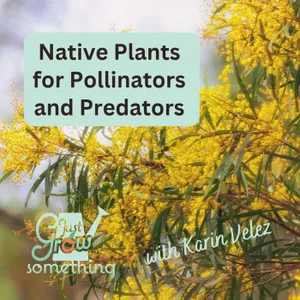
How to Attract Pollinators and Natural Pest Predators with Native Plants - Ep. 324
OCT 27, 202633 MIN
Description
Fall is the best time of year to plant native perennials, and it's also the easiest. The seeds of most native wildflowers need a winter outside before they'll sprout, and plugs planted while the soil is still warm get a head start on roots before they go dormant.
In this episode I'm walking you through why it's worth making room for natives at all, including what researchers are finding about the decline of butterflies, bumble bees, and the insects that birds depend on. Then we'll get into how fall and winter planting works, from dormant seeding after a few hard frosts to the six-week window for plugs, and how that changes if your winters are snowy, rainy, or barely there. After that we'll go plant by plant through milkweeds, coneflowers, black-eyed Susans, bergamot, asters, goldenrod, golden alexanders, and mountain mint, with whether each one is best started from seed, a plug, or either. We'll also talk about the plants that feed the lady beetles, lacewings, and tiny wasps that eat your garden pests.
Let's dig in.
Support the show at https://larryscoffee.com/justgrow and get a free gift!
Work with me! Get a quote for your garden consultation at https://justgrowsomething.com/gardenconsulting
References and Resources:
Edwards, C.B., Zipkin, E.F., Henry, E.H., et al. (2025). Rapid butterfly declines across the United States during the 21st century. Science 387(6738): 1090 (22% decline in butterfly abundance, 2000–2020, 554 species): https://doi.org/10.1126/science.adp4671
USDA National Agroforestry Center (Vaughan & Black) — Agroforestry Note 34: Enhancing Nest Sites for Native Bee Crop Pollinators (4,000 native bee species, ~70% ground nesting, ~30% tunnel nesting, ~45 bumble bee species, overwintering and mowing timing): https://www.fs.usda.gov/nac/assets/documents/agroforestrynotes/an34g08.pdf
University of Delaware, UDaily — Biodiversity for the birds (summary of the chickadee study; oaks support 557 caterpillar species, ginkgo zero): https://www.udel.edu/udaily/2018/october/non-native-plants-birds-insects-washington-chickadee-desiree-narango-doug-tallamy/
University of Illinois Extension — Plant native perennials in the fall for healthy spring growth (plugs six weeks before first frost, seed after first hard frost, watering, no fall fertilizer, mulch timing): https://extension.illinois.edu/news-releases/plant-native-perennials-fall-healthy-spring-growth
Utah Department of Agriculture and Food, Utah Pollinator Habitat Program — Native Seed Planting Guide (sow after several hard frosts, soil below 55°F, seeding before snow, 1:8 seed-to-sand mix, pressing seed, 3–4 years to establish): https://ag.utah.gov/wp-content/uploads/2023/09/Seed-Planting-Guide.pdf
Michigan State University Extension — Attracting Beneficial Insects with Native Flowering Plants, Bulletin E-2973 (seed flowers in 3–5 years vs. plugs in 1–2 years; nectar and pollen extend natural enemies' life span and egg laying): https://sanweb.lib.msu.edu/DMC/extension_publications/e2973/E2973-2007.PDF
Oklahoma State University Extension — Native Milkweed Germination Guide, HLA-6503 (30-day cold stratification for most milkweeds, 60–90 for some; 90% vs. under 1% germination for green antelopehorn): https://extension.okstate.edu/fact-sheets/native-milkweed-germination-guide
University of Wisconsin–Madison Extension — Butterfly Weed, Asclepias tuberosa (zones 3a–9b, deep taproot, fall sowing, 2–3 years to bloom from seed): https://hort.extension.wisc.edu/articles/butterflyweed-asclepias-tuberosa/
University of Georgia, Odum School of Ecology — Tropical Milkweed and Parasite Infections in Resident Monarchs in the Southern U.S. (cut tropical milkweed to 6 inches monthly, October–February; replace with natives): https://ecology.uga.edu/wp-content/uploads/2018/08/monarch-factsheet-2018-1.pdf
USDA NRCS — Plant Guide: Eastern Purple Coneflower, Echinacea purpurea (germinates without cold; overwintered seed germinates rapidly; goldfinches and seed): https://plants.usda.gov/DocumentLibrary/plantguide/pdf/pg_ecpu.pdf
USDA NRCS — Plant Fact Sheet: Golden Alexanders, Zizia aurea (90-day cold stratification, pollen and nectar for short-mouthed beneficial insects, fall seeding and plugs): https://plants.usda.gov/DocumentLibrary/factsheet/pdf/fs_ziau.pdf
University of Illinois Extension — Autumn allergies: don't blame goldenrod (insect-pollinated goldenrod vs. wind-pollinated ragweed; 88% of plants animal-pollinated): https://extension.illinois.edu/blogs/good-growing/2022-10-21-autumn-allergies-dont-blame-goldenrod
New Mexico State University Extension — Guide H-169: Using Insectary Plants to Attract and Sustain Beneficial Insects for Biological Pest Control (alyssum and brassica pests; spring sowing of annual insectaries): https://pubs.nmsu.edu/_h/H169/
Nevison, K.A. (2016). Considering a role for native plant cultivars in ecological landscaping: an experiment evaluating insect preferences and nectar forage values of Phlox species vs. its cultivars. M.S. thesis, University of Delaware (most phlox cultivars equal to species; some wild selections better): https://udspace.udel.edu/handle/19716/21442
Just Grow Something: https://justgrowsomething.com
Gardening Courses: https://justgrowsomething.com/courses
Just Grow Something Merch and Downloads: https://justgrowsomething.com/shop
Just Grow Something Gardening Friends Facebook Group: https://www.facebook.com/share/g/18YgHveF5P/
Check out how you can become a patron on Patreon: https://www.patreon.com/JustGrowSomething
Feed my coffee habit: https://buymeacoffee.com/justgrowsomething
Amazon storefront: https://www.amazon.com/shop/justgrowsomething
Newsletter link: https://dashboard.mailerlite.com/forms/757286/109572786559649154/share
Hosted by Simplecast, an AdsWizz company. See pcm.adswizz.com for information about our collection and use of personal data for advertising.