



La cueva del Topo
La cueva del Topo
El puente de los mundos: la extraordinaria historia del Gran Intercambio Biótico Americano.
NOV 17, 2026132 MIN
Description
Durante millones de años, entre las dos grandes masas continentales americanas persistió una separación que parecía formar parte del propio paisaje del planeta. Entre ambas se extendía una región de islas, volcanes y mar que no tenía todavía la forma que hoy reconocemos en los mapas. Por allí circulaban y se mezclaban las aguas del océano Pacífico y del mar Caribe, mientras los movimientos de la corteza terrestre levantaban montañas, formaban nuevas tierras y modificaban poco a poco el paisaje. En cada territorio, la vida seguía su propio curso, mientras los animales y las plantas evolucionaban en ambientes aislados, bajo condiciones que moldeaban historias naturales diferentes. Mucho antes de que existiera una conexión terrestre continua, hubo algunos grupos de organismos que comenzaron a desplazarse entre las regiones, algunos de ellos encontraron en América Central un lugar donde establecerse. Eran movimientos limitados, difíciles de reconstruir y ocurridos en momentos distintos, pero anticipaban una transformación mucho mayor. La región que hoy ocupan Costa Rica y Panamá no era todavía el puente que hoy conocemos, era un mundo en construcción, sometido a cambios geológicos y ambientales que terminarían alterando no solo la geografía del planeta, sino también las posibilidades de movimiento y evolución de innumerables seres vivos.
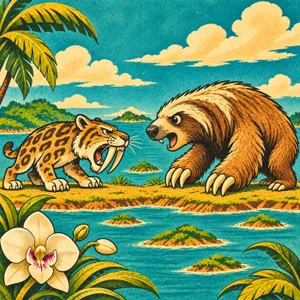
Poco a poco, desde las profundidades del océano comenzó a emerger un arco de islas y volcanes. Una nueva geografía que estrecharía los espacios marinos y cambiaría para siempre los mapas del planeta. Este no fue un cambio repentino, sino una trama lenta y enigmática, repleta de etapas oscuras, pausas e interrupciones que aún hoy desafían la certeza de los científicos. La desaparición de los últimos pasos marinos y el nacimiento de un puente terrestre entre dos continentes no fueron un mismo acontecimiento. Entre ambos momentos transcurrieron millones de años de transformaciones, durante los cuales el mar fue cediendo espacio a nuevos territorios y la geografía de América comenzaba a cambiar para siempre. Mientras la geología ocultaba sus claves, las consecuencias transformaron el mundo para siempre. Separados tras millones de años de aislamiento, el Pacífico y el Caribe emprendieron caminos distintos; sus corrientes y ecosistemas marinos cambiaron para siempre. Y en la superficie, las sombras de dos faunas colosales finalmente se cruzaron. A este encuentro fascinante lo llamamos el Gran Intercambio Biótico Americano, o GABI. Un choque donde algunas vidas prosperaron en reinos desconocidos, mientras otros linajes enteros se extinguieron, dejando tras de sí un misterio impreso en la tierra.
En nuestro viaje de hoy recorreremos la fascinante historia geológica del istmo centroamericano, las transformaciones de sus mares y sus climas, y las distintas migraciones que anticiparon este encuentro monumental. Veremos cómo una joven franja de tierra en construcción cambió para siempre el destino biológico de dos continentes. Aquel mundo remoto desapareció, pero su latido no se ha apagado: vive hoy aún en las criaturas que nos rodean y en los paisajes que pisamos. Al desenterrar sus secretos, descubrimos que el pasado no se fue; sigue vivo, respirando con nosotros.
Música del capítulo
Alexander Nakarada – CreatorChords - Forest Walk
Paleowolf - Megatherium / Giant Sloth (Cenozoic, 2021)
Mythology Sounds - Aztec–Mayan Myth Sounds
8 Bit Universe - Video Killed The Radio Star (8 Bit Remix Cover Version) [Tribute to The Buggles]
Greg Kihn Band - The Breakup Song
Enlaces
Aguilar, T. (1987). Comparación entre la fauna malacológica de las principales formaciones del Plioceno marino de Costa Rica, América Central. Revista Geológica de América Central, (6), 43–73.
https://archivo.revistas.ucr.ac.cr/index.php/geologica/article/view/12333
Bacon, C. D., Silvestro, D., Jaramillo, C., Smith, B. T., Chakrabarty, P., & Antonelli, A. (2015). Biological evidence supports an early and complex emergence of the Isthmus of Panama. Proceedings of the National Academy of Sciences, 112(19), 6110–6115.
https://stri-apps.si.edu/docs/publications/pdfs/Bacon_et_al_2015_Biological_evidence_supports_an_early_and_complex.pdf
Bacon, C. D., Molnar, P., Antonelli, A., Crawford, A. J., Montes, C., & Vallejo-Pareja, M. C. (2016). Quaternary glaciation and the Great American Biotic Interchange. Geology, 44(5), 375–378.
https://doi.org/10.1130/G37624.1
Baskin, J., & Valenciano, A. (2023). Procyonidae (Mammalia, Carnivora) and the Great American Biotic Interchange. En Y.-N. Lee (Ed.), Windows into sauropsid and synapsid evolution: Essays in honor of Prof. Louis L. Jacobs (pp. 341–365). Dinosaur Science Center Press.
https://produccioncientifica.ucm.es/documentos/6581b94baaaaaa46358cbefa
Brandes, C., & Winsemann, J. (2018). From incipient island arc to doubly-vergent orogen: A review of geodynamic models and sedimentary basin-fills of southern Central America. Island Arc, 27, e12255.
https://d-nb.info/1213937787/34
Carrillo, J. D., Forasiepi, A., Jaramillo, C., & Sánchez-Villagra, M. R. (2015). Neotropical mammal diversity and the Great American Biotic Interchange: Spatial and temporal variation in South America's fossil record. Frontiers in Genetics, 5, Article 451.
https://www.frontiersin.org/journals/genetics/articles/10.3389/fgene.2014.00451/full
Carrillo, J. D., Amson, E., Jaramillo, C., Sánchez, R., Quiroz, L., Cuartas, C., Rincón, A. F., & Sánchez-Villagra, M. R. (2018). The Neogene record of northern South American native ungulates. Smithsonian Contributions to Paleobiology, 101. Smithsonian Institution.
https://www.govinfo.gov/content/pkg/GOVPUB-SI-PURL-gpo109553/pdf/GOVPUB-SI-PURL-gpo109553.pdf
Carrillo, J. D., Faurby, S., Silvestro, D., Zizka, A., Jaramillo, C., Bacon, C. D., & Antonelli, A. (2020). Disproportionate extinction of South American mammals drove the asymmetry of the Great American Biotic Interchange. Proceedings of the National Academy of Sciences, 117(42), 26281–26287.
https://pmc.ncbi.nlm.nih.gov/articles/PMC7585031/
Cione, A. L., Gasparini, G. M., Soibelzon, E., Soibelzon, L. H., & Tonni, E. P. (2015). The Great American Biotic Interchange: A South American perspective. Springer.
https://doi.org/10.1007/978-94-017-9792-4
Coates, A. G., Jackson, J. B. C., Collins, L. S., Cronin, T. M., Dowsett, H. J., Bybell, L. M., Jung, P., & Obando, J. A. (1992). Closure of the Isthmus of Panama: The near-shore marine record of Costa Rica and western Panama. Geological Society of America Bulletin, 104(7), 814–828.
https://pubs.usgs.gov/publication/70221643
Coates, A. G., Aubry, M.-P., Berggren, W. A., Collins, L. S., & Kunk, M. J. (2003). Early Neogene history of the Central American arc from Bocas del Toro, western Panama. Geological Society of America Bulletin, 115(3), 271–287.
https://repository.si.edu/server/api/core/bitstreams/974861bb-2a66-4f2e-9258-d2c431ae1d6e/content
Coates, A. G., Collins, L. S., Aubry, M.-P., & Berggren, W. A. (2004). The geology of the Darién, Panama, and the Late Miocene–Pliocene collision of the Panamá Arc with northwestern South America. Geological Society of America Bulletin, 116(11–12), 1327–1344.
https://repository.si.edu/items/ff2d72c6-31b3-4a82-998c-268d70d68e93
Farmer, J. R., Martínez-García, A., Sentman, L. T., Schiebel, R., Arns, A., Yehudai, M., Tiedemann, R., Sigman, D. M., & Haug, G. H. (2025). Early Pliocene shoaling of the Central American Seaway reconstructed from foraminifera-bound nitrogen and oxygen isotopes. Paleoceanography and Paleoclimatology, 40(4), e2024PA005043.
https://repository.library.noaa.gov/view/noaa/71099/noaa_71099_DS1.pdf
Forasiepi, A. M., Soibelzon, L. H., Suarez Gomez, C., Sánchez, R., Quiroz, L. I., Jaramillo, C., & Sánchez-Villagra, M. R. (2014). Carnivorans at the Great American Biotic Interchange: New discoveries from the northern Neotropics. Naturwissenschaften, 101(11), 965–974.
https://stri-apps.si.edu/docs/publications/pdfs/Forasiepi_2014_Procyonid_Neotropics.pdf
Freitas-Oliveira, R., Lima-Ribeiro, M. S., Mendoza-Rodriguez, V. H., & Terribile, L. C. (2025). Reviewing the Great American Biotic Interchange: Climate change as a trigger for biodiversity dispersal. Proceedings of the Royal Society B: Biological Sciences, 292(2058), Article 20251745.
https://pmc.ncbi.nlm.nih.gov/articles/PMC12606168/
Jackson, J. B. C., Jung, P., Coates, A. G., & Collins, L. S. (1993). Diversity and extinction of tropical American mollusks and emergence of the Isthmus of Panama. Science, 260(5114), 1624–1626.
https://repository.si.edu/bitstream/handle/10088/18225/stri_Jackson_Jung_Coates_and_Collins_1993.pdf
Jaramillo, C. A. (2018). Evolution of the Isthmus of Panama: Biological, paleoceanographic and paleoclimatological implications. In C. Hoorn, A. Perrigo, & A. Antonelli (Eds.), Mountains, climate and biodiversity (pp. 323–338). Wiley.
https://repository.si.edu/items/5fab3980-8dcc-4f0d-a136-afc70fd81b92
Jin, Y., & Qian, H. (2025). Latitudinal patterns and climatic drivers of Laurasian and Gondwanan angiosperm tree distributions in forests of the Americas. Ecography, 2025(6), e07687.
https://doi.org/10.1111/ecog.07687
Laurito, C. A., & Valerio, A. L. (2012). Paleobiogeografía del arribo de mamíferos suramericanos al sur de América Central de previo al gran intercambio biótico americano: Un vistazo al GABI en América Central. Revista Geológica de América Central, 46, 123–144.
https://www.scielo.sa.cr/pdf/rgac/n46/a02n46.pdf
Lessios, H. A. (2008). The Great American Schism: Divergence of marine organisms after the rise of the Central American Isthmus. Annual Review of Ecology, Evolution, and Systematics, 39, 63–91.
https://repository.si.edu/items/9d20ff6d-6d6c-4b85-a14a-c1d0ce5d5409
Lucas, S. G., Alvarado, G. E., & Vega, E. (1997). The Pleistocene mammals of Costa Rica. Journal of Vertebrate Paleontology, 17(2), 413–427. https://www.researchgate.net/publication/254313889_The_Pleistocene_mammals_of_Costa_Rica
Lucas, S. G. (2014). Vertebrate paleontology in Central America: 30 years of progress. Revista Geológica de América Central, Número Especial 2014, 139–155. https://archivo.revistas.ucr.ac.cr//index.php/geologica/article/view/16576
Lucas, S. G. (2014). Mamíferos del Pleistoceno Terminal de la localidad de El Hatillo, Panamá. Revista Geológica de América Central, 50, 139–151.
https://doi.org/10.15517/rgac.v0i50.15120
Lucas, S. G., Sequeira, C., Chesnel, V., Rodríguez, D., Alvarado, G. E., Ramírez, T., Méndez, J. C., Vargas, A., Vargas, C., & Ruiz, G. (2025). Serpientes boídos fósiles del Neógeno del sur de Costa Rica. Revista Geológica de América Central, 72, 88–98.
https://doi.org/10.15517/rgac.2025.64924
MacFadden, B. J., Bloch, J. I., Evans, H., Foster, D. A., Morgan, G. S., Rincon, A., & Wood, A. R. (2014). Temporal calibration and biochronology of the Centenario Fauna, Early Miocene of Panama. The Journal of Geology, 122(2)
https://www.researchgate.net/publication/261437653_Temporal_Calibration_and_Biochronology_of_the_Centenario_Fauna_Early_Miocene_of_Panama
MacFadden, B. J., Jones, D. S., Jud, N. A., Moreno-Bernal, J. W., Morgan, G. S., Portell, R. W., Perez, V. J., Moran, S. M., & Wood, A. R. (2017). Integrated chronology, flora and faunas, and paleoecology of the Alajuela Formation, Late Miocene of Panama. PLOS ONE, 12(1), e0170300.
https://doi.org/10.1371/journal.pone.0170300
Montes, C., Cardona, A., McFadden, R., Morón, S. E., Silva, C. A., Restrepo-Moreno, S. A., Ramírez, D. A., Hoyos, N., Wilson, J., Farris, D. W., & Bayona, G. A. (2012). Evidence for middle Eocene and younger land emergence in central Panama: Implications for Isthmus closure. Geological Society of America Bulletin, 124(5–6), 780–799.
https://stri-apps.si.edu/docs/publications/pdfs/STRI-W_Jaramillo_2012_MontesCet_al_Evidence_for_middle_Eocene_younger_land_emergence_in_CP.pdf
Montes, C., Cardona, A., Jaramillo, C. A., Pardo, A., Silva, J. C., Valencia, V., Ayala, C., Pérez-Angel, L. C., Rodríguez-Parra, L. A., Ramírez, V., & Niño, H. (2015). Middle Miocene closure of the Central American Seaway. Science, 348(6231), 226–229.
https://stri-apps.si.edu/docs/publications/pdfs/Montes_2015-Zircon_Panama.pdf
O'Dea, A., Rodríguez, F., De Gracia, C., & Coates, A. G. (2007). La paleontología marina en el Istmo de Panamá. Canto Rodado, 2, 149–179.
https://repository.si.edu/server/api/core/bitstreams/f0a077e1-9913-4a02-af33-cb48b56ac835/content
O'Dea, A., Lessios, H. A., Coates, A. G., Eytan, R. I., Restrepo-Moreno, S. A., Cione, A. L., Collins, L. S., de Queiroz, A., Farris, D. W., Norris, R. D., Stallard, R. F., Woodburne, M. O., Aguilera, O., Aubry, M.-P., Berggren, W. A., Budd, A. F., Cozzuol, M. A., Coppard, S. E., Duque-Caro, H., ... Jackson, J. B. C. (2016). Formation of the Isthmus of Panama. Science Advances, 2(8), Article e1600883.
https://pmc.ncbi.nlm.nih.gov/articles/PMC4988774/
Öğretmen, N., Schiebel, R., Jochum, K. P., Stoll, B., Weis, U., Repschläger, J., Jentzen, A., Galer, S., & Haug, G. H. (2020). Deep thermohaline circulation across the closure of the Central American Seaway. Paleoceanography and Paleoclimatology, 35(12), e2020PA004049.
https://doi.org/10.1029/2020PA004049
Ramírez, D. A., Foster, D. A., Min, K., Montes, C., Cardona, A., & Sadove, G. (2016). Exhumation of the Panama basement complex and basins: Implications for the closure of the Central American seaway. Geochemistry, Geophysics, Geosystems, 17(5), 1758–1777.
https://doi.org/10.1002/2016GC006289
Sentman, L. T., Dunne, J. P., Stouffer, R. J., Krasting, J. P., Toggweiler, J. R., & Broccoli, A. J. (2018). The mechanistic role of the Central American Seaway in a GFDL Earth System Model. Part 1: Impacts on global ocean mean state and circulation. Paleoceanography and Paleoclimatology, 33(7), 840–859. https://repository.library.noaa.gov/view/noaa/32725/noaa_32725_DS1.pdf
Tseng, Z. J., Kahn, L. X., Pacheco-Castro, A., Carranza-Castañeda, O., Aranda-Gómez, J. J., Wang, Y., Chávez-Ambriz, J. C., Hannold, C., McDonald, H. G., & Wang, X. (2026). A 10-million-year biogeographic holding pen primed the Great American Biotic Interchange. Science, 393(6810), 532–536. https://escholarship.org/uc/item/18w192x9
Weems, R. E., Lucas, S. G., Sequeira, C., Chesnel, V., Rodríguez, D., Alvarado, G. E., Ramírez, T., Vargas, A., & Vargas, C. (2025). Late Miocene turtles from Southern Costa Rica. Revista Geológica de América Central, 72, 99–117. https://doi.org/10.15517/rgac.2025.65017
Woodburne, M. O., Cione, A. L., & Tonni, E. P. (2006). Central American provincialism and the Great American Biotic Interchange. In O. Carranza-Castañeda & E. H. Lindsay (Eds.), Advances in late Tertiary vertebrate paleontology in Mexico and the Great American Biotic Interchange (Publicación Especial del Instituto de Geología y Centro de Geociencias de la UNAM, 4, pp. 73–101).
https://www.researchgate.net/publication/228461083_Central_American_provincialism_and_the_Great_America_Biotic_Interchange
Woodburne, M. O. (2010). The Great American Biotic Interchange: Dispersals, tectonics, climate, sea level and holding pens. Journal of Mammalian Evolution, 17, 245–264. https://ceiba.org/wp-content/uploads/Woodburne2010-Great_American_Biotic_Interchange.pdf