


Leadership for the Physical AI Age
Titto Thomas
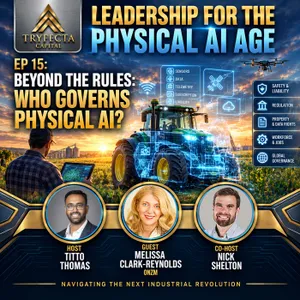
Ep 15: Beyond the Rules: Who Governs Physical AI?
SEP 14, 202631 MIN
Description
American farmers hiring Ukrainian hackers to break into tractor software wasn’t just a right-to-repair battle—it was a preview of the defining debate of our era: Who governs physical AI?
When every piece of hardware is packed with proprietary sensors, tethered to subscriptions, and generating critical telemetry, traditional concepts of property and liability break down. In this episode of Leadership in the Age of Physical AI, host Titto Thomas and co-host Nick Shelton welcome back futurist and director Melissa Clark-Reynolds ONZM to explore why physical AI will never have a single, unified rulebook—and why real productivity gains won’t come from chatbots writing emails, but from intelligent machines operating in the physical world.
In this episode, we discuss:
The Ukrainian Tractor Hack: Closed-loop software, third-party parts, and why right-to-repair is the frontline of physical AI autonomy.
The Patchwork Regulatory Reality: Why physical AI won't be governed by an "AI Act," but by an ad-hoc mosaic of workplace safety, product liability, road rules, and maritime codes.
The History of Job Panic: What the 1906 New York manure export economy and the icemen's union teach us about modern AI displacement—and what the US WARN database actually reveals about tech layoffs.
Capability Multipliers vs. Screen AI: Why generative screen tools have left macroeconomic GDP flat, while physical robotics (warehouse automation and robotic weeding) drive real structural productivity.
Who Owns the Digital Commons? From Danish facial property rights to Australian seven-metre subsurface land laws—who owns the data generated by an autonomous farm, vehicle, or ocean drone?
World Models & Digital Twins: Adapting gaming engine principles from Weta Workshop into low-cost 3D farm simulations for regenerative agriculture, crop planning, and runoff protection.
Liability & The 92% Safety Paradox: Why Swiss Re found autonomous driving dramatically safer than human operation, yet human psychology still resists clinical, sterile autonomous design.
Off-Planet AgTech & Terraforming: Why solving autonomous agricultural intelligence on Earth is the non-negotiable foundation for sustaining life on the Moon and Mars.
What’s Next in Smart Ag: Climate-resilient autonomous greenhouses, in-field mobile cow milking, and drone swarms for pasture management.
Timestamps:
00:00 – The Ukrainian tractor hack & right to repair
02:23 – Patchwork governance: Road rules, safety standards, and Tesla in NZ
04:39 – Why regulation lags behind commercial deployment
06:50 – 1906 manure exports, refrigeration bans, and historical tech panic
09:12 – AI as a capability multiplier: Why physical AI drives true GDP
10:33 – Automating the miserable work: Robotic weeding & regenerative soil
12:30 – Who owns the data? Facial rights, farm telemetry, and the digital commons
15:00 – Subsurface laws: Australia’s 7-metre boundary vs. Texas property rights
16:22 – World models on the farm: Lessons from Weta Workshop and gaming engines
18:29 – Liability models: US litigation vs. NZ/Australia no-fault compensation
21:19 – The 92% safety paradox: Why we fear machines that drive better than us
23:05 – Experience-led engineering: Train Wi-Fi, elevator mirrors, and comfy cars
26:44 – Terraforming Mars: Why off-planet survival starts with farm AI
30:40 – Emerging tech: Heatwave greenhouses, mobile milking, and drone swarms
34:20 – Wrap-up & the future of physical AI
Connect & Resources:
Learn more about Tryfecta Capital: tryfecta.biz
Connect with Titto Thomas on LinkedIn
GUESTS
Melissa Clark-Reynolds ONZM, futurist, professional director and founder of Future Centre New Zealand
https://www.linkedin.com/in/melissaclarkr/
Nick Shelton, Director for North America, Robotyx
https://www.linkedin.com/in/nickshelton/