Tom Barraclough: Sovereign AI policy and digital regulatory architecture
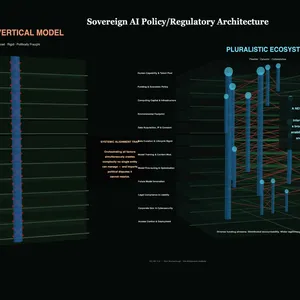
Kia ora and welcome to another irregular Memia podcast - I really need to do more of these! Last week I sat down for an in-depth conversation with Auckland-based researcher Tom Barraclough, one of Aotearoa New Zealand’s most important voices on AI policy, regulation and governance. Tom brings a decade’s experience working inside, alongside and across from governments in law, public policy and technology. He is a founder and director of a tech policy think tank (the Brainbox Institute, since 2018), as well as a start-up tech company (Syncopate, since 2023), which turns regulatory documents into digital infrastructure for implementation in computers. Tom has led public interest legal research projects, acted as project lead for a global multistakeholder coalition on tech transparency, and has consulted to public and private clients including the New Zealand government, the Global Partnership on AI and the Global Network Initiative. He’s a super smart mind and we stretched ourselves across a wide range of topics over an hour’s discussion. Some of the key subjects we covered: * Law as cultural runtime, not neutral code — Tom’s jurisprudence background and why he’s always been sceptical of the idea that law is simply rules neutrally applied; the courts as a kind of interpretive culture rather than a deterministic runtime. * Paper plumbing and the PDF problem — How every large organisation is essentially “made up of PDFs” that don’t network with each other, and why that document architecture is failing us at exactly the moment we need it most. * Introducing Syncopate and DocRef — Tom’s origin story at Syncopate: turning law and regulation into structured, referenceable datasets so they can be versioned, annotated, linked at a granular level, and made interoperable across agencies. * The rules-based order under attack — Why bringing more people into political discourse hasn’t produced the shared interpretive consensus institutions hoped for, and why our “institutional software” may simply be past its use-by date. * What “radical digital regulatory infrastructure” actually means — The Cambridge paper in progress: publishing law and regulation as open, versioned, linkable datasets — roots that filter up through every digital system built on top of them. * Unpacking AI sovereignty — Why Tom was initially sceptical of “sovereign AI” (government builds a foundation model — what could go wrong?🫣), and the multidimensional framework he’s developing to pull the concept apart: compute, data, training, content moderation, literacy, individual agency and more. * The one-in-a-million shot problem — Why even a well-resourced, highly centralised state like China can’t fully nail every layer of the sovereign AI stack simultaneously, and what that means for small countries like New Zealand. * Te Hiku Media as the positive model — The closing epilogue to Karen Hao’s Empire of AI in practice: community-owned, values-driven AI development in Te Reo Māori as a template for what distributed, multi-stakeholder sovereignty could look like. * Confidential computing and personal AI sovereignty — Apple Intelligence, Private Cloud Compute, and the Tinfoil startup doing hardware-verifiable privacy — why contractual assurances aren’t enough and what cryptographic attestation offers instead. * AI-accelerated lawmaking: promise and tension — Tom’s live DocRef/MCP/Claude demo that drafted a new API standard from the existing regulatory corpus in an afternoon, and the open question of how fast legislation should move when stability is itself a public good. Links mentioned: * Brainbox Institute: https://www.brainbox.institute/ * Docref.org / Syncopate Labs: https://docref.org/syncopate/blog/ * Tom’s Sovereign AI multidimensional prototype: https://sovereign-ai.tombcgh.tech/ * Te Hiku Media https://tehiku.nz/ * Tinfoil - Verifiably Private AI https://tinfoil.sh/ * Apple Intelligence / Siri AI WWDC Keynote: Introducing Siri AI and More It was great to geek out with Tom on some pretty technical topics with huge relevance to our future here in Aotearoa New Zealand and the world, I hope you enjoy this episode! Ngā mihi Ben Full Transcript This post has bonus content for paid subscribers. Upgrade to get full access. **Tom Barraclough:** [00:00:00] Any large organization that requires any kind of institution or risk management process or policies is just basically made up of PDFs. And they just get layered and layered and layered, and none of these things network with each other. say you had a government wanting to do a sovereign AI model or even just to fund one, so if you’re gonna have government involved in any of it these are the rough layers that I see you needing to basically ace. And I kinda feel like even if you nail one of them Getting all of them just feels like this one in a million perfect shot. Yeah. And it just feels like it’s never gonna happen to me. **Tom Barraclough:** there’s all these different interesting layers of sovereignty that don’t just require it being a government. And I think you can take it beyond government too, and you can start to think about community sovereignty or you can think about individual agency. **Ben Reid:** agency, to be honest, is the control plane that I’m most interested in here. **Tom Barraclough:** we didn’t have a [00:01:00] rules-based order. We had a pre-rules based order, and maybe now we can move into a rules-based order if we recommit to **Ben Reid:** kia ora and welcome to another irregular Memia podcast. I really need to do a few more of these. I’m Ben Reid, and I write the weekly Memia newsletter, and generally spend a lot of my time drinking from the fire hose of accelerating AI this episode I’m gonna be talking with Tom Barraclough. Tom’s an Auckland-based researcher, former lawyer and one of Aotearoa’s most important voices on AI policy and governance. He’s the founder and director of tech policy think tank the Brainbox Institute, as well as tech startup Syncopate, which turns regulatory documents into digital infrastructure. Tom has consulted to many public and private clients, including the New Zealand Government. Welcome Tom. **Tom Barraclough:** Thank you, Ben. Really nice to be chatting about all of these things and share a drink from the fire hose. **Ben Reid:** Yeah, there’s a fair [00:02:00] amount going on, and we , we need a few more hours. **Tom Barraclough:** Yeah ... **Ben Reid:** we’ve only... We’re, we’ll budget ourselves to one hour not really into Lex Fridman-type five-hour marathons. We could. All so look key things I’d like to talk about today is what you’re doing with Syncopate, Yeah and your current research focus. And I think as part of that, we’ll basically go in on the whole concept of AI sovereignty. So you’re doing work which I think is probably some some of the most advanced analysis of pulling that whole concept apart and ‘cause it means a lot of things to a lot of people. . Let’s also talk about some of the tech sovereign strategies in UK and Europe that’s happened recently. So plenty to be getting on with. Yeah. You and I go back many years. ... And I think we touched base for the first time when I was running the AI Forum New Zealand back in- Mm ...... 2019 or something. So that’s a long time ago. So these conversations have been going on for a long time. And you’ve been right at the center of this with Brainbox and then more recently Syncopate. So maybe just give us a sort of potted career history for yourself and and , the really interesting work you’re doing at Syncopate these days. **Tom Barraclough:** [00:03:00] Thanks, Ben. The potted history would be that I... So I studied law and politics, and n-none of that really came alive for me until I started learning about jurisprudence and the kind of legal philosophy side of things because that sort of lets you sit back and go, “What is this law thing? And what is it-- what do people think it does, and what does it actually do?” And yeah, how does it all work? Whereas the other side of law is quite like what does this… This is a public episode. If you'd like to discuss this with other subscribers or get access to bonus episodes, visit memia.substack.com/subscribe