People of Packaging Podcast

www.adampeek.com

Details

This is a podcast where we illuminate the stories of people in the packaging industry and proudly sponsored by TheLabelKing.com Hosted by the Label King of the Mountains, Adam Peek encase.substack.com

Recent Episodes

OCT 21, 2026
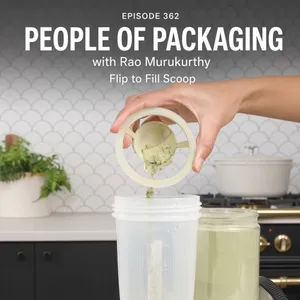
362 - KEEP YOUR DIRTY FINGERS OUT OF YOUR MOUTH! Flip to Fill inventor Rao Murukurthy
Rao Murukurthy started as a mold maker and bottle designer working for his father in the Chicago area. He spent more than a decade there, then moved into plastics and custom blow molding, where the shop was making a large share of the bottles you would see at GNC, from small vials up to the protein tubs. He later ran Denver Custom Packaging and exited it. About a decade in Denver, he was in the executive MBA program at CU Boulder when he pulled an older version of a scoop out of a box of 3D-printed prototypes. Roughly twenty iterations later, that is Flip to Fill. The problem is familiar. The scoop sinks. Someone reaches into the tub with whatever was on their hands after practice. All the filling, barrier, and hygiene work that went into the pack ends at the kitchen counter. Flip to Fill sits between the jar and the cap. Turn the bottle upside down, turn it back, open the cap, and a pre-measured dose is waiting to pour into the shaker. Put the cap back on. It is ready the next day. He filed a provisional patent in the summer of 2023 after graduating, then a utility patent, not just a design patent, covering anything that sits between the jar and the cap for liquid, powder, or granules. The published application is US 20250115401 The engineering is the part packaging people will recognize. The scoops nest, so case count is high and they are easier on a contract manufacturer than bulk-packed scoops that get dropped in by hand. They can be placed in line: powder drops, a chute feeds the scoop, a mechanical arm gives it a squeeze, it drops in, then the cap and the torquer. It does not interfere with the induction liner. Brands can put one in every jar, or send it as an add-on so a first-time customer gets it and reuses it. It is dishwasher safe and meant to last through about twelve bottles. Sizes cover the 89 millimeter neck for amino acids and green drinks, and the 110 and 120 millimeter necks for protein. Molds are modular, so the volume changes without a new tool. The brand logo is an insert, not a whole mold. They pay for the insert. He sells scoops, not tools. On EPR, a traditional scoop is often under two inches and falls through the screen. This one, on an 89 millimeter jar, is about three and a half inches across, so it is designed for recyclability even though it is meant to be reused. It is made from post-consumer recycled polypropylene, with an FDA no-objection letter from a Colorado manufacturer, and made in the US. They are both pushing and pulling the PP stream. The site is fliptofill.com, no hyphens. The form goes straight to his email. Brands can also reach him at [email protected] or on LinkedIn. Instagram is Flip to Fill Scoop. They recorded on October 5. The injection mold was being built, with real scoops for brands in November. * 00:00 Welcome, Adam Peek, People of Packaging * 01:01 Rao Murukurthy joins * 02:13 How they met on Clubhouse in 2020 * 03:42 Mold maker, GNC bottles, Denver Custom Packaging, CU Boulder * 05:42 How Flip to Fill works * 06:15 Hands in the jar, and why that undoes the filling work * 09:52 Utility patent, not a design patent * 10:23 Nesting, case count, and automation on the line * 12:08 One in every jar, or an add-on for DTC * 14:28 89, 110, and 120 millimeter, modular molds, brand logo insert * 17:15 EPR, fist-size rule, post-consumer recycled PP * 20:30 fliptofill.com and how brands reach out * 24:04 Mold in November, where to follow Guest: Rao Murukurthy, Flip to Fill, fliptofill.com. Host: Adam Peek, People of Packaging. (00:00) Welcome to People of Packaging (01:01) Rao Murukurthy joins (02:13) How they met on Clubhouse (03:42) From mold maker to Flip to Fill (05:42) How the scoop works (06:15) Hands in the jar (09:52) A utility patent, not a design patent (10:23) Nesting and the filling line (12:08) In every jar, or as an add-on (14:28) Sizes, modular molds, brand logo (17:15) EPR and designed for recyclability (20:30) fliptofill.com (24:04) Mold in November, where to follow This is a public episode. If you would like to discuss this with other subscribers or get access to bonus episodes, visit encase.substack.com

27 MIN
OCT 13, 2026
361 - Men have skin too and love good packaging design! W/ Freddie Sheridan from YCODE
First of all, before we get to the show notes, I wanted to say sorry to my amazing guest Freddie Sheridan! I thought I had published this episode a few months ago and was going through my recordings and saw that, in fact, it hadn’t been aired yet! You can time stamp the interview when we discuss the World Cup actually :) Secondly, you might notice the podcast got a small upgrade. Each episode will now have it’s own thumbnail and will have chapters so you can skip through to each chapter on Apple Podcasts On to the episode! Freddie Sheridan grew up in the family agency his parents started in the early 1980s, designing retail experiences for luxury beauty brands. He was eight years old with a wash bag bigger than most men carry today. Cleanser, moisturizer, eye cream, exfoliator. He looked around the school washroom and wondered why everyone else was so quick. YCODE started from a gap he kept seeing. Men’s skincare was flagged as one of the biggest growth markets in beauty, and men were not adopting it. Apathy. No education. And the products themselves were usually women’s formulas in masculine packaging. No one was designing them for men’s skin from scratch. Men’s skin is about 25% thicker, has roughly twice the oil, a lower pH, and a denser collagen structure on a different timetable. Freddie’s point is the same one packaging people already know: the right fuel for a Formula One car is not a generic one. Specific purpose gets better results faster. YCODE spent about five years in development before anything hit the market. The brand launched in October and November 2024 with one product, the Well Kept Advanced Eye Serum, because the eye area was men’s single biggest issue. In November 2025 they added the Hydrating Face Serum and the Mattifying Moisturiser. The packaging was developed on the same timeline, so it did not have to be rushed. The name is the Y chromosome, the thing that makes men biologically distinct, plus the code they study to design for it. The original outer box is a matchbox. Men were not used to skincare, but they were used to a matchbox. Nudge it from the bottom, the product reveals, no instructions required. Racing green and gold, because a vintage Porsche is more exciting to a lot of guys than a skincare aisle. The paper is from GF Smith, already in the color they wanted, FSC certified. Lettering is indented on the outside so the gold reads against the matte green, and slightly raised and gloss on the inside. A glue dot holds the tube centered and quiet in transit. Freddie will tell you it was too firm. That is the learning for the next batch. They rebranded early. The first identity was at 70 or 80 percent of what it could be, and they would rather fix it before the world got used to it. Dark green became a cleaner white. The logo was tightened. Stereotypes about what men want, dark colors, bro language, heavy fragrance, were the thing they were trying not to repeat. They kept the inner tray and the primary pack and only swapped the sleeve, so the first batch was not thrown away. Batch two catches the tray and the tube up. The tube itself is an old-school super glue tube, all aluminum, including the cap. Ordinary aluminum tubes still needed a plastic cap hard enough to thread onto metal, and that plastic could not be recycled. This one removes that problem. Opening it the first time is like shaving the first time. Someone has to show you. Hold the tube lightly, snap the lid, do not squeeze, or you lose product. There is no air in the tube on purpose. Fresher, and the customer gets a full fill. YCODE is available at ycode.co. Chapters (00:00) Welcome to People of Packaging (00:52) Freddie Sheridan joins (02:16) Why YCODE, and the name (04:30) Born into skincare (05:31) Women’s formulas in masculine packaging (06:29) Launched with the eye serum (07:11) Serum and moisturizer (09:02) Arriving at the original box (11:40) The matchbox men already know (12:55) Racing green, gold, and GF Smith (15:07) The glue dot that was too firm (16:48) Indented outside, raised inside (18:09) The early rebrand, without the waste (22:43) Do people judge your skin? (24:24) A routine that still gets you out the door (26:43) A super glue tube, all aluminum (28:22) How to open it the first time This is a public episode. If you would like to discuss this with other subscribers or get access to bonus episodes, visit encase.substack.com

38 MIN
OCT 8, 2026
360 - Beyond the Die Line - The pitch was awful. They liked the bar! Tom Seymour and Ree Dolnick
Ree Dolnick did not set out to leave science. She was a cancer researcher who got handed lab bars she would not eat: chalky, too sweet, and a label she could actually read. She had worked her way through school as a sous chef, so she treated the kitchen like a lab and started writing recipes in a notebook. The company name came from her daughter. Kids at daycare could not say Jessica. They called her Jekka. Ree trademarked JECA, registered the company, and then did nothing with it for six or seven months. Someone finally asked if she was going to use the trademark she had paid for. What followed is the part founders usually skip. A bad pitch at Ignite Buffalo that still won, because the judges liked the bar. A website with zero hits. A winter farmer’s market where the limit on sales was how many bars she could make after a full-time job. Customer discovery at UB Cultivator that proved the buyer was not the person she had pictured. And a co-man search that died because they could not make the recipe, wanted it changed, and needed huge runs to make the math work. She kept the recipe. With an engineer out of medical-device manufacturing and the team at RIT, JECA built its own equipment, owns the IP, and controls quality and minimums. Buyers like the short turns. She works more. The packaging lesson is the one this show is for. The first design could not run on the machine. Plain film, then a digital printer, then ePac, then a color change after John Lawson said he could not read yellow on white and the message was not clear. A wrapper is a billboard with nanoseconds of attention. The window on the pouch does some of the talking the words cannot. JECA bars are at Whole Foods, Wegmans, Big Y, and Tops, plus Amazon and jecabar.com. If you can buy direct, that is the margin that keeps a self-manufacturer alive. Then put one in the cart at the store so the retailer keeps the shelf. * 00:02 Open, Tom Seymour and Ree Dolnick * 02:19 Before CPG: cancer research, not a planned career * 05:00 Lab bars she would not eat, sous-chef pantry, kitchen as a lab * 08:28 The name JECA, from Jessica * 09:32 Trademark sat unused, then Share Workspace * 13:01 Ignite Buffalo: awful pitch, they liked the bar * 15:14 Website crickets, winter farmer’s market * 21:50 Lifestyle, boutique, or scale, and defending margin * 26:01 Friends will not tell you the truth * 26:44 UB Cultivator and six months of customer discovery * 38:21 Six a.m. to eleven p.m., seven days * 39:32 Why co-man failed, and building the line with RIT * 45:08 “There shouldn’t be any aftertaste” * 53:29 Packaging: film, digital print, ePac, John Lawson * 1:02:08 Where to buy, and why direct matters Guest: Ree Dolnick, JECA Energy Bars, jecabar.com. Host: Tom Seymour, Beyond the Die Line. Thanks for reading People of Packaging Podcast with Adam Peek! This post is public so feel free to share it. This is a public episode. If you would like to discuss this with other subscribers or get access to bonus episodes, visit encase.substack.com
69 MIN
SEP 9, 2026
358 - Former NBA President/GM Tommy Sheppard drops some leadership NUGGETS!
Ok, I get it, this is a weird one for the People of Packaging Podcast but it’s so worth it! Tommy is a business and leadership coach with global experience leading teams and developing talent. Why wouldn’t you want to learn from him? His website is www.tommysheppard.com and his LinkedIn is another way to connect Here are some show notes! In this crossover episode for the People of Packaging and Utah HS Hoops podcasts, Adam Peek sits down with veteran sports executive Tommy Sheppard to discuss servant leadership, building relational equity, and navigating a career in an NBA front office. The conversation bridges the gap between basketball operations and everyday business management by highlighting how genuine connections and treating people right remain the ultimate metrics for success. Episode Timestamps * 00:00 Introduction to the unique crossover format and welcoming listeners. * 01:17 Tommy Sheppard details his background and entry into the sports industry. * 02:00 Early career steps working in sports information at UNLV under Jerry Tarkanian. * 02:15 Joining the Denver Nuggets in 1994 and experiencing a decade of massive organizational change. * 03:41 The emotional rollercoaster of the NBA, from thrilling playoff runs to a historically difficult 11 win season. * 06:16 A humorous look at the contrast between teenage sports fandom and the reality of working alongside professional athletes. * 08:26 Honoring the life and legacy of Joe Wolf, emphasizing the profound and lasting impact of authentic friendships. * 11:32 Tommy explains his internal transition from public relations into scouting and formal basketball operations. * 12:24 The journey to the Washington Wizards, ultimately taking on the General Manager role after years of dedicated work. * 15:00 Core leadership principles, the necessity of humility, and why executives should never take themselves too seriously. * 18:00 The immense value of servant leadership and building relational equity instead of relying on purely transactional interactions. * 20:52 Final reflections on maintaining a positive attitude, protecting your work ethic, and controlling what you can control. Key Takeaways * Servant Leadership Translates Everywhere: Whether managing an NBA roster or a corporate team, prioritizing people and prioritizing relational equity consistently yields the best long term results. Tommy highlights that job titles are temporary, but the way you treat people endures forever. * Control the Controllables: Attitude, daily effort, and how you treat your colleagues are entirely within your control. Even when external circumstances fluctuate wildly, showing up with gratitude makes a tangible difference in team culture. * Authenticity Over Ego: Moving through various roles requires checking your ego at the door. Remaining grounded, remembering your roots, and acting with kindness toward everyone in the organization builds a resilient and supportive professional environment. This detailed exploration of the human side of sports provides practical lessons that apply directly to navigating any corporate landscape, proving that solid fundamentals win both on the court and in the boardroom. This is a public episode. If you would like to discuss this with other subscribers or get access to bonus episodes, visit encase.substack.com
39 MIN