Philosophy for Lunch

Philosophy for Lunch

Details

Ever wish someone would just explain philosophy in a way that actually connects to your real life? That's Philosophy for Lunch. Hosted by Shawn and Claire Spainhour, Philosophy for Lunch is a weekly podcast that makes the great ideas of philosophy, psychology, and the history of thought genuinely accessible — without dumbing them down. Each episode runs 25 to 35 minutes: long enough to go deep, short enough for a lunch break, a commute, or the end of your day. From Stoicism and Marcus Aurelius to Anna Freud's defense mechanisms, from Gödel's incompleteness theorems to the trolley problem — Shawn and Claire explore the ideas that matter most for understanding yourself, other people, and the world. No prior knowledge required. No lectures. Just two curious people thinking out loud together. If you enjoy Philosophize This!, The Partially Examined Life, or Hidden Brain — and want something warmer, shorter, and built around genuine conversation — this show is for you.

Recent Episodes

OCT 19, 2026
Episode #028 - Maslow's Hierarchy: What He Actually Said
You have seen the pyramid. Everyone has seen the pyramid. Physiological needs at the bottom, safety above that, then love and belonging, then esteem, and at the very top — in the smallest triangle — self-actualization, usually illustrated with a person standing on a mountain, arms outstretched, having apparently arrived. It is on posters in corporate break rooms. It is in freshman psychology textbooks. It has been turned into productivity frameworks, marketing frameworks, HR training modules. Here is the detail that will surprise most listeners: Abraham Maslow never drew that pyramid. Not once. It does not appear anywhere in his actual writing. In this episode, Shawn and Claire go back to Maslow's original 1943 paper and his later work to recover what he actually argued — and it is both more interesting and more demanding than the poster version. They cover what Maslow was reacting against (the mechanical reductionism of behaviorism and the pathology-focused lens of Freudian psychoanalysis), why he insisted the needs are satisfied in relative rather than absolute terms — meaning a person facing real hardship can still meaningfully pursue meaning, creativity, and connection rather than being locked out until lower needs are fully secured — and why the rigid, one-size-fits-all sequence of the popular pyramid directly contradicts what Maslow himself wrote. The episode also recovers the part of the theory almost nobody knows: Maslow added a need above self-actualization late in his career. Self-transcendence — the capacity to move beyond a focus on one's own growth toward connection with something larger: service, spiritual experience, identification with humanity as a whole. He worried that self-actualization, stripped of that further step, could curdle into narcissism. That worry turned out to be prophetic. This episode is about what gets lost when a genuinely rich psychological theory becomes a meme — and what is worth reclaiming from underneath the poster. Shawn and Claire together. No prior psychology required. SHOW NOTES Primary Sources Maslow, A. H. (1943). A theory of human motivation. Psychological Review, 50(4), 370–396. Maslow, A. H. (1970). Motivation and Personality (2nd ed.). Harper & Row. Maslow, A. H. (1971). The Farther Reaches of Human Nature. Viking Press. Works Referenced in This Episode Bridgman, T., Cummings, S., & Ballard, J. (2019). Who built Maslow's pyramid? A history of the creation of management studies' most famous symbol. Academy of Management Learning & Education, 18(1), 81–98. Tay, L., & Diener, E. (2011). Needs and subjective well-being around the world. Journal of Personality and Social Psychology, 101(2), 354–365. Seligman, M. E. P. (2011). Flourish: A Visionary New Understanding of Happiness and Well-Being. Free Press. Accessible Starting Points Hoffman, E. (1988). The Right to Be Human: A Biography of Abraham Maslow. St. Martin's Press. Compton, W. C., & Hoffman, E. (2019). Positive Psychology: The Science of Happiness and Flourishing (3rd ed.). SAGE Publications. New episodes every Monday. Philosophy for Lunch · Big ideas. Human conversations.
38 MIN
OCT 12, 2026
Episode #027 - The Philosophy of Fatherhood
Here is the thing nobody tells you clearly enough before you become a father: you are given enormous influence over a person — more influence than you will ever have over anyone else in your life — and almost none of the control that would make that influence feel safe to exercise. In this solo episode opening Series Two, Shawn sits with that problem from two places at once. On one side, fourteen years of fatherhood to his daughter, now navigated across two households rather than one. On the other side, the very beginning again — a son due in December, someone he has not met yet. He draws on Kierkegaard's account of anxiety as a signal of honest seeing rather than a sign that something is wrong; on Aristotle's theory of moral education and the mutual, two-way nature of the relationship between a parent and a child; and on the Stoic tradition of fathers writing to sons who were not yet ready to hear them. He also takes on a question none of the ancient sources had to face directly: what it means to shape a child's values and sense of self when that shaping happens in blocks of time rather than as a continuous presence, alongside another parent's household, rhythms, and values — without either household needing to be wrong for the other to be real. The episode is honest about fear that does not resolve and about partnership that the philosophical tradition, mostly written by men in eras of separate spheres, never quite anticipated. It closes with Kierkegaard's concept of repetition — the challenge of meeting a second child as genuinely new, rather than as a repeat performance of a role already assumed to be mastered. This is philosophy from inside the mess, written by someone currently living inside it. Shawn solo. No prior philosophy required. SHOW NOTES Primary Sources Kierkegaard, S. (1980). The Concept of Anxiety (R. Thomte & A. B. Anderson, Trans.). Princeton University Press. (Original work published 1844) Kierkegaard, S. (2009). Repetition and Philosophical Crumbs (M. G. Piety, Trans.). Oxford University Press. (Original work published 1843) Aristotle. (1999). Nicomachean Ethics (T. Irwin, Trans., 2nd ed.). Hackett Publishing. Seneca, L. A. (2004). On the Shortness of Life (C. D. N. Costa, Trans.). Penguin Classics. Works Referenced in This Episode Epictetus. (1983). Handbook (Enchiridion) (N. P. White, Trans.). Hackett Publishing. Marcus Aurelius. (2002). Meditations (G. Hays, Trans.). Modern Library. Accessible Starting Points May, W. F. (2019). Fatherhood: A Philosophical Reflection. Oxford University Press. Lewis, C. S. (2017). The Four Loves. HarperOne. New episodes every Monday. Philosophy for Lunch · Big ideas. Human conversations.
36 MIN
OCT 5, 2026
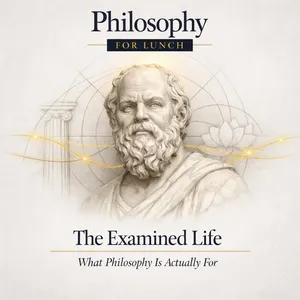
Episode #026 - The Examined Life: What Philosophy Is Actually For
Twenty-five episodes ago, this show started with a parking lot. Someone cut Shawn off, he made a generous interpretation of why, and Claire asked whether that was genuine philosophical practice or just a defense mechanism. That question turned out to be the whole show in miniature. In this episode, Shawn and Claire step back from the individual thinkers and ask the question the entire series has been circling: what is philosophy actually for? Not as an abstract question about an academic discipline, but as a personal one. Why does any of this matter? What is the examined life supposed to produce in the person who takes it seriously? They work through what twenty-five episodes of building this show has clarified and what it has changed. What it means that the philosophical tradition is not a museum of solved problems but a long conversation — still ongoing, still inhabited — that anyone can join. What it means to let ideas actually change something rather than simply inform something. Why the examined life is harder, more honest, and more worthwhile than any of the comfortable alternatives. The episode draws the arc of the season together: from Anna Freud's account of how the mind hides things from itself, through Marcus Aurelius's daily practice of honest self-examination, through Nietzsche's diagnosis of a civilization without foundations, through Frankl's argument that meaning is available even in the worst circumstances, through the Stoic and Buddhist convergence on the inner life as the real domain of freedom — and asks what all of that adds up to when you hold it together. Shawn also speaks honestly about what the grief episode cost and what it gave — about why the philosophy was not decoration for the loss but the only framework that was also honest. And about the unexpected gift of twenty-five episodes inside the long conversation that philosophy is. This is not a finale. The show runs continuously. But it is a resting point — and an honest accounting of what philosophy is actually for, from two people who have been living inside the question. Shawn and Claire together. No prior philosophy required. SHOW NOTES Primary Sources Hadot, P. (1995). Philosophy as a Way of Life (A. Davidson, Ed.; M. Chase, Trans.). Blackwell. (The essential text on philosophy as practice — foundational to this episode and to the show.) Plato. (2002). Five Dialogues (G. M. A. Grube, Trans., 2nd ed.). Hackett Publishing. Aristotle. (1999). Nicomachean Ethics (T. Irwin, Trans., 2nd ed.). Hackett Publishing. Works Referenced in This Episode Nehamas, A. (1998). The Art of Living: Socratic Reflections from Plato to Foucault. University of California Press. Nussbaum, M. C. (1994). The Therapy of Desire: Theory and Practice in Hellenistic Ethics. Princeton University Press. Frankl, V. E. (2006). Man's Search for Meaning. Beacon Press. Arendt, H. (1978). The Life of the Mind (2 vols.). Harcourt. Accessible Starting Points de Botton, A. (2000). The Consolations of Philosophy. Pantheon. Irvine, W. B. (2009). A Guide to the Good Life. Oxford University Press. New episodes every Monday. Philosophy for Lunch · Big ideas. Human conversations.
37 MIN
SEP 28, 2026
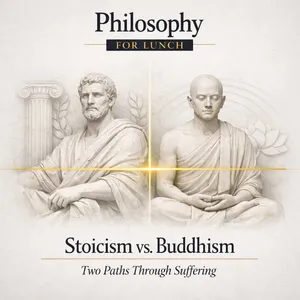
Episode #025 - Stoicism vs. Buddhism: Two Paths Through Suffering
Picture two men. On opposite sides of the world. In the same century. With no knowledge of each other. One is sitting under a tree in northern India, determined not to move until he understands something. His name is Siddhartha Gautama. He was born a prince, raised in luxury, shielded from illness, old age, and death — until one day he left the palace and saw them. A sick man. An old man. A corpse. And he could not go back. The other is in Athens, having just survived a shipwreck that cost him everything. His name is Zeno of Citium. He wanders into a bookshop, picks up a text about Socrates, and follows a philosopher walking past. The tradition he eventually builds from that chance encounter becomes Stoicism. Two men. Two traditions. No knowledge of each other. The same century. And a set of conclusions about human suffering that are — when you look closely — remarkably similar. In this solo episode, Shawn maps the convergence in detail: both traditions diagnose human suffering as largely self-generated, produced not by what happens to us but by our relationship to what happens — by craving, clinging, and misaligned judgment. Both are built around practice rather than belief. Both insist that the inner life is the real domain of freedom. And both argue that transformation is available to anyone willing to do the sustained work of attention. The episode also addresses where they genuinely diverge. The Stoics assume a fixed, persisting self whose job is to be disciplined. Buddhism goes further — the doctrine of no-self holds that the fixed self we take for granted is itself a construction, and that clinging to it is a source of suffering in its own right. The Stoic path strengthens the self. The Buddhist path, at its deepest levels, sees through it. Shawn also draws the wider convergence — Jesus, Confucius, the Hebrew prophets, the Sufi mystics — and asks what it means that traditions this different, developed in contexts this separate, keep arriving at the same fundamental insight about the inner life. Shawn solo. No prior philosophy required. SHOW NOTES Stoic Primary Sources Epictetus. (2008). Discourses and Selected Writings (R. Dobbin, Trans.). Penguin Classics. Epictetus. (1983). Handbook (Enchiridion) (N. P. White, Trans.). Hackett Publishing. (Start here — short, direct, immediately useful.) Marcus Aurelius. (2002). Meditations (G. Hays, Trans.). Modern Library. Seneca, L. A. (2004). Letters from a Stoic (R. Campbell, Trans.). Penguin Classics. Buddhist Primary Sources Thich Nhat Hanh. (1999). The Heart of the Buddha's Teaching. Broadway Books. (The most accessible introduction to core Buddhist teaching.) Bodhi, B. (Trans.). (2005). In the Buddha's Words: An Anthology of Discourses from the Pali Canon. Wisdom Publications. Works Referenced in This Episode Irvine, W. B. (2009). A Guide to the Good Life: The Ancient Art of Stoic Joy. Oxford University Press. Kabat-Zinn, J. (1994). Wherever You Go, There You Are. Hyperion. Goldstein, J. (2002). One Dharma: The Emerging Western Buddhism. HarperOne. Accessible Starting Points Holiday, R. (2014). The Obstacle Is the Way. Portfolio/Penguin. Haidt, J. (2006). The Happiness Hypothesis. Basic Books. New episodes every Monday. Philosophy for Lunch · Big ideas. Human conversations.
38 MIN
SEP 21, 2026
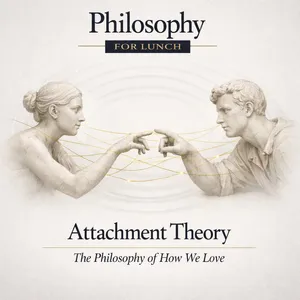
Episode #024 - Attachment Theory: The Philosophy of How We Love
Why do I keep doing this? Why do I keep pulling away from people who get close, or clinging to people who are unavailable, or trusting people who do not deserve it? Why do I seem to have the same relationship over and over, with different people wearing slightly different clothes? Attachment theory is the most empirically grounded answer we have to those questions. It is also one of the most philosophically rich frameworks in modern psychology — one that raises genuinely deep questions about freedom and determinism, about what we owe each other in relationship, and about what genuine love actually requires. In this solo episode, Claire takes the full arc of attachment theory from its origins to its philosophical implications. She covers John Bowlby's foundational insight — that the infant's bond to the caregiver is not primarily about food but about safety and proximity — and Mary Ainsworth's Strange Situation experiments, which revealed that infants organize their attachment behavior around the specific pattern of their caregiver's responsiveness. Secure, anxious, avoidant, disorganized: these are not temperamental types. They are adaptive strategies, developed in response to what the caregiving environment reliably provides. The episode covers the bridge to adult relationships — Hazan and Shaver's finding that romantic love in adults is an attachment process, organized by the same behavioral system that governed the infant's bond to the caregiver. The internal working models built in early life shape how adults approach intimacy, how they respond to closeness and distance, and what happens when the attachment system is activated under stress. But this is not a determinism story. Attachment styles are stable — but they are not fixed. The mechanism of change is not intellectual insight. It is repeated experience that violates the predictions of the old model, in a relationship safe enough for those violations to register rather than be defended against. The episode also asks what attachment theory means for ethics: what genuine love requires beyond feeling, and what we owe each other as attachment figures. Claire solo. No prior psychology required. SHOW NOTES Primary Sources Bowlby, J. (1969). Attachment and Loss: Vol. 1. Attachment. Basic Books. Bowlby, J. (1973). Attachment and Loss: Vol. 2. Separation: Anxiety and Anger. Basic Books. Ainsworth, M. D. S., Blehar, M. C., Waters, E., & Wall, S. (1978). Patterns of Attachment: A Psychological Study of the Strange Situation. Lawrence Erlbaum Associates. Works Referenced in This Episode Main, M., & Solomon, J. (1986). Discovery of an insecure-disorganized/disoriented attachment pattern. In T. B. Brazelton & M. W. Yogman (Eds.), Affective Development in Infancy (pp. 95–124). Ablex. Hazan, C., & Shaver, P. (1987). Romantic love conceptualized as an attachment process. Journal of Personality and Social Psychology, 52(3), 511–524. Fonagy, P., Gergely, G., Jurist, E. L., & Target, M. (2002). Affect Regulation, Mentalization, and the Development of the Self. Other Press. Goldie, P. (2012). The Mess Inside: Narrative, Emotion, and the Mind. Oxford University Press. Accessible Starting Points Johnson, S. M. (2008). Hold Me Tight: Seven Conversations for a Lifetime of Love. Little, Brown. (The most accessible application of attachment theory to adult relationships.) Levine, A., & Heller, R. (2010). Attached: The New Science of Adult Attachment. Tarcher/Penguin. New episodes every Monday. Philosophy for Lunch · Big ideas. Human conversations.

39 MIN