


Pockets of Knowledge
Pockets of Knowledge
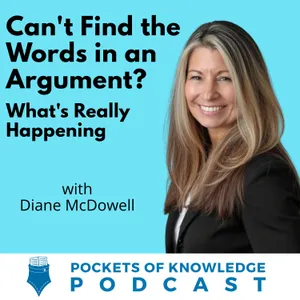
#207. Can't Find the Words in an Argument? What's Really Happening with Diane McDowell
OCT 14, 202646 MIN
Description
Ever walk away from a conversation and think of the perfect thing to say ten minutes later? In the car. In the shower. Stirring something on the stove. You had those words the whole time. You just couldn't reach them.
This week's guest is Diane McDowell, therapist, speaker, and founder of Powerful Questions Coaching & Counseling. After 25 years of watching human behavior, nearly two decades of it in psychiatric emergency services, Diane kept seeing the same thing. People under pressure don't turn into someone else; they lose access to the parts of themselves that were there all along: the clarity, the patience, the voice.
She calls it access, and her whole point is that it shifts before the emotion ever shows up. Your attention goes first. Then your pacing. Then your language. Diane walks us through the four ways we lose it, control, adaptation, escalation, and disconnection, and why you might escalate with your spouse and go quiet with your boss.
The practical stuff is so good. Pretend to take notes. Reach for your water. Go stand in the bathroom and do the power pose if you have to. Anything that buys you the pause.
But the part that really got to me: I am responsible for walking away from every conversation proud of how I handled myself. No outsourcing it to whoever else was in the room.
She also reframes the guilt. You don't need to forgive yourself for being human. You need to get curious. Stop asking what's wrong with me and start asking what changed.
Bio:
Diane E. McDowell is a therapist, speaker, and author whose work explores what happens to people in the moments that matter most.
Over more than twenty-five years observing human behavior and interaction—including nearly two decades in psychiatric emergency services and later in private practice—Diane began noticing the same pattern across thousands of conversations.
People don't become someone else under pressure. They can lose access to qualities that are available to them elsewhere—their clarity, confidence, patience, perspective, and voice.
That observation led Diane to a different question: What happened to their access?
Her work explores how changing conditions influence what becomes available to us in real time—and why the same person can be clear in one conversation, unable to find their words in another, and know exactly what they wished they had said ten minutes later.
Rather than beginning with what's wrong with someone, Diane asks people to look earlier: What changed? What became harder to reach? And when did it become available again?
Her work brings this lens to leadership, relationships, parenting, health, and the everyday conversations that shape our lives.
At the center of Diane's work is a simple distinction:
You can have the capacity without having equal access to it in every moment.
Connect with Diane McDowell:Email: [email protected]
Website | Facebook | Instagram | LinkedIn | YouTube
Free assessment:
Access Assessment
Books mentioned:Becoming Available to Yourself: Why You Lose Access to Yourself—and How to Find Your Way Back by Diane E. McDowell – Amazon
The Four Agreements – Bookshop | Amazon
God's Psychiatry – Amazon
Podcasts mentioned:
Being Well Podcast
━━━━━━━━━━━━━━━━━━━━
Enjoyed this episode? Leave a review and share it with a friend. The more we educate, inspire, and empower each other, the further this conversation goes.
Questions or just want to say hi? Find me at PocketsofKnowledge.com or on Instagram @desireedstanley. Thanks for listening!
This podcast is intended to educate, inspire, and empower you on your personal journey. Guests may have a direct or indirect financial interest in products or services mentioned. Nothing here is medical advice—I'm not a doctor. Please consult a qualified health professional for any medical concerns.